





 Português
  Inglês
  Espanhol
  4 min de leitura
  2 comentários


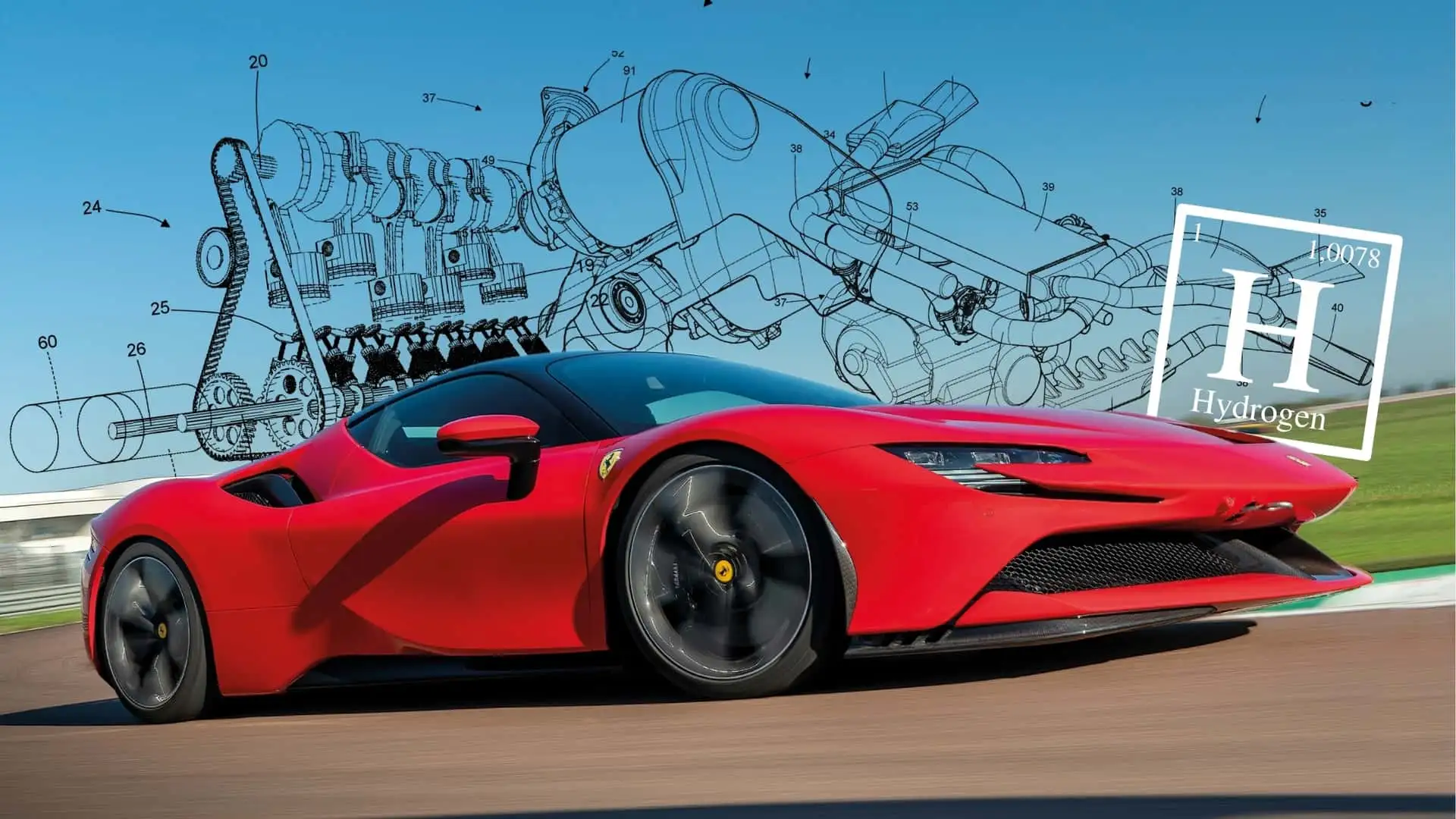


Ferrari Announces Bold Project to Develop Six-Cylinder Hydrogen-Powered Engine with Innovative Design
The Ferrari has taken an innovative step in the automotive sector by filing a patent application for a hydrogen-powered internal combustion engine. The initiative, published by the United States Patent and Trademark Office (USPTO) on February 29, 2024, demonstrated the automaker’s interest in reducing emissions without completely abandoning internal combustion engines, even in an increasingly stringent regulatory environment.
Unlike hydrogen fuel cells, which convert hydrogen into electricity to power electric motors, the hydrogen combustion engine simply burns the fuel directly.
This process eliminates carbon dioxide emissions, one of the main contributors to the greenhouse effect. Although the idea is not new — BMW, for instance, experimented with the technology in a 7 Series model in the early 2000s — it is the first time Ferrari has shown public interest in this format.
-
OMODA & JAECOO grows in Europe in 2026 with an integrated strategy of sales, innovation, local production, and technological advancement in the United Kingdom, Italy, and Spain.
-
OMODA & JAECOO expands after-sales service in Brazil with competitive maintenance, a 7-year warranty, and high availability of parts for technological SUVs.

-
OMODA & JAECOO appoints Alessandra Souza as executive marketing director in Brazil and accelerates brand expansion with a focus on innovation, networking, and hybrid portfolio.

-
Jaecoo 7 with super hybrid SHS system exceeds 1,200 km of combined range with a 1.5 turbo engine, high-density battery, and intelligent energy management.


Reducing Emissions, but Not to Zero
In the patent application, Ferrari states that the hydrogen combustion engine can drastically reduce pollution levels, generating only small amounts of carbon monoxide and particulates.
Despite the significant reduction, these minimal emissions still do not constitute a zero-emissions scenario. Additionally, the production of the hydrogen needed to fuel these engines raises questions about the overall carbon footprint.
According to the Rocky Mountain Institute, the environmental impact of hydrogen depends on the production method.
While hydrogen obtained through electrolysis using renewable energy has a reduced impact, fossil fuel-based production can generate emissions comparable to those of coal. This underscores the need for a sustainable production chain to maximize the environmental benefits of the new technology.
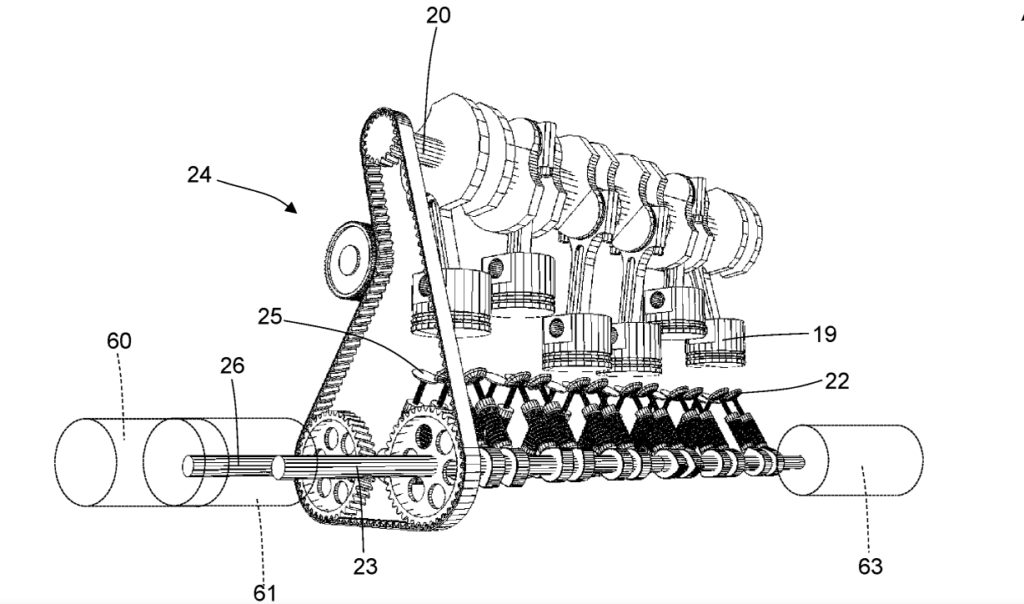
How a Hydrogen Combustion Engine Works
| Stage | Technical Description |
|---|---|
| Intake | Mixture of gaseous hydrogen and air is injected into the cylinder. |
| Compression | Piston compresses the mixture, increasing the efficiency of combustion. |
| Combustion | Spark plug creates a spark, igniting the hydrogen and generating energy. |
| Expansion | Piston is pushed down, converting chemical energy into mechanical motion. |
| Exhaust | Water vapor, the main byproduct, is expelled through the exhaust valve. |
Advantages
- Emissions: Only water vapor (no CO2).
- Technology: Based on traditional internal combustion engine.
Challenges
- Storage: Requires high-pressure tanks.
- Safety: Hydrogen is highly flammable.
Technical and Structural Challenges of Ferrari’s Engine
One of the points raised by Ferrari in the patent application is the impact of hydrogen on vehicle design and performance. Because it is less energy-dense than gasoline, hydrogen requires greater storage capacity to achieve a range similar to that of a traditional combustion engine.
This results in potentially longer and heavier cars, compromising the efficiency and performance characteristic of the brand’s models.
Despite these challenges, the quick refueling time of hydrogen may offset the range limitations, especially compared to electric vehicles.
However, there is a significant structural problem: the lack of reliable infrastructure for hydrogen refueling. Owners of the Toyota Mirai, a fuel cell vehicle, have reported difficulties due to limited and sometimes ineffective infrastructure.
Competition in Development
Ferrari is not alone in the search for cleaner combustion alternatives. Toyota, for instance, has been actively investing in the development of hydrogen combustion engines.
In 2021, the automaker unveiled a hydrogen-powered Corolla race car, and the following year showcased a hydrogen V-8 engine based on the Lexus RC F. These advances show that hydrogen combustion is being explored as a viable solution to maintain sports performance while reducing environmental impact.
Additionally, Porsche, another giant in the high-performance car market, has been directing efforts toward synthetic fuels.
This approach also aims to prolong the lifespan of internal combustion engines, demonstrating that the premium vehicle industry is seeking sustainable alternatives.
An Uncertain but Promising Future
It is still unclear whether Ferrari will follow Toyota’s example and present prototypes of hydrogen combustion engines soon. However, the patent registration indicates that the automaker is open to exploring new pathways to balance performance, tradition, and sustainability.
As environmental regulations become stricter, luxury automakers face the challenge of innovating without compromising their brand identity.
If hydrogen proves viable, it could be the ideal solution for Ferrari to continue offering high-performance vehicles while meeting the demands of a more sustainable world.
This initiative reinforces that, in the automotive sector, innovation and legacy preservation go hand in hand. Ferrari’s hydrogen engine could be a game-changer, both for the industry and the future of transportation.









Não entendi o beneficio de colocar o motor de cabeça para baixo… visto que ocasionaria um acumulo de oleo nos cilindros dos pistões.
Gostaria de sugerir uma correção na descrição técnica. Como o motor deve trabalhar de cabeça para baixo, durante a expansão o pistão deverá ser empurrado para cima, e não para baixo como num motor normal.