





 Portuguese
  English
  Spanish
  6 min of reading
  0 comments


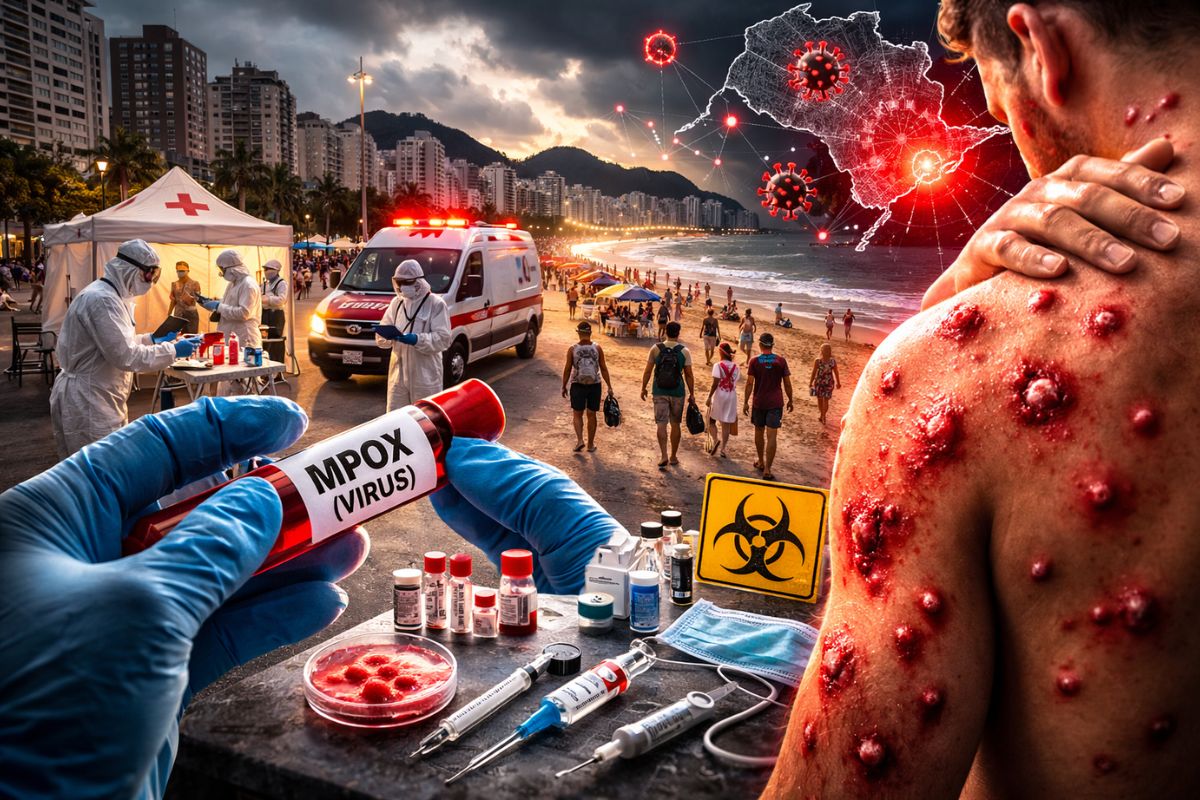
Santos Confirmed Two Cases, and the Numbers for 2026 in the State Help Understand Why Mpox Requires Attention Even When There Is Rapid Medical Discharge: It Transmits Through Direct Contact With Skin, Wounds, and Secretions, and Also Through Close Exposure to Respiratory Droplets, Without Waiting for Things to Worsen
According to the G1 portal, mpox has re-entered the radar of the São Paulo coast after Santos confirmed two cases registered in January and confirmed on a Friday (20). According to the city hall, the patients, men aged 25 and 35, showed good clinical improvement and have already been discharged, while the State of São Paulo reported a total of 44 cases in 2026 as of a Thursday (19).
The central point is that mpox does not depend on large gatherings to spread: it can disseminate in common situations of proximity, especially when there is skin-to-skin contact, exchange of secretions, and prolonged interaction. Understanding how transmission occurs, what signs to observe, and when to isolate is what makes a difference in interrupting chains of infection.
What Happened in Santos and Why These Two Cases Matter
In Santos, the confirmation of two cases of mpox involves two men, aged 25 and 35, who had a good recovery and were discharged.
-
The government requests the Federal Revenue Service for a new system to automate the income tax declaration, reducing errors, time, and bureaucracy for millions of Brazilians.

-
Pix in installments, international Pix, and contactless payment without internet: the Central Bank revealed the new features coming to the tool that is already used by almost every adult in Brazil.

-
Mercado Livre has just started selling medications with delivery in up to three hours to your door, and this move could completely change the way Brazilians buy medicines on a daily basis.

-
In Dubai, rising tensions from the war in the Middle East are causing super-rich individuals to leave the Gulf and direct their fortunes to a new financial refuge in Asia.


The city hall did not indicate if there was a relationship between the patients but emphasized a crucial point: transmission occurs through direct contact between people, both through skin and secretions, and also through close and prolonged exposure to droplets and other respiratory secretions.
The contrast with the previous year helps gauge the local scenario. In 2025, Santos accounted for only two diagnoses of mpox for the entire year; now, in 2026, there are already two cases recorded in January. This does not automatically turn the situation into an outbreak, but signals why surveillance, clear information, and precautions in close contact remain relevant.
How Mpox Spreads in Daily Life
Mpox primarily spreads when there is contact with infected respiratory secretions, with wounds or blisters on the skin of an infected person.
The Ministry of Health lists examples of contact: kissing, hugging, and sexual intercourse, in addition to other situations where there is sufficient proximity for the exchange of secretions and skin-to-skin contact. The risk increases when contact is intimate, repeated, or prolonged.
There is also the possibility of transmission through close exposure to droplets and respiratory secretions. This does not mean that any quick encounter leads to contagion but emphasizes that the combination of proximity, time, and contact with secretions or lesions is a critical point.
Another recommended precaution is not to share objects and personal items, such as towels and bedding, because they may come into contact with secretions or skin lesions.
Symptoms: What to Observe Before and After the Lesions
Mpox can manifest with general signs that many people confuse with other viral infections, which delays the perception of risk.
Among the symptoms mentioned are headache, back pain, body aches, chills, fever, fatigue, and swollen lymph nodes, which can appear before the skin rash. When the body shows “common” signs, the context of recent contact becomes very important.
The skin lesions, described as rashes, serve as a marker that draws more attention but are not the only element in the picture.
The presence of swollen lymph nodes before the lesions is an important detail because it helps differentiate mpox from other conditions that also cause spots and fever.
The practical guidance is to observe the whole: systemic symptoms, skin signs, and recent contact history.
When Isolation Ceases to Be an Option and Becomes Urgent
The recommendation for suspected cases is to avoid close contact with others until symptoms disappear.
In practice, this means that when a combination compatible with mpox arises (especially with skin lesions or blisters), the most protective behavior is to immediately reduce physical proximity, stop kissing and hugging, and avoid any situation of skin-to-skin contact.
Immediate isolation is not a punishment; it is a sanitary barrier to protect family, colleagues, and partners.
Moreover, the guidance includes not sharing personal items, such as towels and bedding. In real scenarios, this is one of the measures that most prevents transmission inside the house, precisely because mpox takes advantage of common routines: sleeping in the same space, sharing a bathroom, using the same towel, or touching lesions unknowingly.
Monitoring in São Paulo: What the Health Network Does With Suspected Cases
The São Paulo State Health Department reported it continuously monitors the epidemiological scenario of mpox and maintains permanent coordination with municipal health departments and the healthcare network.
In parallel, health services carry out early identification, notification, and investigation of suspected cases, including testing and clinical follow-up.
This process includes tracking and monitoring contacts, according to technical protocols.
The goal is to interrupt the transmission chain before it amplifies, which depends on both the system’s ability to test and monitor, as well as people’s cooperation in reporting symptoms, avoiding close contact, and following isolation guidelines when necessary.
Why “Monkeypox” Changed Its Name and What This Changes in Perception
Mpox became known to many as “monkeypox” because it was first identified in colonies of monkeys in 1958.
However, the Brazilian Society of Primatology points out that monkeys do not participate in transmission to humans, which occurs between contaminated people. This issue is relevant because popular names can lead to misperceptions and even violent attitudes.
In 2022, the name change to mpox was established, and the need became even more evident when attacks against primates occurred in regions of Brazil due to the mistaken association.
The public health point here is direct: blaming animals does not protect anyone and worsens the collective response by diverting attention from what truly reduces risk, which is managing close contact and recognizing symptoms.
Without Specific Treatment: What Is the Focus of Care and How to Reduce Risks
According to the Ministry of Health, there is no specific treatment for infection by the mpox virus. Medical attention focuses on relieving pain and other symptoms and preventing long-term sequelae.
This reinforces why early detection and reducing transmissions is so important: when there is no “target” medication, clinical management and containment measures gain even more weight.
In daily routines, reducing risks involves simple choices, especially during symptomatic periods: avoiding intimate contact, not sharing personal items, and interrupting physical proximity until recovery.
In public health, the detail of everyday behavior becomes the deciding factor, as it is within this that mpox finds a pathway to circulate or be blocked.
Two confirmed cases in Santos, with discharge and good evolution, may seem like a one-off episode, but the scenario of 44 records in 2026 in the State reminds us that mpox continues to require practical attention: recognizing signs such as fever and skin lesions, understanding that close contact is the main vector, and acting quickly with isolation when there is suspicion.
I want to hear you very directly: If someone close presented skin lesions and fever, would you know which contacts to interrupt immediately in your routine (at home, at school, at work, in a relationship)? And, looking at your social circle, what do you find more difficult to change: avoiding kisses and hugs when there are symptoms or not sharing items like towels and bedding?









-

-

2 pessoas reagiram a isso.