





 Portuguese
  English
  Spanish
  5 min of reading
  0 comments


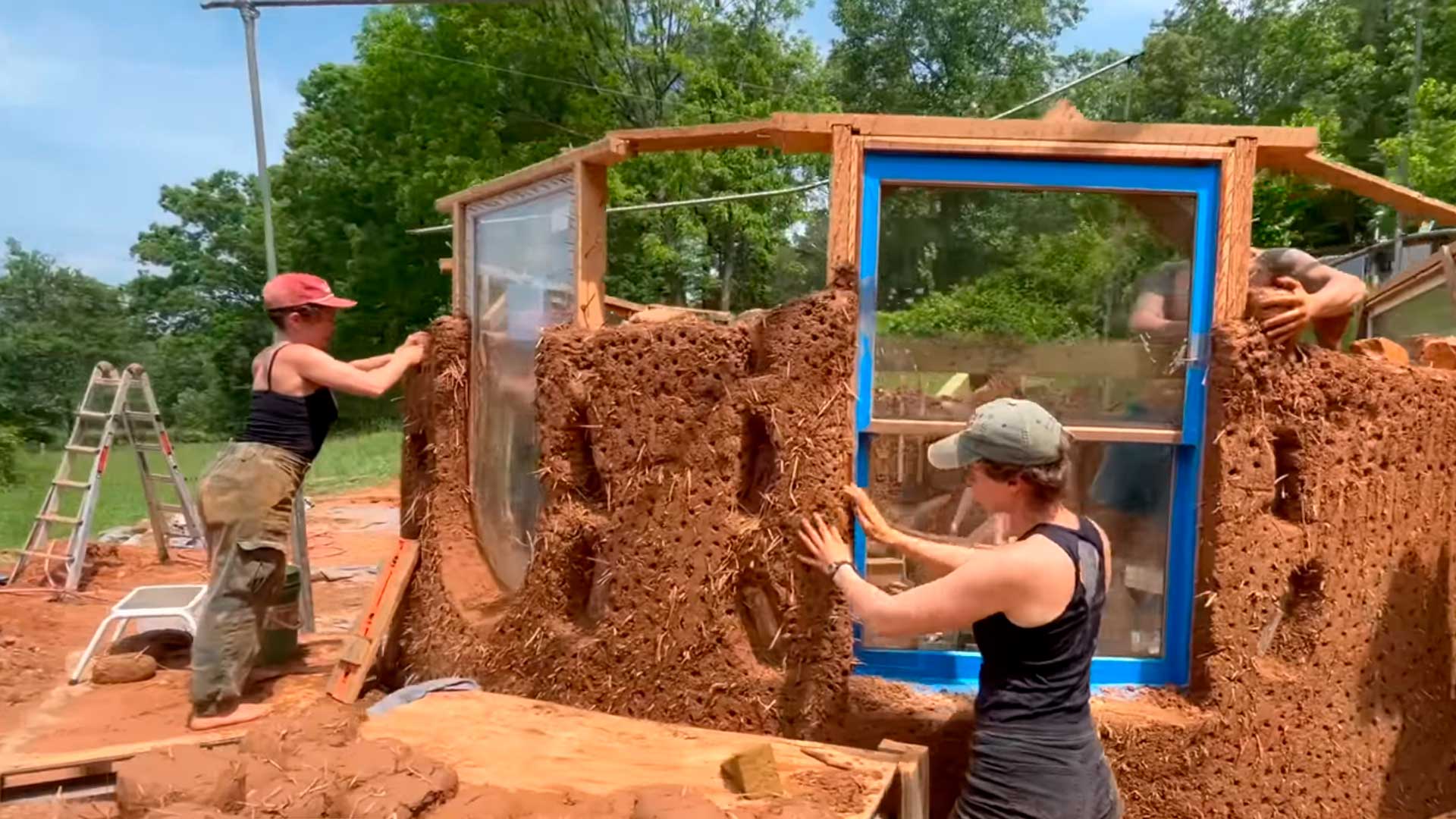
Workshop in the North Carolina Mountains Demonstrates Step by Step How to Build Ecological Cottage Using Natural Materials, Drained Foundation, Sculpted Cob Walls and Living Roof
Sustainable construction gained an impressive practical example with a 5-week workshop held in the North Carolina mountains, in the United States. The project demonstrated how it is possible to build a complete house using only local natural materials: clay, sand, straw, and wood. The technique known as cob, a variation of traditional Brazilian wattle, resulted in a functional and aesthetically unique cottage.
According to information from the Natural Buildings channel, responsible for recording the workshop on video, the entire process was documented and transformed into a tutorial series of seven episodes. The initiative aims to democratize knowledge about bioconstruction and show that ecological housing is viable and accessible.
The cob technique, which has ancient roots, has gained renewed prominence in the current context of seeking sustainable alternatives in construction.
-
Friends have been building a small “town” for 30 years to grow old together, with compact houses, a common area, nature surrounding it, and a collective life project designed for friendship, coexistence, and simplicity.

-
This small town in Germany created its own currency 24 years ago, today it circulates millions per year, is accepted in over 300 stores, and the German government allowed all of this to happen under one condition.

-
Curitiba is shrinking and is expected to lose 97,000 residents by 2050, while inland cities in Paraná such as Sarandi, Araucária, and Toledo are experiencing accelerated growth that is changing the entire state’s map.

-
Tourists were poisoned on Everest in a million-dollar fraud scheme involving helicopters that diverted over $19 million and shocked international authorities.


This construction method can significantly reduce the environmental impact of buildings, in addition to providing superior thermal comfort compared to conventional constructions.
Robust Foundation Ensures Durability of Natural Construction


The first critical step in building a wattle house is to establish a solid foundation with adequate drainage. According to information from Biohabitate, a company specializing in bioconstruction, when working with earth materials, it is essential to protect the walls from moisture with elevated bases and roofs with large overhangs.
In the North Carolina workshop, the team started by digging a drainage trench with a slight downhill slope. The efficiency of the system was confirmed by pouring water at the high end and observing the flow. After validation, they installed geotextile fabric and filled the trench with compacted gravel.
The stacked stone foundation serves a dual purpose: it elevates the cob walls off the ground, keeping them dry, and provides structural support for the weight of the wall system. According to an article published by UGREEN in May 2024, choosing the correct foundation is crucial to ensure the longevity and stability of cob constructions, with common use of stone, concrete, or even recycled tires filled with compacted earth.
Over the stone foundation, a layer of compacted gravel was installed for drainage, followed by insulation made from repurposed cardboard pieces. A layer of clay slip was applied over the cardboard before the installation of the earthen floor.
Mixture and Application Technique of Cob Allows Handcrafted Construction
The preparation of cob follows a traditional method known as “canvas method”, which was the only method used throughout the entire construction of the cottage. The basic mixture combines clay, sand, straw, and water in specific test-proven proportions.
The process begins with the dry mixing of clay and sand on a large canvas. After adding water, participants step on the mixture repeatedly, folding the canvas to create a rolling motion. According to the National Federation of Architects and Urbanists, in an article from August 2024, the cob technique stands out for its malleability, allowing for organic and irregular shapes to be created.
When the ideal consistency is reached — a cohesive mass that holds its shape — straw is added for tensile strength. The straw acts as a natural reinforcement, preventing cracks. According to Wikipedia information about earth construction, cob can support up to two stories when proportions and thicknesses are appropriate.
The “loaves” of cob are molded into shapes that facilitate transport and construction. The application to the walls requires clay slip at the top of the foundation, followed by the placement of the loaves and manual “stitching” of the mixture to create a monolithic mass without seams. Tools such as the “thumb of the cobber” help to integrate the layers.
Sculptures and Finishes Transform Functional Walls into Works of Art
One of the most striking characteristics of cob constructions is the ability to create sculptural elements integrated into the walls. In the North Carolina cottage, the team added details that include animals, niches, shelves, and frames for glass bricks.
Architect Vika Martins, a Master in Rural Development, stated to the FNA that cob “can be an excellent option for community buildings, such as cultural centers and gathering spaces, where community participation in the construction process is encouraged and valued.” The sculptural nature of the technique allows for a unique customization of each project.
To ensure proper adhesion of the subsequent plaster, holes and grooves were intentionally created in the sculptures. The process of applying clay plaster involved testing different proportions of clay soil, coarse and fine sands, and animal manure.
The teams used chisels and trowels to spread and shape the plaster on the walls. According to Estúdio Piloti Arquitetura, which specializes in wattle constructions, earth walls function as thermal buffers, decreasing temperature and humidity amplitudes, contributing to the health of inhabitants and reducing energy costs.
The final finish included tile and marble mosaics, as well as refinement of shapes around niches and shelves. For surfaces that required a smooth finish, the team performed burnishing — polishing the surface of the plaster.
Living Reciprocal Roof Completes Sustainable System of the Building
The roof of the cottage utilized a structural technique called reciprocal roof, in which all beams support each other, eliminating the need for central support. During construction, a temporary beam (called “Charlie stick”) supported the weight until the last beam was installed.
The main beams were secured with rods and threaded nuts. Once all were positioned, the team slightly lifted the assembly to fit the final beam, creating a self-supporting structure. After removing the temporary support, secondary beams were installed to support the covering boards.
Shims were cut and installed to level the roof planes before securing the covering boards. Over these boards, a layer of insulation was applied using pieces of repurposed carpet, followed by a waterproof membrane.
The green roof was constructed in layers: a base of sand, a layer of straw, and finally, local clay soil. According to information from Biohabitate about green roofs, these gardened coverings provide thermal insulation, can produce food, capture rainwater, and create a favorable local microclimate.
Drainage gutters, ceiling boards, and a central skylight completed the roofing system. The project was finalized with closing the gap between the top of the cob wall and the roof, applying the last layers of plaster and installing the final layer of the earthen floor.
And you, were you already familiar with the cob construction technique? Many people still associate earthen houses with precariousness, but as we have seen, these constructions can be extremely durable and sustainable when well executed. Could this ancient technique become a viable alternative in Brazil to reduce the environmental impact of civil construction? Leave your opinion in the comments and share if you have had any experience with bioconstruction!










-

-

-

-

-

-

15 pessoas reagiram a isso.