





 Português
  Inglês
  Espanhol
  4 min de leitura
  5 comentários


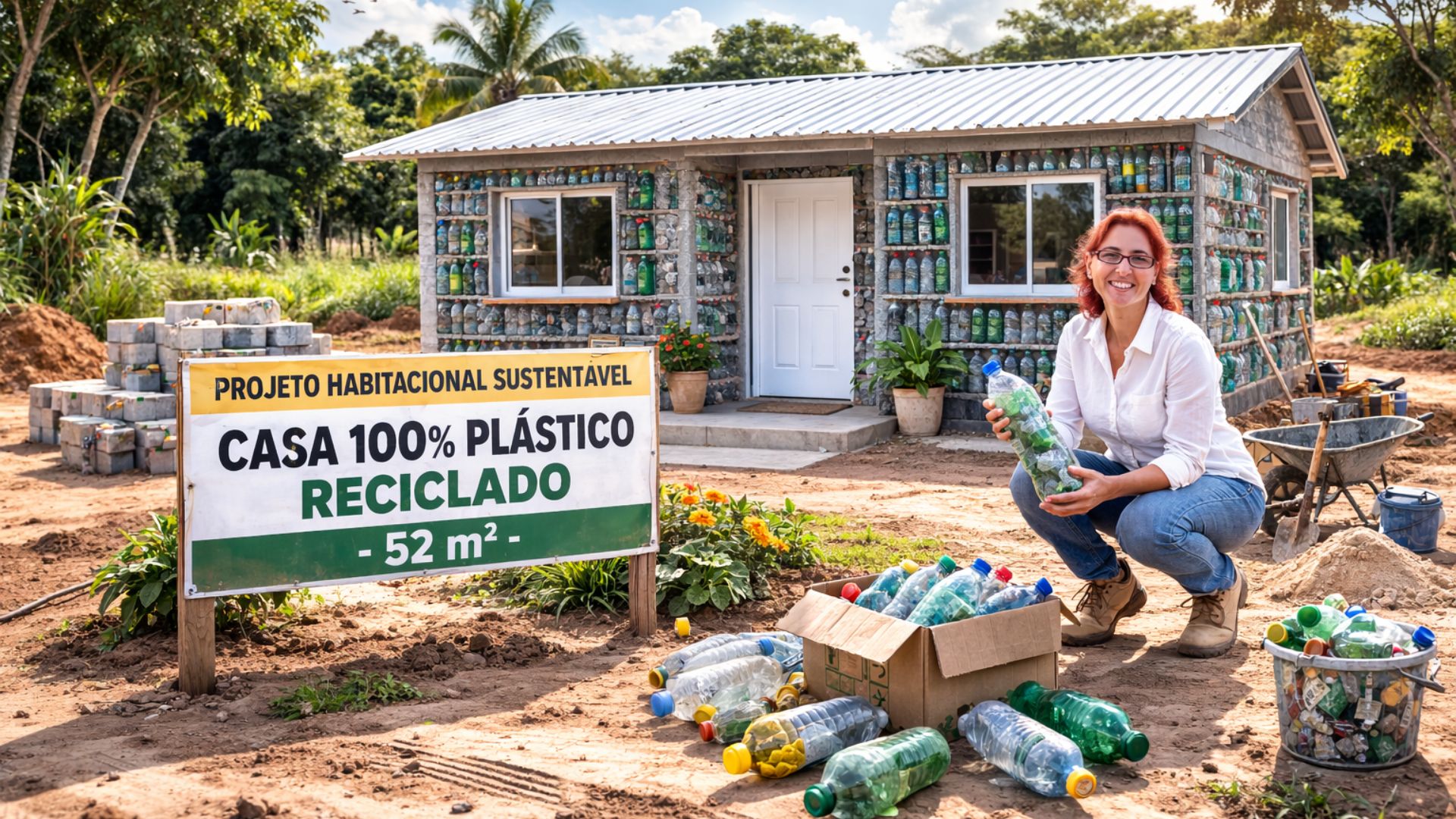


Latin American Project Reuses PET Bottles as Building Blocks and Transforms Waste into Part of the Structure of Homes for Vulnerable Families, with a Method Involving Filling, Assembly and Coating with Clay, Along with Figures That Draw Attention Due to the Volume of Material Used in Each Construction.
The Bolivian Ingrid Vaca Diez leads the project Bottle Houses, an initiative that reuses PET bottles as part of the structure of homes for families in vulnerable situations in the city of Warnes, in the department of Santa Cruz.
Over the years, the method has scaled up and already resulted in more than 300 houses in countries like Bolivia, Argentina, Mexico, Panama, and Uruguay, according to publications tracking the project’s trajectory in the region.
How the PET Bottle Becomes a “Brick” in Construction
In the technique described in reports on the project, the bottles are filled with reusable materials, such as expired milk powder, soot, sand, or manure, and they serve as rigid pieces to form the walls.
-
A megaproject worth R$ 89 billion is advancing in Iraq and promises to change the game in global trade by creating a new corridor between Asia and Europe, reducing traditional routes and repositioning the country as a logistics powerhouse.
-
Goodbye bedside table: floating shelves become a trend in 2026 by freeing up space in the bedroom, improving circulation, bringing visual lightness, and integrating technology without taking up floor space.
-
Israel, Greece, and Cyprus signed an agreement in 2020 to transport gas from the Mediterranean to Europe via a 1,872 km pipeline, but Turkey claimed sovereignty over part of the maritime route, and the project never materialized.

-
Israel, Greece, and Cyprus signed an agreement in 2020 to transport gas from the Mediterranean to Europe via a 1,872 km pipeline, but Turkey claimed sovereignty over part of the maritime route, and the project never materialized.


Once positioned and secured in the assembly, these bottles are covered with a layer of clay or mud, a step that finishes and helps reinforce the surface, according to descriptions released by environmental websites.
Although the composition of the filling and the coating varies according to the location and availability of supplies, the logic is to keep plastic out of disposal and, at the same time, reduce costs by using waste and low-cost materials.
How Many Bottles per Square Meter Are Needed for Construction
On average, different texts reporting on the project indicate that the number reaches about 80 bottles per square meter, a figure that may change depending on the size of the packaging and the design of the planned construction.
This type of estimate helps to gauge the logistics of the work, as construction depends on collection, sorting, and storage, in addition to filling and assembly, steps that require time and coordination within the served community.

First House of 170 m² and the Milestone of 36,000 Bottles
The first work attributed to Ingrid Vaca Diez is dated 2000 in Brazilian publications, with an area of 170 m² and an approximate use of 36,000 PET bottles, a figure that is often repeated as the initial milestone.
The volume impresses because it transforms a common waste into a construction element and, in practice, serves as a showcase to explain the method in workshops and demonstrations, expanding the circulation of the idea beyond Warnes.
Expansion of the Bottle Houses Project in Latin America
With the growth of the project, reports published in Portuguese and Spanish indicate that the initiative has reached other parts of Latin America, with homes delivered to families affected by poverty, social exclusion, and lack of access to formal housing.

In this context, Ingrid herself is also mentioned as interested in taking the proposal to Brazil, where the level of plastic consumption and the advancement of recycling networks could facilitate the acquisition of the necessary bottles.
The comparison with the Brazilian scenario generally appears linked to the housing crisis and the increase in the population living on the streets, but the figure of “more than 220,000” cited in some texts is not the most recent data available.
In April 2025, Agência Brasil reported that records from CadÚnico indicated more than 335,000 people in a situation of homelessness in the country, highlighting the existence of underreporting and historical inconsistencies in the series.
Challenge of Scale and Logistics in Housing with Recycled Plastic
The Bottle Houses proposal is often presented as a practical response for families unable to build with traditional materials, while also attempting to reduce the environmental impact of waste disposal, according to reports compiled in articles.
Nevertheless, the expansion of the model depends on factors such as local mobilization, access to materials for coating, training, and coordination with donors, points mentioned in texts that describe the routine of the work.

By transforming a bottle into a building unit, the method also imposes a logistical challenge that rarely appears in simple figures because it involves a constant flow of material, space for storage, and minimum standardization not to compromise the construction.
Without promising a unique solution to the housing deficit, the initiative has come to be cited as an example of scalable social technology, especially in regions where precarious housing coexists with a large volume of plastic waste.
If the availability of bottles and the need for housing continue to grow side by side in so many places, what kind of public policy or local partnership could transform experiences like those in Warnes into stable, scalable, and safe alternatives?








O que ela coloca dentro das garrafas pet pra equilibrar e não amassar no futuro?
Muito bacana o projeto dela , poderia tentar,aqui no Brasil.
Muita propaganda nas sua materias,quase ñ consegue let.zexagero.
Tenho dúvida Qto a durabilidade, pois barro é fàcilmente destruído com chuvas fortes.
Não é não viu. A durabilidade de casa feita de barro é bastante.