





 Portuguese
  English
  Spanish
  8 min of reading
  0 comments


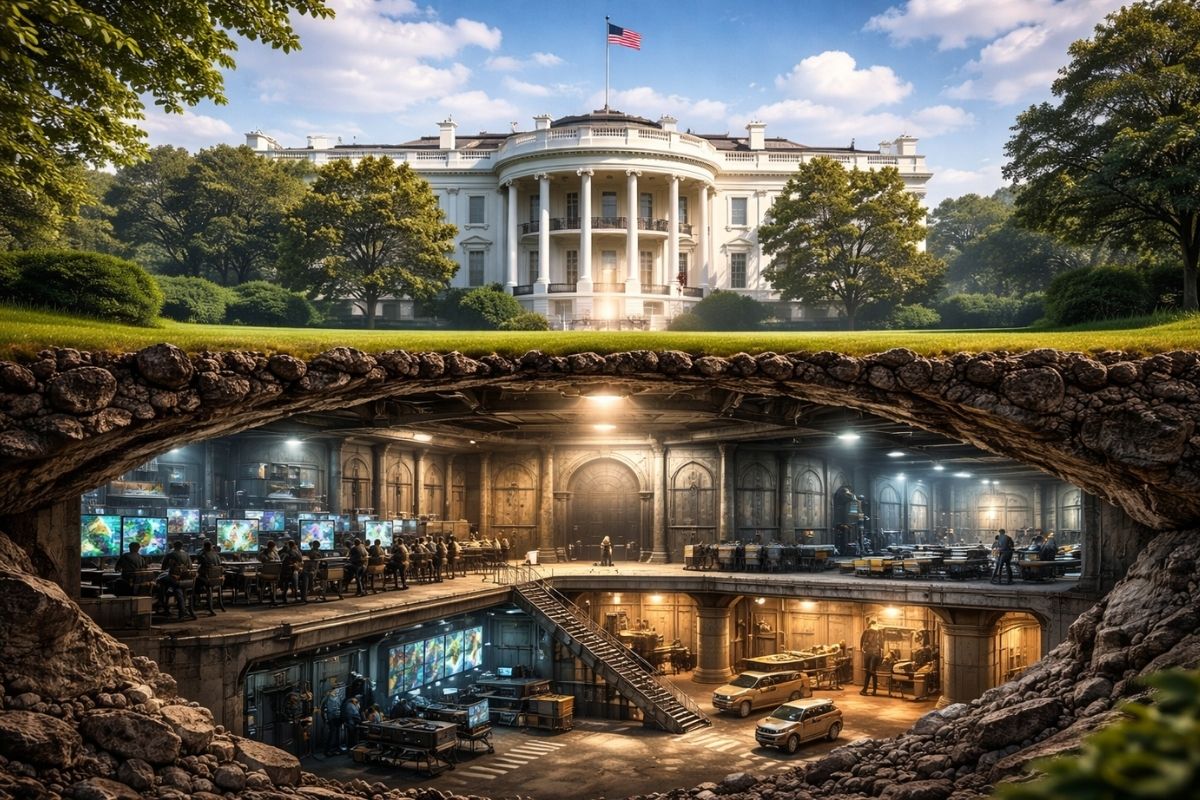
Behind The Perfect Facade, The White House Hides Tunnels, Bunker, Steel Structure, Radical Reforms, And A Subterranean City That Died And Reborn Several Times Over More Than Two Centuries.
At first glance, the White House appears to be just an elegant mansion in Washington, a calm symbol of power. But it is not just a house, it is an iceberg. Most of its structure is hidden below ground, in a labyrinth of concrete, steel, and secret rooms. To understand how the White House became this nerve center of world power, one must go back more than 230 years, to when everything started amid the mud of a swamp.
It was there that George Washington chose the land and envisioned, where many only saw a marsh, a potential masterpiece. The White House emerged from the brute force of enslaved workers, immigrants, and local residents, who extracted soft and porous stone from a creek, hand-carved every detail, and gradually erected the largest stone house in the United States at the time. Every inch of the foundation of the White House was earned with human sweat, in a slow, dangerous, and improvised process that already bore the seeds of future problems.
From Mud To The First Presidential Palace

The construction of the White House began in the late 18th century, without machines and comfort. Skilled masons were brought from Scotland to carve flowers, ornaments, and facades in stone, while oyster shells were burned to produce lime and mortar.
-
Friends have been building a small “town” for 30 years to grow old together, with compact houses, a common area, nature surrounding it, and a collective life project designed for friendship, coexistence, and simplicity.

-
This small town in Germany created its own currency 24 years ago, today it circulates millions per year, is accepted in over 300 stores, and the German government allowed all of this to happen under one condition.

-
Curitiba is shrinking and is expected to lose 97,000 residents by 2050, while inland cities in Paraná such as Sarandi, Araucária, and Toledo are experiencing accelerated growth that is changing the entire state’s map.

-
Tourists were poisoned on Everest in a million-dollar fraud scheme involving helicopters that diverted over $19 million and shocked international authorities.


Glass, a rare luxury, mostly came from Europe, and many pieces broke before they even reached Washington.
On the outside, the White House took on the form of a palace. Inside, however, the structure was almost entirely made of wood, a ticking time bomb.
To waterproof, molten lead was used, deadly for workers, but considered the only protection against rain.
The grand staircase was designed for kings, but destined for presidents, anticipating the symbolism of each step in that still cold, damp, and unfinished interior.
When John Adams entered the White House on November 1, 1800, the paint was still fresh and only a few of the many rooms were truly habitable. The first lady, Abigail Adams, used the East Room to dry the family’s clothes.
There was no running water, no switches, just wood, iron, and fire, and the house that was meant to represent a new nation still resembled more of an improvised construction site.
Jefferson, who came later, added the first side “wings” for ice, meat, and wine, like hidden gears of the mansion, and brought innovations like the first indoor bathroom, reducing nighttime trips to the garden.
When The White House Burned And Reborn White
By 1810, the White House seemed finally complete. But a few years later, the heart of the presidential residence would be consumed by flames.
In August 1814, British troops invaded Washington, sat down at the table of the White House, dined, toasted to their own king with the president’s wine, and then decided to erase the memory of the young republic by burning the White House from within.
The wooden skeleton acted like an oven. The heat was so intense that it made the stone crack, leaving the structure marked forever.
The interior disappeared, leaving only the stone shell that smelled of smoke. Some advocated moving the capital far away, but if the republic wanted to survive, the White House would have to be rebuilt in the same place. James Hoban, the original architect, was called back to reclaim his work from the ruins.
The stains of fire, however, could no longer be removed from the stone. To hide the damage, a thick layer of white lime was applied over the entire facade.
It is at this moment that the White House truly “is born” as we know it, with the color that would become its trademark.
Inside, the plan was to reproduce what existed before, which meant re-creating a wooden skeleton inside a stone box.
More fireplaces ensured heating, but also more smoke, and the house became, at the same time, a presidential home and a showroom of style, with French influences and increasingly luxurious environments.
From Family Home To Power Machine

As the decades passed, the White House began to transform from residence to government machine. Gates were erected as symbols of security after the fire, and decorative elements, like the ceiling of the Blue Room, gained political weight.
The White House ceased to be just a home to become a declaration of power, a stage where every detail carried message and intent.
Lighting evolved from candlelight to gas, then to electricity, in a process that brought light, but also risks.
Presidents feared to touch the switches, still suspicious of the technology. Running water finally replaced buckets carried by hand, the kitchen was modernized, and internal circulation became more efficient.
Gradually, the house became a hybrid of museum, residence, and office, with adapted corridors, new rooms, and a constant flow of historical decisions.
As presidential work grew, the spaces of the White House began to feel cramped. A house designed to be a home was being swallowed by work.
Then arose the need for an executive office building, connected to the residence, as a sort of bridge between domestic life and the command of the country.
It was supposed to be a temporary solution, but this expansion solidified and gave rise to areas like the famous Oval Office, designed to convey authority, historical continuity, and absence of corners to hide, reinforcing the idea of transparency and exposed power.
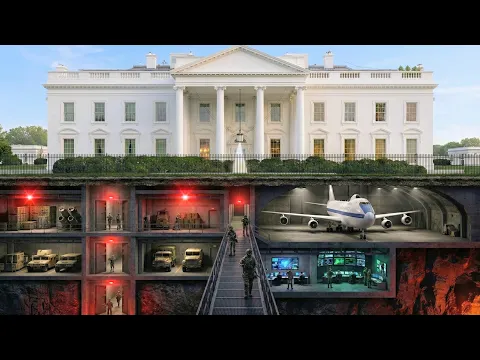
The Subterranean City Of The White House
While the visible part of the White House refined, another transformation, much more discreet, was happening beneath the surface.
As the world entered wars and aerial threats became real, the White House began to turn into a buried fortress.
The public saw new spaces and assumed they were just offices, but part of what was being built was a front for something much more secret.
Workers dug up the clay of Washington at night to create a presidential emergency operations center, a reinforced basement capable of withstanding bombings.
A tunnel over two hundred meters long connected the East Wing to the Treasury building, creating protected escape and communication routes.
The White House literally became a subterranean city with war rooms, discreet corridors, and hidden command infrastructure, where decisive decisions were made away from the public eye.
This subterranean expansion, combined with successive adaptations, placed extra weight on an already tired structure. Over time, the old combination of stone and wood began to show signs of exhaustion.
The walls opened up, the floor creaked, and reports indicated that every truck passing outside made the house “scream.”
At one point, the White House was officially considered dangerous to serve as the presidential residence.
When The White House Almost Collapsed
The radical solution came in the 20th century. The stone shell of the White House was too iconic to be lost, but its interior needed to be practically redone.
Thus began one of the most dramatic renovations in the building’s history. Heavy machines entered where historic rooms once were, tearing down floors, dismantling structures, and revealing an aging skeleton, about to give way.
The old roof was removed, and the original wood was replaced with a steel skeleton, expanding the internal space without altering the external silhouette. For the first time, the White House became truly fireproof and structurally solid.
New floors, additional escape routes, modern plumbing, and climate control systems became part of the building’s routine.
Within the classic shell, a completely new building was born, a concrete and steel bunker hidden behind the same white facade as always.
The controversial porch added in one of the renovations, criticized by many at the time, became a beloved element and today seems a natural part of the architecture.
At the end of this process, the challenge was to fit the “old face” of the White House into a modern, more robust body, capable of hosting receptions for hundreds of people and safely housing the most powerful person in the world.
Museum, Bunker, And Digital Hub At The Same Time
In recent times, the White House continued to adapt. An important part of the mission became to preserve the main house as a museum, while it functions as the digital and operational center of the executive power.
This means reconciling historic halls with cables, antennas, real-time communication systems, and layers of data protection against modern threats.
Physical and cyber security became priorities. Walls were reinforced, barriers increased, and discreet technologies were incorporated into the walls, ceilings, and windows.
Meanwhile, spaces like swimming pools, technical rooms, and support areas were absorbed by the logic of the subterranean city.
Under the gardens and corridors that the public knows, there exists a parallel world of rooms, booths, ducts, and equipment that keep the White House in permanent operation.
Energy efficiency itself made it onto the agenda, with the White House becoming an example of modernization in certain areas, while still preserving old characteristics.
Today, the White House appears, on the outside, frozen in another era, but inside and beneath it is a living organism, designed for a future of quick decisions, global crises, and constant communication.
The House That Died And Reborn Five Times
Over more than two centuries, the White House burned, cracked, sank, almost collapsed, and was practically emptied inside to be reborn with a new structure.
In symbolic and practical terms, it is as if it had died and reborn five times, always preserving the same stone shell and the same white color, while the interior adapted to the needs of each era.
It is not just an official address, but a kind of organism that expands, strengthens, and shields itself with each crisis. Today, the White House is, at the same time, home, museum, bunker, office, and subterranean city, and continues to be the visible center of a power that relies on everything that does not appear in the facade photos.
After learning about the secret history behind the White House, what surprises you more: its fragile past of wood and fire or the subterranean city of concrete, steel, and security that exists hidden underneath?









-

-

-

-

4 pessoas reagiram a isso.