





 Portuguese
  English
  Spanish
  5 min of reading
  5 comments


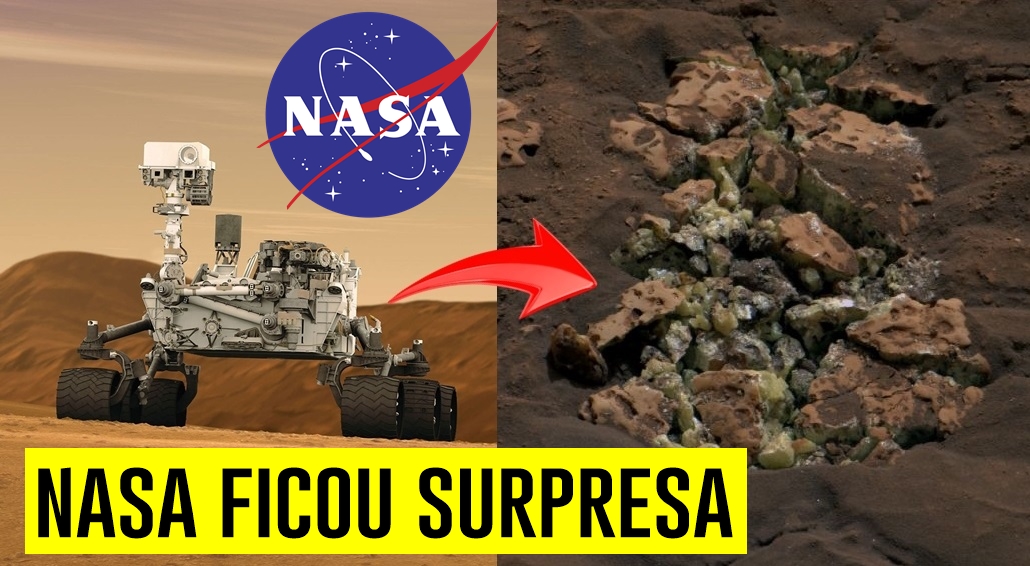


The NASA Curiosity Rover Conducted an Analysis on a Rock on Mars and Revealed Something Surprising, Reinforcing the Mysteries of the Red Planet.
In one of its most recent discoveries, NASA’s Curiosity robot revealed a great mystery on Mars. While rolling over a rock in the Gediz Vallis Channel, the spacecraft inadvertently broke the exterior of the rock, revealing shiny yellow crystals of elemental sulfur.
Although sulfur is a known mineral found in compound forms on Mars, the discovery of its pure form was a great surprise for scientists. The broken rock, which appeared common on the outside, hid an unexpected treasure.
Scientists Identify Pure Sulfur on the Red Planet for the First Time, Something They Did Not Expect.
-
Motorola launched the Signature with a gold seal from DxOMark, tying with the iPhone 17 Pro in camera performance, Snapdragon 8 Gen 5 that surpassed 3 million in benchmarks, and a zoom that impresses even at night.

-
Satellites reveal beneath the Sahara a giant river buried for thousands of kilometers: study shows that the largest hot desert on the planet was once traversed by a river system comparable to the largest on Earth.

-
Scientists have captured something never seen in space: newly born stars are creating gigantic rings of light a thousand times larger than the distance between the Earth and the Sun, and this changes everything we knew about stellar birth.

-
Geologists find traces of a continent that disappeared 155 million years ago after separating from Australia and reveal that it did not sink, but broke into fragments scattered across Southeast Asia.

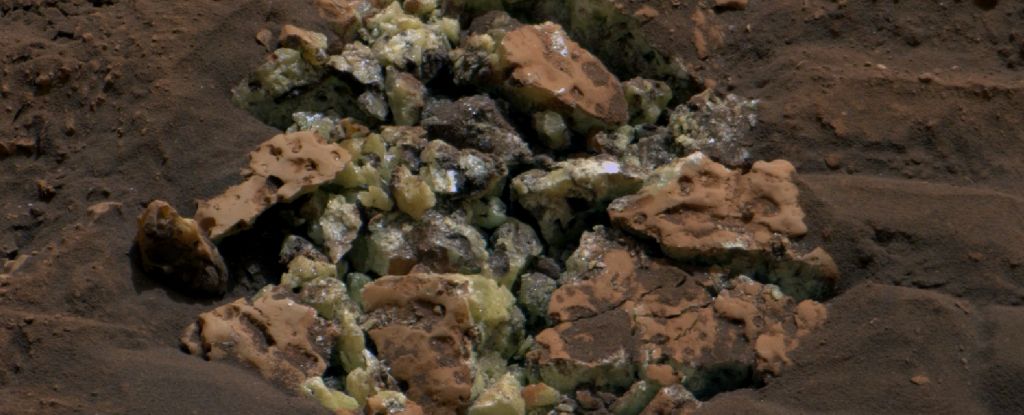
Pure Sulfur on Mars: An Intriguing Discovery
The most intriguing aspect is that the area where Curiosity made the discovery, the Gediz Vallis Channel, is filled with other rocks that look similar to the one that broke. This raises an exciting possibility: pure sulfur may be more abundant on Mars than previously thought.
“Finding a field of rocks made of pure sulfur is like finding an oasis in the desert,” stated Ashwin Vasavada, a scientist for the Curiosity project at NASA’s Jet Propulsion Laboratory. The discovery is a mystery to be unraveled. “It shouldn’t be there, so now we have to explain,” he said.

NASA/JPL-Caltech/MSSS )
Therefore, the discovery of pure sulfur is rare, as this element only forms under very specific geological conditions.
For this to happen, a well-controlled environment is necessary, with heat and pressure present, which is not typical of the area where Curiosity found the sulfur.


The formation of the mineral requires very different conditions than those found on the surface of Mars, making this discovery even more curious.
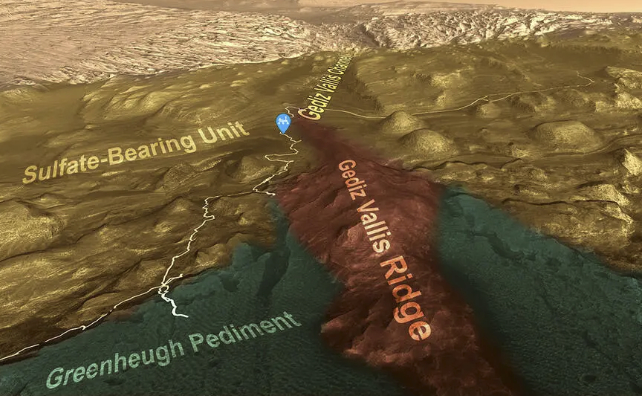
NASA/JPL-Caltech/ESA/University of Arizona/JHUAPL/MSSS/USGS Astrogeology Science Center )
The Importance of Sulfur for Life and for Mars
In summary, sulfur is an essential element for life as we know it. On Earth, it is used by living organisms to produce essential amino acids, which are fundamental for protein formation.
Even without direct signs of life on Mars, the discovery of elemental sulfur reinforces the idea that the planet may have conditions that could one day be favorable to life. Although scientists already knew of the presence of sulfates on Mars, this new discovery opens doors to new questions about the planet’s history.
On Mars, sulfates, which are compounds of sulfur and other minerals, form when water, in the past, evaporated, leaving these salts behind.
Thus, this information is crucial, as it allows scientists to reconstruct a bit of the history of water on Mars and understand how the planet has evolved over time. Elemental sulfur, however, is something entirely new and requires further analysis.
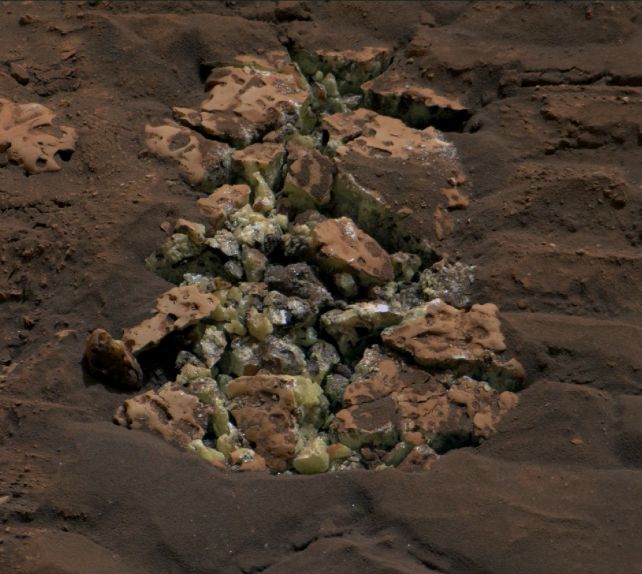
NASA/JPL-Caltech/MSSS )
How Did Curiosity Reach This Surprise-Filled Rock?
The Curiosity mission has been essential for the exploration of the Red Planet, but, in the case of the sulfur discovery, the robot had help from chance.
Scientists explain that if Curiosity had not rolled over the rock, the discovery of sulfur could have taken longer. Through its drilling and analysis tool, the robot can study the composition of Martian rocks, but the accidental breaking of the rock was what allowed sulfur to be identified in its pure form.
Now, scientists face a new challenge: understanding how this sulfur got there. This will require detailed geological modeling to try to comprehend the conditions on Mars that enabled the formation of pure sulfur, something that is not typical of the region.
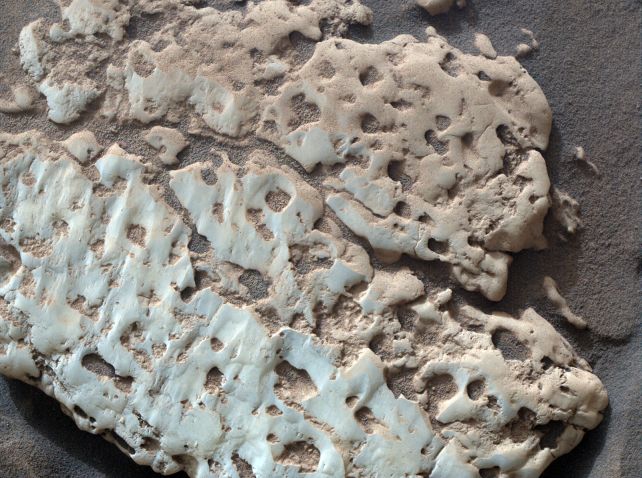
NASA/JPL-Caltech/MSSS )
Next Step in the Mission on Mars
After completing the exploration of the Gediz Vallis Channel, NASA’s Curiosity rover is preparing for a new phase of its mission on Mars. The next step involves a journey of several months toward a formation known as “boxwork,” characterized by spider-web-like patterns extending for miles across the Martian surface. These structures are formed by minerals that have deposited in fractures of the rocks, hardening over time.
Before leaving the Gediz Vallis Channel, Curiosity captured a 360-degree panorama of the region, highlighting intriguing features, such as a field of white stones rich in sulfur. These observations provide valuable insights into the latest wet periods on Mars and the transition to a drier climate.
The exploration of the “boxwork” formation will allow scientists to closely study these mineral structures, offering a unique opportunity to better understand Mars’ geological history and the processes that shaped its surface. This investigation is crucial for deepening our knowledge of the planet’s climatic evolution and the presence of water on its surface.
What Comes Next?
The discovery of elemental sulfur is just one of the many surprises Curiosity has encountered in the Gediz Vallis Channel. This site, an ancient riverbed that existed on Mars billions of years ago, carries a rich geological history.
The rocks in the area are filled with traces of an aquatic past, which still needs to be fully unraveled.
The exploration of Mars continues with great discoveries and many mysteries to be solved. With each new analysis, Curiosity brings us more answers about the planet’s past and about the possibility of life in its soil. The mission is still far from over, and the future promises new and exciting revelations.








Boa tarde “À CIÊNCIA SEM FIM”, muito boa esta sua matéria sobre o que o opportunity descobriu no planeta Marte. Parabéns por seu discernimento e pela relevância deste assunto. Ok???!!!??🌹👍👏👏👏👏
Boa tarde “À CIÊNCIA SEM FIM”, muito boa esta sua matéria sobre o que o opportunity descobriu no planeta Marte. Parabéns por seu discernimento. Ok???!!!??🌹👍👏👏👏👏
Gostaria de saber ,posso me candidatar em morar em Marte ,ou dar sugestões sobre o planeta Marte?
Sugestões ,que acho do planeta,e como poderia viver lá.