





 Portuguese
  English
  Spanish
  5 min of reading
  0 comments


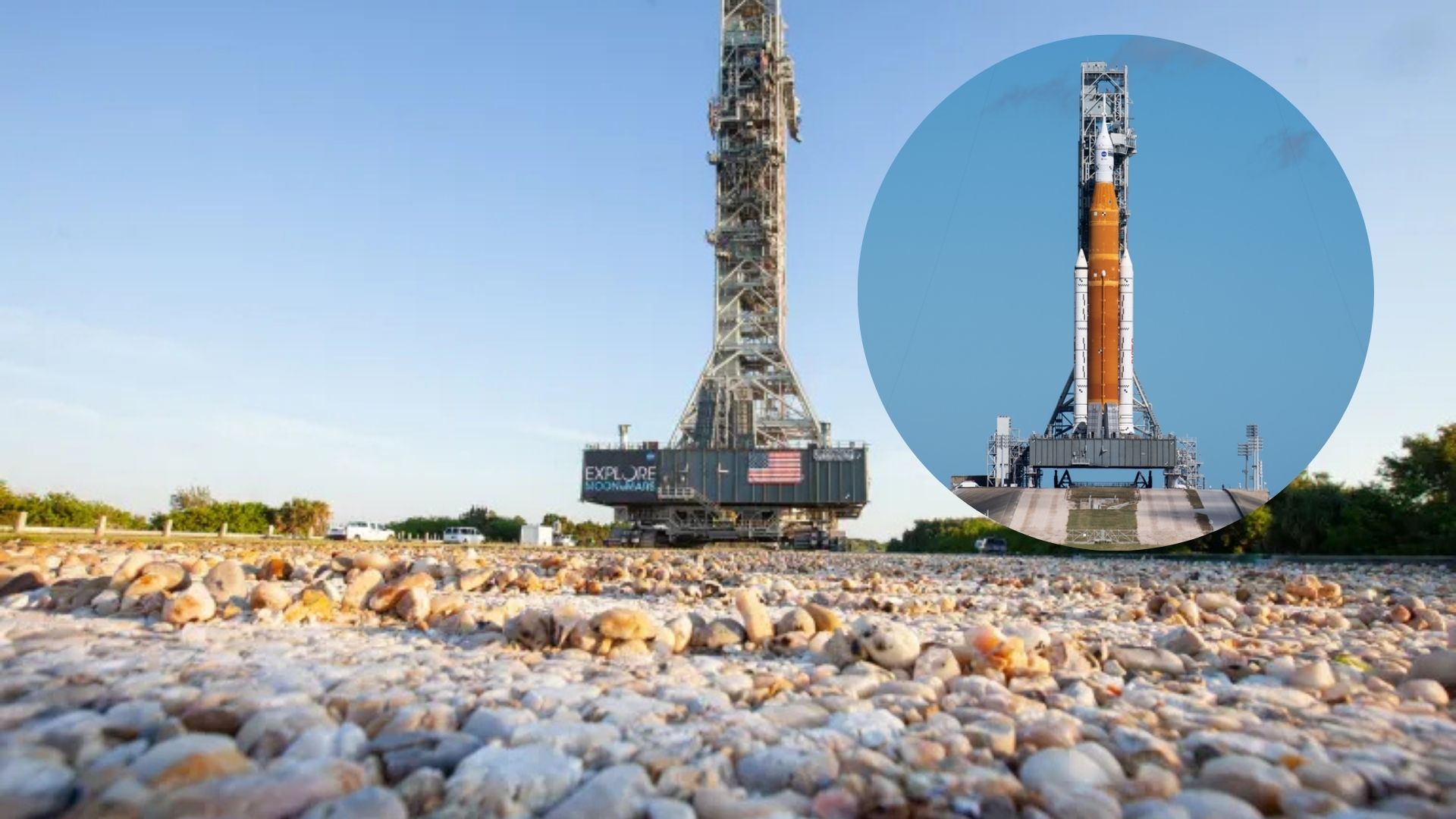
Invisible Infrastructure of the Kennedy Space Center Supports SLS Movement to the Platform with Alabama River Rocks, Deep Layers, and Engineering Designed for Extreme Loads, Ensuring Millimeter Stability Before the Final Operations of the Artemis Program.
NASA maintains, at the Kennedy Space Center in Florida, a road of about 4.2 miles and approximately 130 feet wide built to safely move giant rockets, including the Space Launch System (SLS) stack and the Orion spacecraft.
Known as Crawlerway, the road connects the Vehicle Assembly Building to the launch areas of Launch Complex 39 and supports the movement of the mobile launcher driven by Crawler-Transporter 2, a critical step before the final operations on the platform.
Although it looks like a gravel road, the corridor was designed to maintain leveling and stability under extreme loads, because small undulations that would be irrelevant for cars can affect alignment and safety when the goal is to transport a rocket vertically.
-
Friends have been building a small “town” for 30 years to grow old together, with compact houses, a common area, nature surrounding it, and a collective life project designed for friendship, coexistence, and simplicity.

-
This small town in Germany created its own currency 24 years ago, today it circulates millions per year, is accepted in over 300 stores, and the German government allowed all of this to happen under one condition.

-
Curitiba is shrinking and is expected to lose 97,000 residents by 2050, while inland cities in Paraná such as Sarandi, Araucária, and Toledo are experiencing accelerated growth that is changing the entire state’s map.

-
Tourists were poisoned on Everest in a million-dollar fraud scheme involving helicopters that diverted over $19 million and shocked international authorities.


Therefore, the movement occurs at low speed, calculated to offer the smoothest possible trajectory for the transported stack, reducing oscillations and vibrations along a route that crosses open areas exposed to wind and rain.
Crawlerway Connects the Vehicle Assembly Building to Launch Complex 39

Instead of rigid paving, the top layer is made of rounded river stones, often described by the agency as rocks from Alabama rivers, used to distribute pressure under the tracks and avoid common cracking patterns found in traditional pavements.
This granular “carpet” behaves like a controlled bed, capable of accommodating contact with the tracks while maintaining a usable surface even when the material is gradually crushed, which requires periodic maintenance and replenishment.
Structure with Two Parallel Lanes to Support the SLS
Crawlerway functions as a dual track, with two parallel lanes where the transporter’s tracks rest, separated by a central median, a design that helps maintain alignment over long stretches and during maneuvers near the platforms.
In the technical documentation released by NASA, the reference is for lanes of about 40 feet each, with a broad central area, a composition that contributes to equipment stability and predictability of the path in repeated operations.
Reinforced Curves and Thickness Variation of the Stones
The thickness of the stones is not uniform: in straight sections, the layer is often cited as thinner, while in curves it becomes thicker, because lateral forces and shear increase during the transporter’s change of direction.

This reinforcement is treated as part of the operational design, as curves concentrate forces unevenly under the tracks, and correcting the surface profile helps preserve leveling and reduce degradation of the bed over the campaigns.
Deep Layers Ensure Millimeter Stability
Under the visible layer, there is a deep foundation composed of different levels of graded and compacted material, designed to prevent settlement, impede the formation of ruts, and reduce the risk of deformation, even under the combined weight of the transporter and the rocket.
This structure is closer to a foundation engineering approach than a common road, because the central goal is to support concentrated loads and maintain predictable behavior in wet weather, with drainage and stability sufficient to prevent it from turning into mud.
Constant Maintenance to Preserve Alignment Tolerances


Over time, the passage of the equipment pulverizes part of the rocks, altering granulation and compaction, and NASA reports that the material needs to be replenished and distributed in adequate layers to avoid water accumulation and preserve safe rolling conditions.
Beyond wear, height control and regularity directly influence the stability of the stack, because small variations can affect alignment parameters during approach to the launch areas, a stage when the system is already configured for critical operations.
The origin of the aggregate also comes into planning, as the supply of the rocks involves extraction, preparation, and delivery according to specifications, so that the surface maintains expected properties of resistance and behavior under friction, according to materials released by the agency itself.
Infrastructure Created During Apollo Remains Essential in Artemis

The path was designed to meet the demands of the large launchers of the Apollo program and continued to be used in later phases of the center, which helps explain why ground infrastructure remains strategic even when the vehicles and systems on top change.
Today, the road integrates the logistics of the Artemis program missions by supporting the transport of the SLS and Orion to Launch Complex 39, with the same operational priority: to deliver the assembled vehicle with stability and predictability before launch.
In the case of Crawler-Transporter 2, NASA also describes dimensions and operational limitations that help understand the scale involved, emphasizing that the system relies on a route capable of distributing loads and providing a controlled path.
The logic of the design is simple in concept and complex in execution: an apparently common road must function as an engineering base, because without a reliable surface the transporter cannot fulfill the ground stage that precedes final integrations and checks.
While launch images show the rocket already positioned, the movement to the platform is part of the system and requires that every meter of the path responds as planned, especially in curves and sections subject to greater effort, where reinforcements are essential.
In this backdrop, Crawlerway remains a permanent operational component of Launch Complex 39, supporting the slow passage of structures that concentrate mass and height, and placing the ground infrastructure as a prerequisite for the rhythm of the missions.









Seja o primeiro a reagir!