





 Portuguese
  English
  Spanish
  4 min of reading
  0 comments


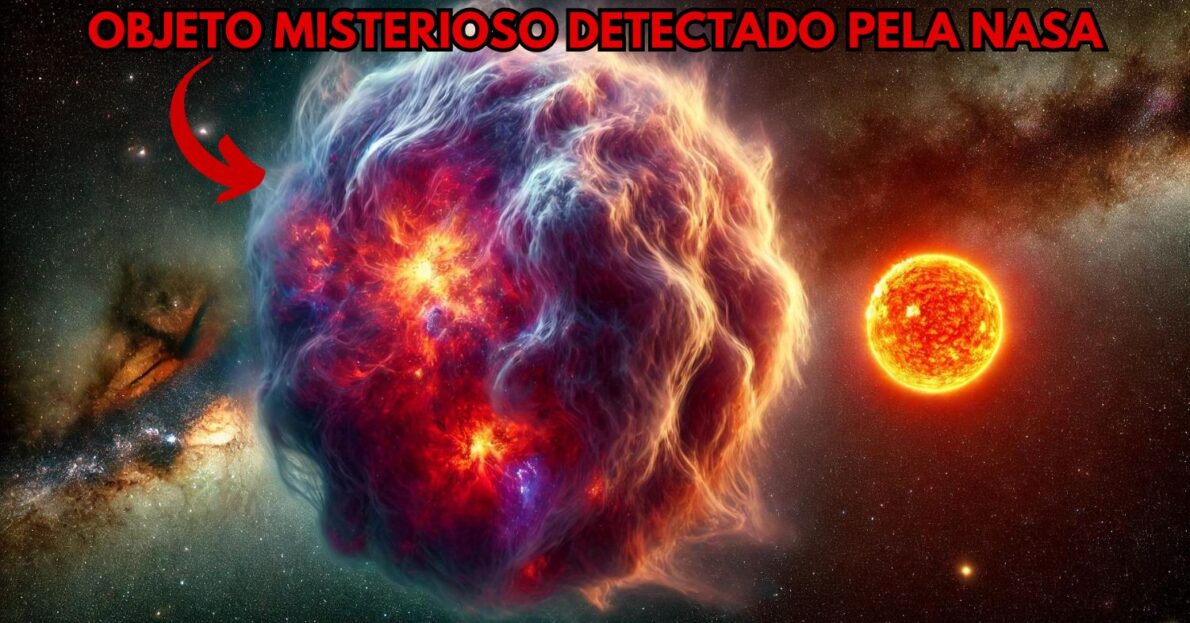
NASA Detects Mysterious Object Larger Than Earth Traveling at High Speed That Could Escape the Galaxy and Open New Frontiers in Astrophysics.
The NASA is currently tracking a mysterious object that is piquing the curiosity of scientists and astronomers around the world. This celestial body, identified by the Planet 9 project and dubbed CWISE, is flying through the Milky Way at a remarkable speed of over 1.6 million kilometers per hour. In addition to its extreme speed, what catches attention is the fact that this mysterious object has a mass 27,000 times greater than Earth.
What Do We Know About the Mysterious Object Detected by NASA?
The mysterious object detected by NASA, known as CWISE, is similar in size to a small star, according to information published by the British newspaper The Mirror. To give you an idea of its magnitude, it is tens of thousands of times larger than Earth. This object was identified a few years ago and has since been closely monitored.
The CWISE is traveling at such a high speed that there is a real possibility that it could escape the gravity of our galaxy, the Milky Way, and be launched into the vast intergalactic space. This prospect raises a series of intriguing questions about its origin and final destination.
-
Motorola launched the Signature with a gold seal from DxOMark, tying with the iPhone 17 Pro in camera performance, Snapdragon 8 Gen 5 that surpassed 3 million in benchmarks, and a zoom that impresses even at night.

-
Satellites reveal beneath the Sahara a giant river buried for thousands of kilometers: study shows that the largest hot desert on the planet was once traversed by a river system comparable to the largest on Earth.

-
Scientists have captured something never seen in space: newly born stars are creating gigantic rings of light a thousand times larger than the distance between the Earth and the Sun, and this changes everything we knew about stellar birth.

-
Geologists find traces of a continent that disappeared 155 million years ago after separating from Australia and reveal that it did not sink, but broke into fragments scattered across Southeast Asia.
Theories and Hypotheses
The origin of this mysterious object is one of the great mysteries that scientists are trying to unravel. One of the suggested theories is that CWISE may have originated from a binary system, where a companion star, possibly a white dwarf, exploded in a supernova. This catastrophic event could have propelled the object out of the system, initiating its rapid journey through the Milky Way.
Another hypothesis is that CWISE may have come from a star cluster that, upon encountering a pair of black holes, was launched at high speed. This type of complex dynamic interaction between celestial bodies is rare, but not impossible, and could explain the unusual trajectory of this object larger than Earth.
Kyle Kremer, an assistant professor in the Department of Astronomy and Astrophysics at the University of California, San Diego, commented to The Mirror about the complexity of these interactions. He explained that when a star encounters a binary black hole, the resulting dynamics can force the star out of the cluster, which could be the case with CWISE.
What Does CWISE Tell Us About the History of the Milky Way?
Another fascinating aspect of the mysterious object detected by NASA is its chemical composition. Observations made by the WM Keck Observatory, located in Maunakea, Hawaii, revealed that CWISE has less iron and other metals than most known stars. This discovery suggests that it is extremely old, possibly belonging to one of the first generations of stars formed in the Milky Way.
The low amount of metals indicates that CWISE may have formed at a time when the universe was very young, and the nucleosynthesis processes that create heavier elements were still in their early stages. This makes CWISE not just a mysterious object in terms of its trajectory and speed, but also a precious relic that could offer us insights into the ancient history of our galaxy.
What Can We Expect?
As scientists continue to monitor CWISE, one of the biggest questions is what will happen to it in the future. Its speed and trajectory suggest that it may eventually escape the Milky Way and continue its journey through intergalactic space. If that happens, CWISE will become one of the few known objects to make this trip, making it one of the most intriguing celestial bodies ever discovered.
The possibility that this celestial body could escape the gravity of our galaxy opens new areas of study in astrophysics. Scientists are particularly interested in understanding the forces driving its speed and what that can teach us about the interactions between stars, black holes, and other massive objects.
The Importance of the Discovery for Science
The discovery and ongoing study of this mysterious object highlight the importance of projects like Planet 9, which are dedicated to detecting and analyzing astronomical objects that are still poorly understood. This celestial body, larger than Earth, is an excellent example of how science is constantly pushing the boundaries of our knowledge about the universe.
By tracking CWISE and trying to understand its origin and destiny, scientists are not only attempting to solve a specific mystery, but they are also contributing to our broader understanding of how galaxies and celestial bodies interact over billions of years.
As the study of this mysterious object progresses, we can expect new revelations that will help us better understand the universe we live in and, perhaps, discover new phenomena that we have yet to imagine. One thing is certain: the story of CWISE is just beginning to be written.








Seja o primeiro a reagir!