





 Português
  Inglês
  Espanhol
  5 min de leitura
  4 comentários


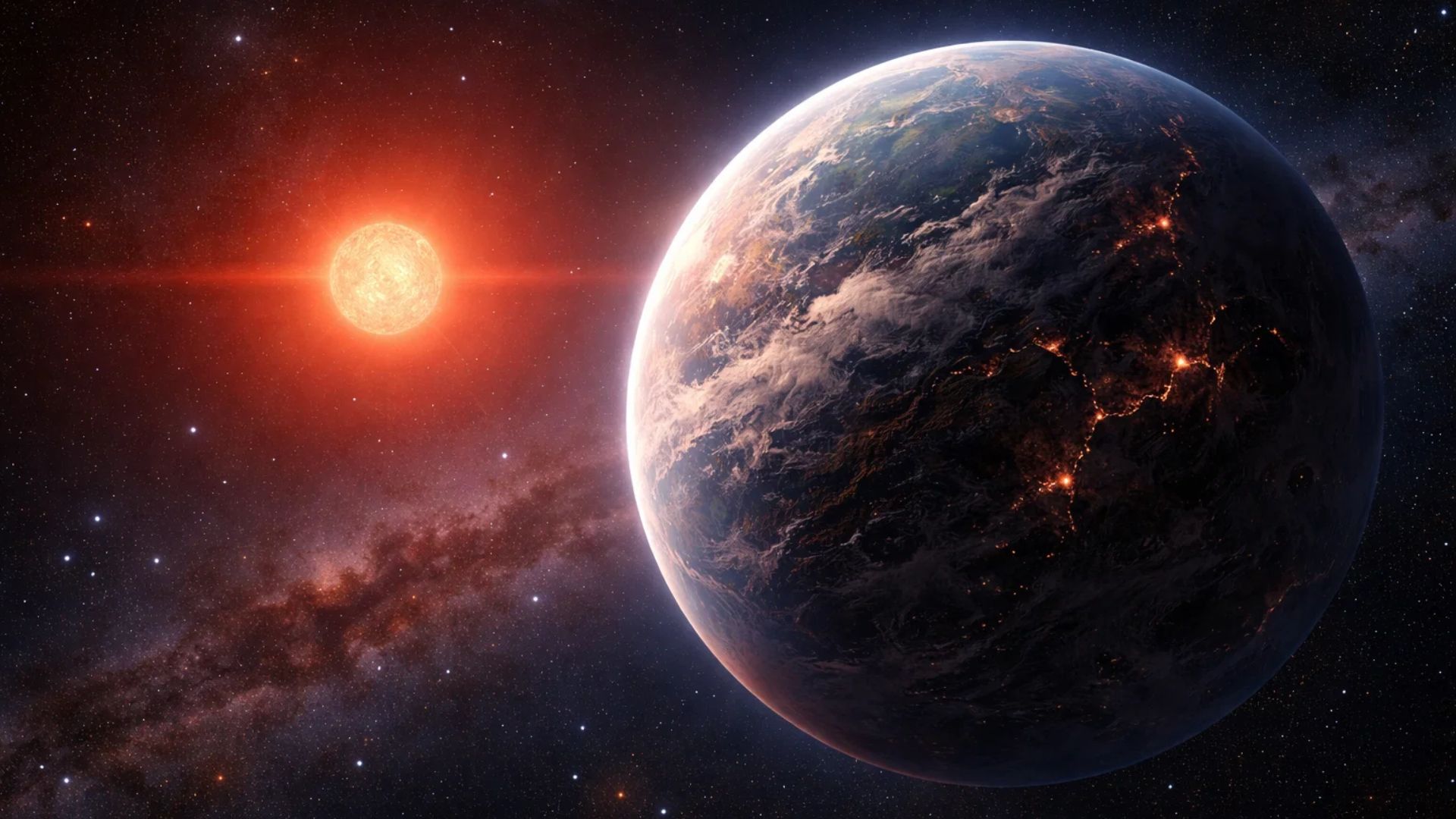


Far beyond urban traffic, power plants, and the rising electricity bills that are part of human daily life, NASA has just announced the discovery of a new cosmic “neighbor” that reignites one of the greatest questions of modern science: Are we alone in the Universe? It is the planet TOI-715 b, a so-called “super-Earth” located about 137 light-years from Earth, positioned in the so-called habitable zone of its star.
The information was disclosed through official statements from NASA, based on a scientific study published in the journal Monthly Notices of the Royal Astronomical Society, and quickly garnered the attention of the international scientific community. The reason is not only the relatively short distance in astronomical terms but also a detail that intrigues even experienced astronomers: the year on this planet lasts only 19 Earth days.
Despite this, according to researchers, TOI-715 b may have conditions that allow for the existence of liquid water on its surface, one of the main requirements for life as we know it.
-
A bright yellow mushroom imported from Asia escaped from a cultivation farm in the United States in 2010 and is now aggressively spreading across 25 states, destroying entire communities of native fungi in American forests.

-
Buried under China, a colossal machine weighing 20,000 tons began operating as the largest neutrino detector on the planet and, in just 59 days, surpassed results that science took half a century to achieve.

-
Iran enters the center of a climate alert after the war emitted 5.6 million tons of CO2 in two weeks, surpassing the annual pollution of entire countries.

-
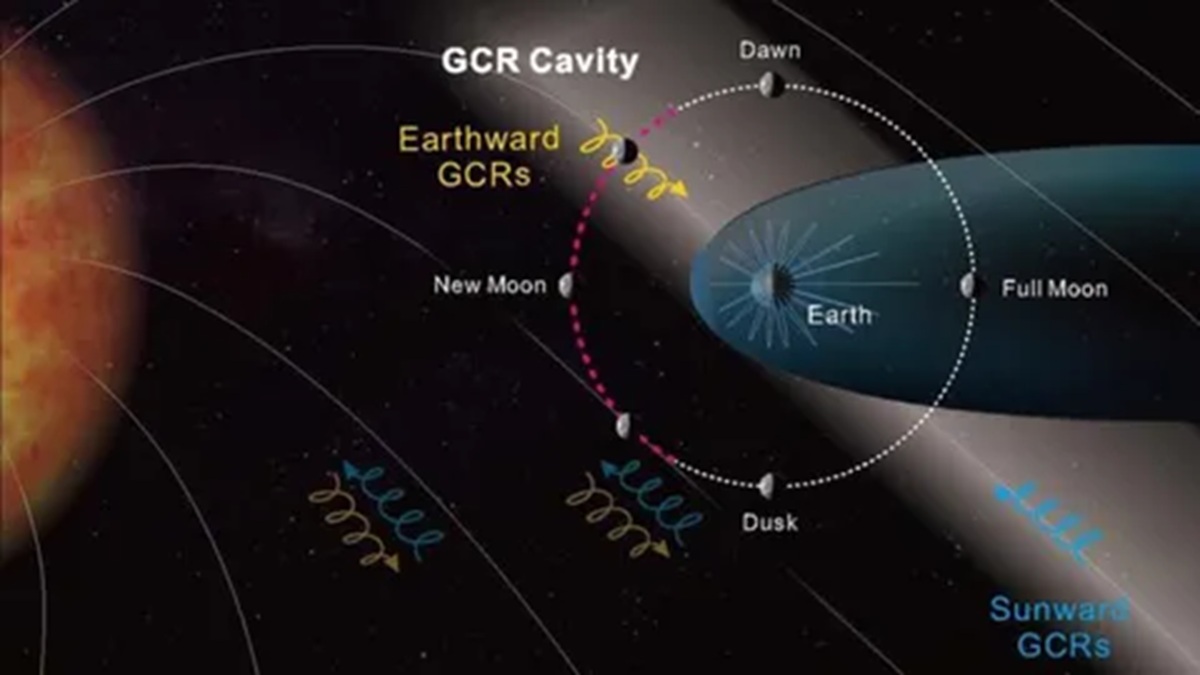
Lunar exploration may change after a Chinese probe finds a “cavity” of radiation that reduces the impact on astronauts by up to 20% at certain times on the Moon.

A Super-Earth in the So-Called “Goldilocks Zone”

TOI-715 b is classified as a super-Earth because it has larger dimensions than our planet. According to observational data, it has about 1.5 times the diameter of Earth and an estimated mass of approximately three times that of Earth. These numbers indicate a rocky planet, not a gas giant like Jupiter or Saturn.
The planet orbits its star at just over 8% of the distance between Earth and the Sun, completing one full orbit in only 19 days. At first glance, this proximity could suggest an extremely hot and hostile environment. However, there is a crucial factor that completely changes this scenario.
The host star of TOI-715 b is a type M red dwarf, much smaller and cooler than the Sun. Therefore, even orbiting so close, the planet receives a moderate amount of radiation, sufficient to position it within what scientists call the conservative habitable zone — the region where temperatures can allow liquid water on the surface.
According to NASA, this distance may provide “the right temperature for the formation of liquid water,” although the agency emphasizes that other factors, such as atmospheric composition, remain unknown.
Red Dwarfs, Fast Orbits, and Scientific Advantage
TOI-715 b was identified by the TESS (Transiting Exoplanet Survey Satellite), NASA’s space telescope designed to detect exoplanets by observing small dips in star brightness when a planet passes in front of it.
Red dwarf stars are ideal targets for this type of research. Because they are smaller and cooler, rocky planets can orbit much closer without overheating, in addition to completing fast orbits, which allows for multiple observations in a short period.
In the case of TOI-715 b, this “year” of 19 days gives scientists a huge practical advantage: it is possible to observe several orbits in a few months, accelerating the confirmation of orbital data, size, and mass.
NASA highlights that systems with red dwarfs currently represent the best chance of finding potentially habitable planets, precisely due to this compact and efficient architecture for observation.
Even more intriguingly, data suggest that the same system may host a second planet, slightly larger than Earth, also located in the habitable zone. If confirmed, it would become the smallest planet in the habitable zone ever discovered by TESS.
Habitability Goes Far Beyond Distance to the Star
Despite the excitement, scientists are cautious. Being in the habitable zone does not automatically guarantee the presence of liquid water, let alone life. The atmosphere of TOI-715 b remains a complete mystery.
Factors such as greenhouse effect, the presence of gases like carbon dioxide and methane, cloud cover, volcanic activity, and even the planet’s rotation can turn a potentially habitable world into an arid or frozen environment.
Earth itself is a clear example of this fragility. Small variations in the concentration of greenhouse gases are already sufficient to cause more intense heatwaves, glacier melting, and extreme weather events, even while remaining in the same orbital position.
The scientific lesson is straightforward: the correct distance is just the starting point. The true climatic balance depends on atmospheric chemistry and planetary dynamics.
A Promising Target for the James Webb Telescope
With its characteristics, TOI-715 b now enters the list of priority targets for the James Webb Space Telescope. The Webb is capable of analyzing light filtered through the atmospheres of exoplanets, searching for signs of water vapor, carbon dioxide, methane, and other chemical compounds.
Similar techniques have already been applied to other worlds, like TOI-561 b, an extremely hot super-Earth that scientists described as a “warm lava ball.” Although this planet is inhospitable to life, the methods used there can be applied to cooler targets like TOI-715 b.
According to researcher Renyu Hu from NASA’s Jet Propulsion Laboratory, these worlds “are really very exciting,” both for the possibility of life and for what they teach about the survival of atmospheres under different stellar conditions.
What This Distant Planet Teaches Us About Earth Itself
Even invisible to amateur telescopes, TOI-715 b serves as a true cosmic mirror. It helps scientists understand which combinations of size, atmosphere, and radiation allow a planet to maintain stable conditions over time.
The same equations used to study this exoplanet are applied to predict Earth’s climatic future, reinforcing that habitability is not guaranteed, but a delicate balance.
In the end, the TOI-715 b reminds us that habitable conditions depend on very specific physical and chemical choices. Here on Earth, these choices are increasingly in the hands of humanity itself.






Cuando leo noticias sobre posibles colonizaciones en Marte, planetas posiblemente habitables a años luz y cosas así, pienso: Primero los recursos a utilizar son tantos que, los podíamos utilizar directamente para recuperar el planeta Tierra; segundo si los super-ricos, no tienen intención de cuidar ni preservar el planeta, su prioridad es ser eternamente ricos a costa de conseguir mas recursos fuera de el planeta que ya habitamos… quieren huir del planeta que han destrozado… las ratas quieren abandonar el barco que se hunde.
Os cientistas deveriam pesquisar algo mais útil para a Terra e a vida humana, pois descobrir planetas a trilhões de km, inatingível, não levará a lugar algum, mesmo que encontrem formas de vida, não haverá comunicação
La vuelta es en 18 días porque está girando alrededor de UNA ESTRELLA ENANA, simple lógica por ser un factor importante.