





 Portuguese
  English
  Spanish
  6 min of reading
  1 comment




NASA Prepares Artemis 2 As A Crewed Test Mission That Will Send Four Astronauts Around The Far Side Of The Moon In About 10 Days Using The SLS Rocket And The Orion Integrity Capsule, With Launch Planned For February 5, 2026 At Kennedy In Florida From The Official Platform 39B
The NASA is counting down to what it defines as a crewed return to the Moon after more than five decades, but with a technical message: Artemis 2 will be, above all, a test flight to validate people, systems, and procedures in deep space.
The mission is planned to take four astronauts on a journey of approximately 10 days, passing the far side of the Moon, conducting operations tests within the capsule, safety checks, and a water landing in the Pacific Ocean.
What NASA Wants To Prove With Artemis 2

The NASA treats Artemis 2 as a critical transition between an uncrewed test and a crewed flight capable of exposing the system to human variables that cannot be fully simulated on the ground.
-
A “silent skill” is allowing Brazilians to earn up to R$ 22,000 per month without a degree and become indispensable for companies that rely on millions of data to survive.

-
Researchers at the Toyota Research Institute found that if a human uses robotic arms to flip a pancake 300 times in an afternoon, the robot learns to do it on its own the next morning, and this is currently the most promising method to solve the biggest bottleneck in modern robotics.

-
Goodbye iron: a common item in households is starting to lose space to technology that smooths clothes in minutes without an ironing board and with less energy consumption.

-
Antarctica reveals an unusual clue high in the Hudson Mountains, and what appeared to be just an isolated rock began to expose a secret hidden under the ice for ages.


In practice, Artemis 2 focuses on validating onboard life routine, communication, nutrition, sleep, exercise, bathroom use, and responses to emergency procedures, including deep space radiation scenarios.
The central goal is to place the Orion capsule in a real mission profile, with maneuvers and sequences that depend on integration between the spacecraft, software, boosters, power, controls, and human decision-making.
The NASA also emphasizes that the mission does not include a lunar landing: the plan is a flyby with safe approach and return, in a controlled risk design for a crewed test.
NASA’s Rocket: SLS, Solid Boosters, And The ICPS Stage

The launch system used by the NASA is the Space Launch System, the SLS, described as the most powerful crewed rocket of the program.
The system includes two solid side boosters and a central stage, in a configuration that resembles the concept of propulsion with boosters.
In the Artemis 2 configuration, the solid boosters receive a specific visual highlight: a America 250 logo painted on both, as a reference to the 250th anniversary of the United States in 2026.
Above the central stage, enters the ICPS, the interim cryogenic propulsion stage, responsible for burns that place the spacecraft in the planned orbit before the push toward the trajectory to the Moon.
Orion: The Core Of The Mission And The “Integrity” Capsule

The NASA positions Orion as the central element of the flight, as it is the module where the crew lives and works throughout the mission.
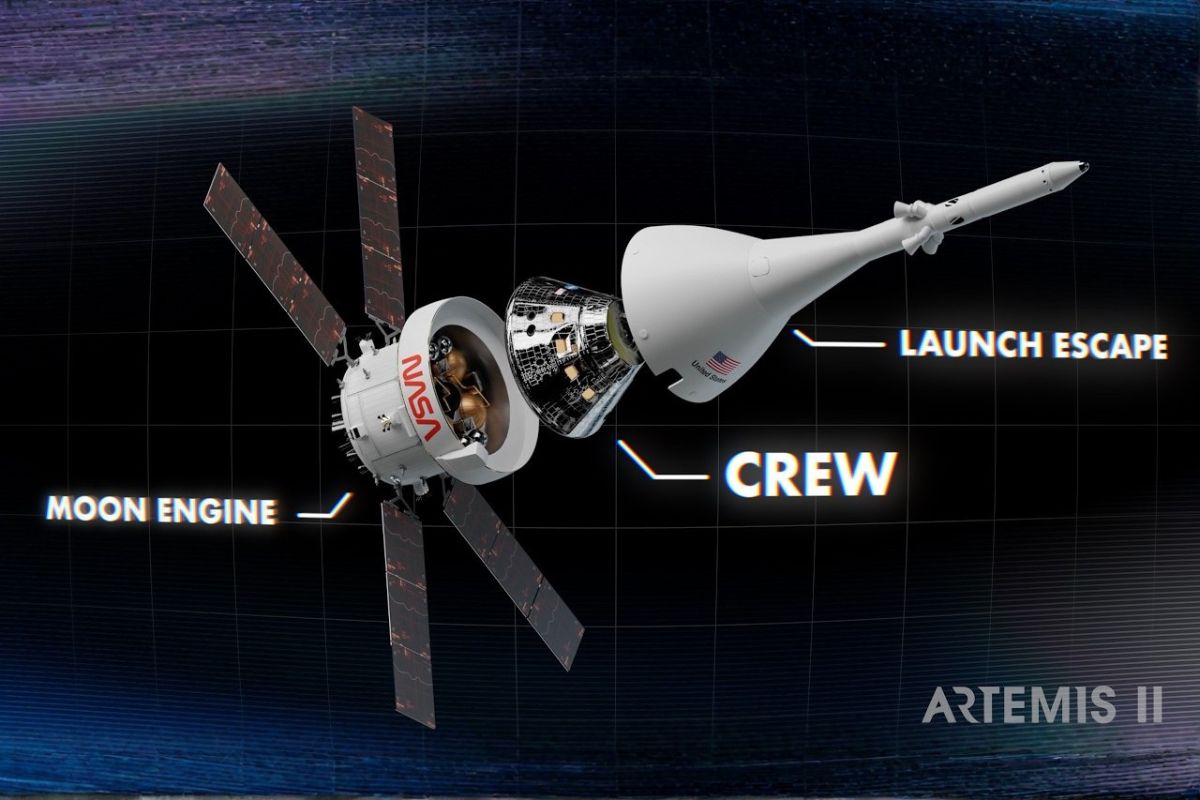
The mentioned architecture separates Orion into clear functional parts.
The lower module is the ESM, the European service module, which provides power and propulsion, allowing the movement and control of the spacecraft in space.
Above is the crew module, also called the capsule, where astronauts remain from start to finish.
In Artemis 2, the crew named the capsule Integrity, and NASA emphasizes that, in the end, this will be the only part that returns to Earth.
At the top, there is the most critical safety system of the launch: the Launch Abort System (LAS), designed to separate the capsule from the rest of the rocket in the event of a severe failure, explosion, or event that directly threatens the lives of the crew.
Launch Sequence And Initial Flight Milestones

The mission is scheduled to launch from the Kennedy Space Center in Florida, from the 39B platform, which has previously been used in historic Apollo program missions and Space Shuttle operations.
The indicated date is February 5, 2026, with potential operational adjustments.
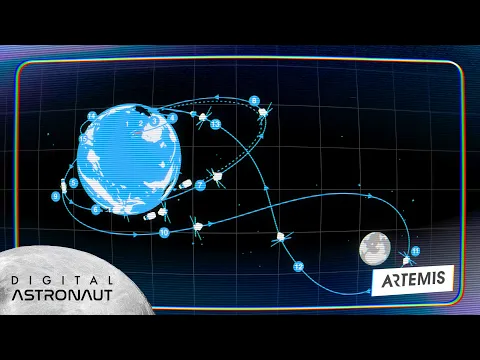
After launch, the described sequence includes an initial segment of about 2 minutes, when the solid boosters are discarded.
Next, the central stage conducts the spacecraft to a low Earth orbit, and the launch abortion system is also discarded when it is no longer needed.
Around 8 minutes, the main stage separates and returns, while the ICPS ignites to complete the effort of insertion and orbital positioning.
The NASA details that, after two burns of the ICPS, Orion will be in a high elliptical orbit, with parameters cited of 46,000 miles from Earth at the farthest point and 115 miles at the closest point, with an approximate period of 1 day per complete orbit.
Docking Training And Propulsion Validation
Still on the first day, Orion separates from the ICPS and begins a docking training phase, considered essential for future missions where Orion will need to dock with other elements of the program.
The NASA associates this type of validation with a direct objective: ensuring that the autopilot and the boosters function as expected, preventing any anomalous behavior from compromising navigation and flight safety.
The mission, being crewed, requires reinforced validation of stability, response to commands, and redundancy.
Translunar Injection And The Free Return Trajectory
After an additional pass by Earth, Orion reignites the engine for the translunar injection (TLI), the maneuver that puts the spacecraft on the path to the Moon.
The profile presented by the NASA adopts a free return trajectory, in which the gravity of the Earth and the Moon tends to return the mission to the planet without the need for additional burns.
The logic of the free return trajectory is to reduce risk in a test flight: if there are critical issues, the spacecraft would still have a natural path back, sustained by gravitational dynamics, decreasing the dependence on complex maneuvers for return.
The journey to the Moon, in this design, is estimated at 4 days, during which the crew executes checklists and emergency procedures, with emphasis on simulations related to radiation events in deep space.
Orion, according to the description, has an internal shelter for such situations, and the mission plans to test its operation in practice.
Passing The Far Side And Approaching The Surface
Artemis 2 is not a landing mission.
The plan is a close pass that takes the crew to the far side of the Moon, the area not visible from Earth with the naked eye due to synchronized rotation.
The indicated distance for the pass relative to Earth is about 230,000 miles.
In the phase of closest proximity to the lunar surface, the NASA describes an approach of approximately 4,600 meters, followed by small corrections to adjust the return precisely.
After the pass, the spacecraft performs the necessary corrections to set the point and timing of reentry.
After more than 4 days, the Integrity capsule separates from the service module and reenters the atmosphere for water landing in the Pacific Ocean, with recovery planned by the U.S. Naval forces.
Who Is On Board: Commander, Pilot, And Mission Specialists
The NASA lists four astronauts for Artemis 2, distributed by functions and complementary profiles.
Reed Wisman will be the commander.
The cited biography describes him as a Navy veteran with 27 years of service, a pilot, engineer, and father, originally from Baltimore, an astronaut since 2009, with 167 days in space.
Victor Glover will be the pilot. He is described as a test pilot, engineer, father, and legislative advisor, with experience in Operation Iraqi Freedom, and has logged 40 aircraft in 24 combat missions. He has been an astronaut since 2013.
Christina Cook is a mission specialist. She is noted as an electrical engineer, Antarctica explorer, firefighter, and participant in scientific programs for the NASA and NOAA.
The biography indicates that she holds the record for the longest single spaceflight by a woman, lasting nearly a year, and is also an astronaut since 2013.
Jeremy Hansen completes the crew as a mission specialist, representing Canada. The description notes him as a pilot, physicist, colonel in the Canadian Armed Forces, aquanaut, and father.
He became an astronaut in 2009 and, in 2017, was named the first Canadian to lead a NASA astronaut class. Artemis 2 will be his first spaceflight, debuting directly in a lunar mission.
What Could Change Before Launch
The window indicated for the mission opens on February 5, 2026, but the NASA itself suggests that cancellations and additional attempts may occur before an effective launch, especially since it is a crewed mission focusing on safety and complete system validation.
Thus, Artemis 2 presents itself as an operation where the schedule is important, but where the dominant criterion is reliability, because the mission carries people and tests the entire system chain of a modern lunar architecture.
If NASA delays the launch to correct details, do you see this as excessive caution or as the only acceptable stance in a crewed flight to the Moon?







Moço….eh nao daos da vonta çô.