





 Português
  Inglês
  Espanhol
  4 min de leitura
  0 comentários


Nuclear Technology Promises to Halve Travel Time to Mars, But the Use of Uranium Linked to World War II Raises Controversy.
When it comes to exploring Mars, technological limitations make the journey extremely lengthy.
The NASA and other space agencies have been investing in alternatives to speed up this journey, and one of them promises to cut the travel time in half.
However, the use of uranium, an element that evokes memories of the Second World War, still raises concerns. Can nuclear technology revolutionize space travel or will taboos about its use be an obstacle?
-
A bright yellow mushroom imported from Asia escaped from a cultivation farm in the United States in 2010 and is now aggressively spreading across 25 states, destroying entire communities of native fungi in American forests.

-
Buried under China, a colossal machine weighing 20,000 tons began operating as the largest neutrino detector on the planet and, in just 59 days, surpassed results that science took half a century to achieve.

-
Iran enters the center of a climate alert after the war emitted 5.6 million tons of CO2 in two weeks, surpassing the annual pollution of entire countries.

-
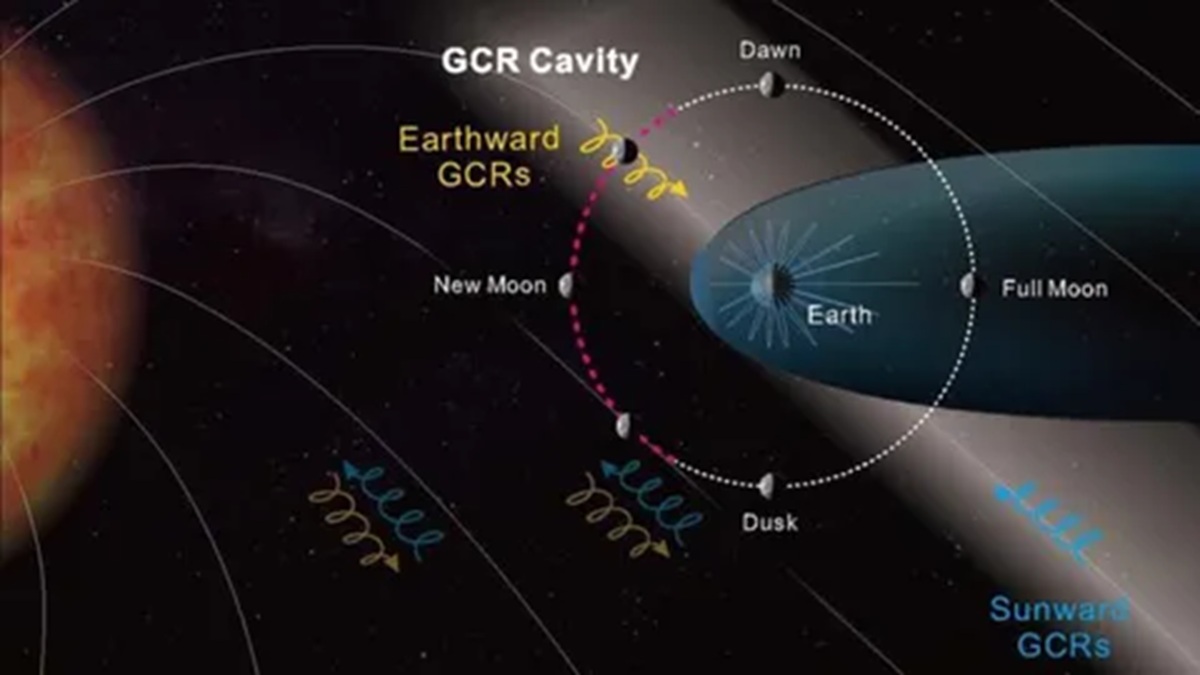
Lunar exploration may change after a Chinese probe finds a “cavity” of radiation that reduces the impact on astronauts by up to 20% at certain times on the Moon.

Nuclear Technology as a Shortcut to Mars
As Dan Kotlyar, a professor at Georgia Institute of Technology, explains, the current travel time to Mars is determined by the use of conventional chemical fuels.
These systems, based on the combustion of hydrogen and oxidants, provide the energy needed to overcome Earth’s gravity, but are less efficient for long-distance journeys in deep space.
Nuclear thermal propulsion, on the other hand, presents an innovative alternative: using nuclear fission to generate thrust.
Kotlyar asserts that the use of a specific isotope, uranium-235, makes nuclear propulsion much more effective.
“Nuclear rockets have almost twice the efficiency of conventional rockets, which means that travel could be completed in half the time,” the professor highlights.
This time savings would not only accelerate the journey but also reduce the risks of exposure to cosmic radiation for astronauts, one of the main challenges of long-duration missions.
The Dilemma of Using Uranium and the Challenges of Implementation
Despite the benefits, the use of uranium-235 raises delicate issues due to its association with nuclear weapons.
Nuclear technology has a complex history, and its use in non-military contexts is still viewed with some caution.
Although nuclear propulsion systems are not related to armaments, the idea of using them in space missions is not fully accepted by the scientific community.
Kotlyar emphasizes that safety is a priority in research on space nuclear propulsion.
“Although the technology is based on nuclear fission, it does not pose a risk of nuclear explosion like in armaments,” he says.
The focus, according to him, is on harnessing already established energy for peaceful and scientific exploration purposes.
Benefits of Nuclear Propulsion: Efficiency and Increased Payload
One of the main attractions of nuclear rockets is their fuel efficiency.
Kotlyar explains that with nuclear thermal propulsion, rockets could carry more payload, essential for prolonged missions.
This includes everything from scientific equipment to food and other supplies necessary to sustain human life on Mars.
Additionally, the system offers a specific impulse twice that of chemical propulsion, which means higher speed and less time of exposure to hostile space.
This reduced time is crucial to protect astronauts from cosmic radiation, a problem that current technology cannot fully resolve.
Technical Challenges: The Long Path to Implementation
Even with so many advantages, nuclear propulsion for space travel faces considerable technical challenges.
Before any nuclear engine can be flight-tested, a rigorous modeling and simulation process is necessary to ensure it functions under extreme conditions.
“Temperature and pressure changes are critical factors that need to be analyzed precisely,” Kotlyar points out.
These simulations require advanced computational resources, with specific software tools developed exclusively for the space environment.
“The simulation technology we use for conventional reactors is not sufficient. We need new tools, tailored to the demands of space nuclear propulsion,” he explains.
Future of Space Exploration: Is Mars Closer?
With advances in the development of nuclear engines, the exploration of Mars could become a reality sooner than we think.
Still, the issue of uranium use and the high costs of research are obstacles to overcome.
According to Kotlyar, researchers hope to create models that can operate autonomously, ensuring greater safety and efficiency in missions.
The dream of shortening the distance to Mars is an ambitious project, and nuclear technology seems to be the key to making that dream possible.
If humanity can overcome taboos and technical challenges, Mars could be within reach of our generation.
But the question remains: are we ready to let go of taboos and invest in nuclear energy to accelerate space exploration?






Seja o primeiro a reagir!