





 Portuguese
  English
  Spanish
  3 min of reading
  0 comments


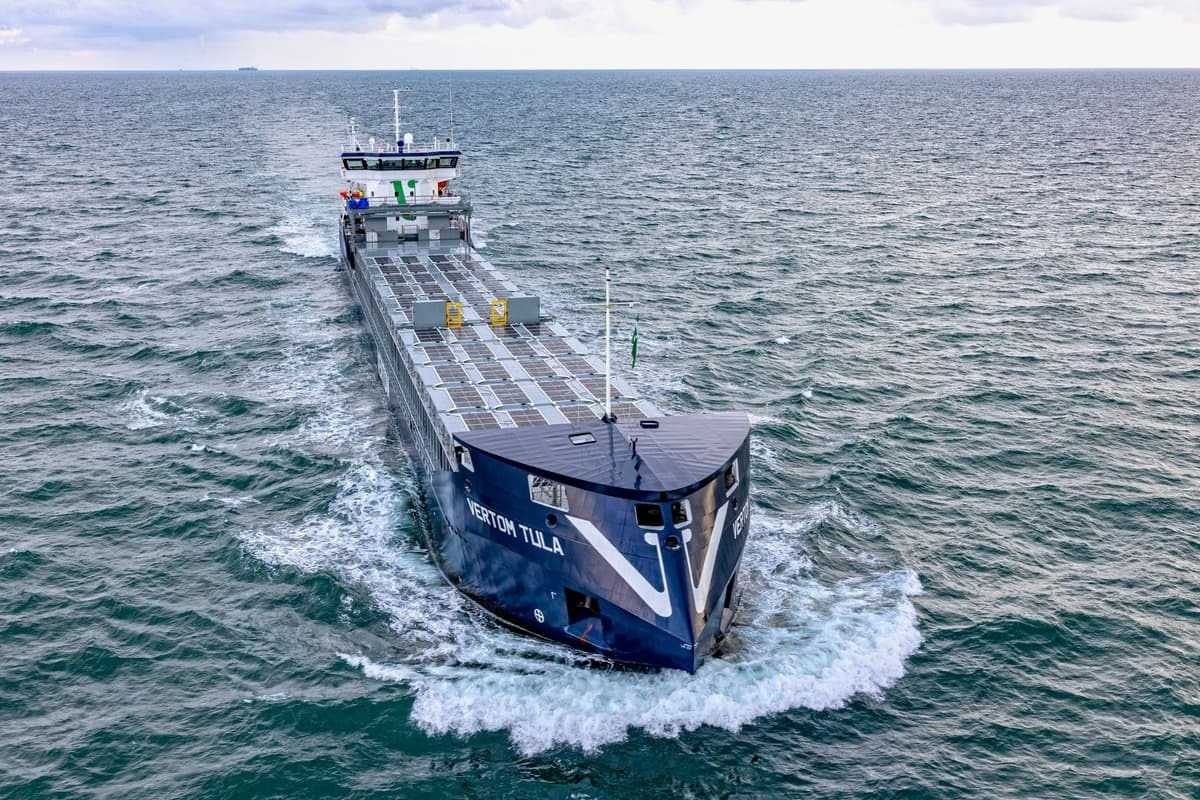
With 44 Solar Panels and a Power of 79 kWp, the Cargo Ship MV Vertom Tula from the Netherlands Became the First Ship in the World to Operate with a Large-Scale Solar System, Reducing Emissions and Fuel Consumption
A maritime solar energy company in the Netherlands achieved an unprecedented feat by installing the first large-scale solar energy system on a cargo ship.
The initiative represents an important advance towards sustainable maritime transport and the reduction of emissions in the naval sector.
The project was developed by Wattlab, a clean energy company based in Rotterdam. The system was installed on the diesel-electric ship MV Vertom Tula, which has a gross tonnage of 7,280 tons and belongs to the maritime services operator Vertom Group.
-
Motorola launched the Signature with a gold seal from DxOMark, tying with the iPhone 17 Pro in camera performance, Snapdragon 8 Gen 5 that surpassed 3 million in benchmarks, and a zoom that impresses even at night.

-
Satellites reveal beneath the Sahara a giant river buried for thousands of kilometers: study shows that the largest hot desert on the planet was once traversed by a river system comparable to the largest on Earth.

-
Scientists have captured something never seen in space: newly born stars are creating gigantic rings of light a thousand times larger than the distance between the Earth and the Sun, and this changes everything we knew about stellar birth.

-
Geologists find traces of a continent that disappeared 155 million years ago after separating from Australia and reveal that it did not sink, but broke into fragments scattered across Southeast Asia.

With 44 flat solar panels and a capacity of 79 kilowatts peak (kWp), the new solution can supply approximately 20% of the ship’s energy demand, including lighting, navigation, and air conditioning systems. “We thank Vertom for the trust and the smooth collaboration over the past three years,” said Bo Salet, CEO and co-founder of Wattlab.
Solar Energy Reaches the Seas
The installation took place in September at the Port of Harlingen and was completed in just one day, thanks to the modular design of the equipment. This made the MV Vertom Tula the first deep-sea ship in the world to have a complete solar installation.
“For ship owners, time is money, so speed and ease of use are important,” Salet explained. He highlighted that space also represents a cost: “If it’s necessary to remove the panels to make room for special cargo, the crew can stack them and store them in the space of a 20-foot container.”
The solar panels were manufactured and assembled at Wattlab’s new facilities. Their modular structure allows for quick installation and removal, with standard connections used in maritime containers.
Before the final implementation, Wattlab and Vertom conducted two pilot projects over three years under adverse coastal conditions. “During the pilot tests, the results showed that the Solar Flatrack system performs well in the challenging environment of coastal maritime transport,” said Thomas van Meerkerk, business development manager at Vertom.
A Solar Boost for Vessels
The tests were validated by the Netherlands Organization for Applied Scientific Research (TNO), which confirmed the reliability of the performance and structural integrity of the panels in a marine environment.
“These factors depend on the conditions under which our ships operate, but it is clear that the system can provide a positive return on investment and contribute to the reduction of CO₂ in maritime transport,” Salet stated.
The executive also emphasized that the panels can remain on top of the hatch covers during loading and unloading operations. “The crew was skeptical at first, fearing a lot of extra work,” he revealed. “But they soon discovered that the flat solar panels are easy to use and require minimal maintenance.”
Another observed advantage was that the panels do not accumulate salt crusts, as water naturally drains off their surface, maintaining consistent performance even in a salty environment.
European Support and Climate Goals
The project received co-funding from the Just Transition Fund (FTJ) of the European Union, an initiative aligned with the continental goal of climate neutrality by 2050.
Both Wattlab and Vertom believe that this technology could drive sustainability in coastal and short-distance maritime transport, serving as an example for a new generation of vessels powered by clean and renewable energy.








-

Uma pessoa reagiu a isso.