





 English
  Francês
  Alemão
  Italiano
  Japonês
  Norueguês
  Portuguese
  Spanish
  3 min of reading
  0 comments


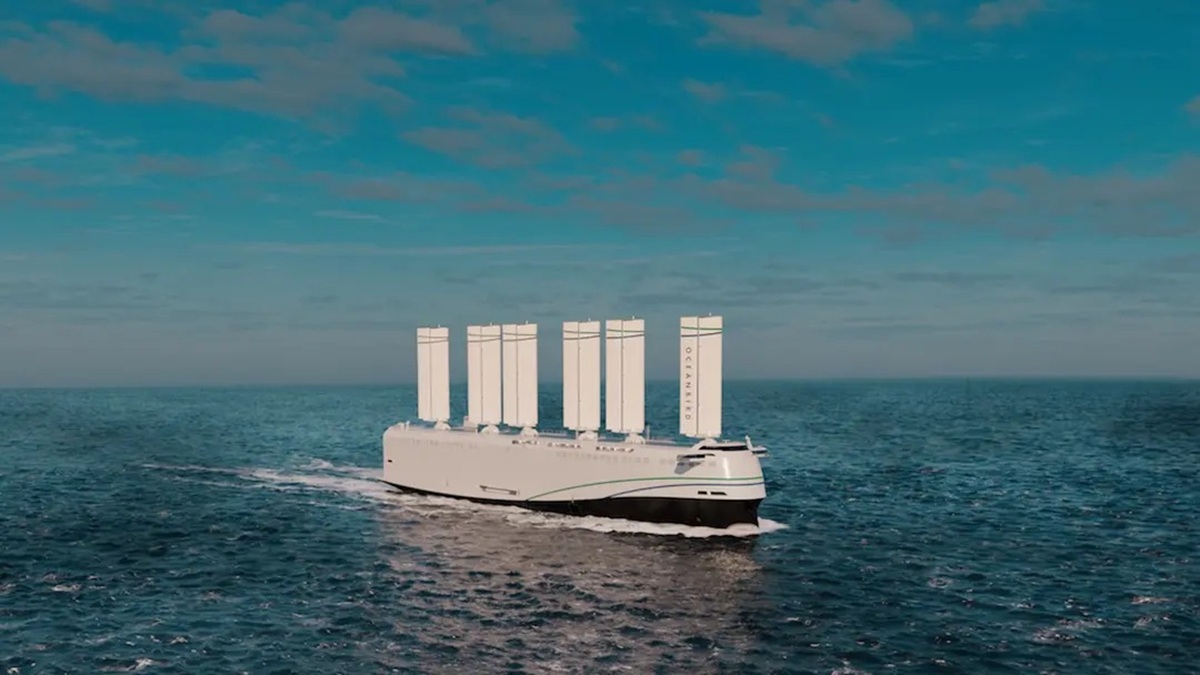
First Order of the Wing 560 Sails, 557 m² Marks Start of Commercial Production of Oceanbird, With Installation Planned for 2027 in Europe and Potential Fuel Savings of Up to 18% and Reduction of 111 Tons of CO2 on Specific Routes
The Oceanbird announced its first order for two units of the tiltable Wing 560 sail, measuring 557 m², with installation scheduled for early 2027 in Europe, promising fuel savings of up to 18% on specific routes.
Oceanbird Secures First Order of the Tiltable Wing 560 Sail
Oceanbird, a joint venture between Alfa Laval and Wallenius Lines, announced on February 13 that it has received the first order for its tiltable Wing 560 sail technology.
The order was placed by an unidentified shipowner, who ordered two Oceanbird Wing 560 rigid sails. The customer’s name will be announced later, according to the company.
-
Ocean Giant Could Change Everything: Nuclear Container Ship Project Promises to Transport 16,000 Containers Without Using Fossil Fuels

-
Hormuz Strait: Hundreds of Ships and Oil Tankers Stranded After Attacks in the Middle East

-
World’s Largest Electric Ship, China Zorrilla, Will Connect Argentina and Uruguay Across the Río de la Plata with a $200 Million Investment and Operations Planned for 2026
-
How A 20-Ton Anchor Holds 200,000-Ton Ships Even Under Extreme Winds And Why It Fails In The Deep Ocean
The installation of the two units is planned for early 2027 in Europe. With this, the company claims to have filled its first two production slots and officially started its commercial journey.
Technology Adaptable to Ships Over 200 Meters
The Wing 560 sails are tiltable and designed for PCTC car carriers, bulk carriers, and tankers over 200 meters long.
According to Oceanbird, the technology can be adapted to existing vessels. The proposal is to allow emission reduction and fuel savings through wind propulsion.
The company states that a single tiltable sail installed on an existing cargo ship can provide fuel savings of up to 10%.
On routes such as the North Atlantic, with sailing favorably against the wind, a ship equipped with two sails can save up to 18% in fuel.
Emission Reductions and Production Goals
According to information released by the company, the same vessel that saves up to 18% in fuel can reduce its CO2 emissions by up to 111 tons.
The CEO of Oceanbird, Amrit Kaur Bhullar, stated that the order represents a milestone for the company and that wind propulsion is a viable and scalable solution for maritime transport.
She also stated that the order is a concrete step towards cleaner and smarter shipping, resulting from the combination of Alfa Laval’s engineering expertise with Wallenius Lines’ operations.
Origin of the Joint Venture and Previous Tests
Alfa Laval and Wallenius Lines founded Oceanbird in 2021 with the aim of developing wind propulsion technologies for the maritime industry.
In 2020, Wallenius Lines announced the successful completion of a maritime test on a smaller vessel using its wind propulsion technology.
According to the company’s website, savings calculations vary depending on the vessel and route. Still, the tiltable Wing 560 sail is presented as a solution adaptable to different types of cargo ships.
Oceanbird stated that it intends to scale up production and serve vessels worldwide, consolidating its presence in the wind propulsion sector. The planned installation for 2027 marks the beginning of this commercial expansion.









-

-

-

3 pessoas reagiram a isso.