





 Portuguese
  English
  Spanish
  4 min of reading
  0 comments


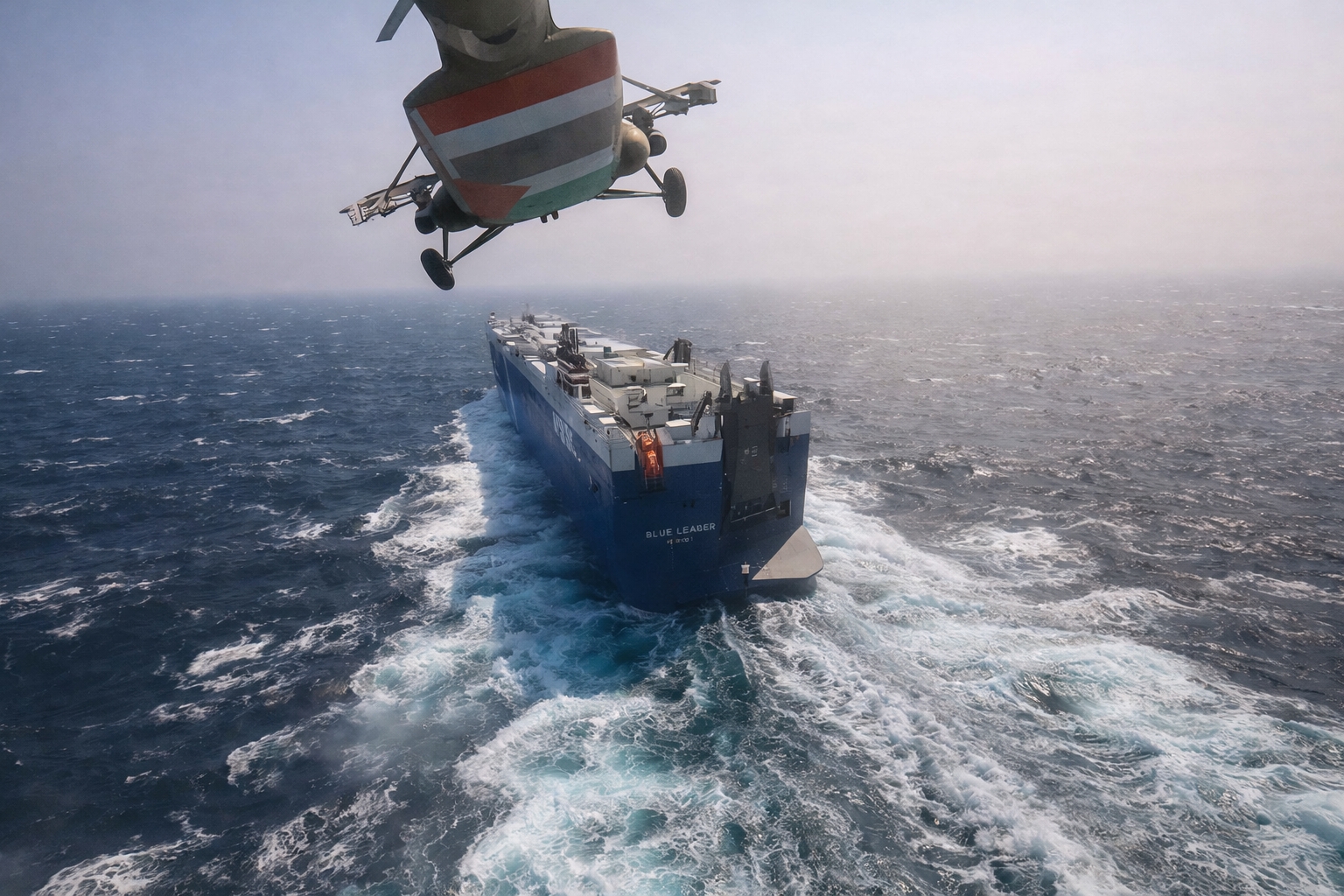
18 Months of Testing and an Bold Idea from the USA to Save the Red Sea and Black Sea from the Risk Zone: Pulling Guard, New Towed Platform with Elevated Drone to Hunt Threats, Reduce Delays, Logistic Costs and Get Ships Back on the Shortest Path to Save Millions of Dollars
The maritime traffic in the Black Sea changed noticeably in 2026. Instead of following direct routes between origin and destination, ships began to circle the southern coast, mainly near Turkey.
The reason is clear. Even without a conventional navy, Ukraine managed to disrupt Russian vessels using aerial and maritime drones. The impact was immediate.
Ships from different countries started to keep their distance from the risk zone to avoid being hit by unmanned weapons. The result was increased costs, logistical delays, and pressure on marine insurance.
-
Motorola launched the Signature with a gold seal from DxOMark, tying with the iPhone 17 Pro in camera performance, Snapdragon 8 Gen 5 that surpassed 3 million in benchmarks, and a zoom that impresses even at night.

-
Satellites reveal beneath the Sahara a giant river buried for thousands of kilometers: study shows that the largest hot desert on the planet was once traversed by a river system comparable to the largest on Earth.

-
Scientists have captured something never seen in space: newly born stars are creating gigantic rings of light a thousand times larger than the distance between the Earth and the Sun, and this changes everything we knew about stellar birth.

-
Geologists find traces of a continent that disappeared 155 million years ago after separating from Australia and reveal that it did not sink, but broke into fragments scattered across Southeast Asia.

Use of Drones in Conflicts Changes Routes and Elevates Global Costs
What happens in the Black Sea is not an isolated case. Similar incidents have been recorded in the Red Sea, the Strait of Hormuz, and even in the Baltic Sea.
The growing use of drones in conflict regions has created a new scenario for international maritime transport.
Navies around the world are not prepared to offer constant protection against terrorism, piracy, and regional wars at the same time. This has exposed significant weaknesses in global supply chains.
The detail that caught the most attention was the change in route behavior. The diversion became a survival strategy.
Militarizing Commercial Ships Faces Legal and Operational Barriers
A direct solution would be to equip merchant ships with armaments and advanced detection systems.
In practice, this runs into legal and political obstacles. There are international restrictions and diplomatic concerns involved in militarizing civilian vessels.
Furthermore, adapting ships already in operation requires time, significant investment, and interruptions that impact contracts and schedules.
It was in this context that a different alternative emerged.
Pulling Guard Invests in Towed Platform with Elevated Drone and High-Performance Sensors
The United States Defense Advanced Research Projects Agency, known as DARPA, in partnership with Raytheon, is developing the Pulling Guard project.
The proposal is simple in idea but complex in execution. Instead of arming the ship, a semi-autonomous platform is created that is towed behind the main vessel.
This structure acts as an extra layer of defense.
The system combines three central components: a towed platform, a tethered drone, high-performance electro-optical and infrared sensors.
The drone serves as an elevated observation point. This expands the field of vision and improves the ability to identify threats in advance.
The information gathered is processed by software designed to identify risks and withstand cyber interference. A single remote operator can supervise multiple units at the same time and authorize any defensive action.
Electronic Warfare, Directed Energy, and Missiles Are Among Possible Responses
The specific countermeasures have not been officially detailed. However, the system can integrate resources such as electronic warfare, directed energy weapons, missiles, or other means of neutralization.
The development is divided into two phases.
The first phase will last approximately 18 months and involves building the platform, integrating sensors, and conducting engagement simulations to refine the software.
In the second phase, the system will undergo real tests with operational launchers and complete interception demonstrations.
What seemed like just an experimental response could become a new standard of protection in critical regions.
Maritime Security Could Gain a New Layer of Protection in Areas Like the Red Sea
According to Colin Whelan, President of Advanced Technology at Raytheon, the goal is to enhance security in strategic regions such as the Red Sea.
The proposal aims to deliver a scalable solution with more controlled costs, reducing risks both for cargo and naval assets.
If the tests confirm the effectiveness of the system, the towed platform could reduce the need for significant route deviations, minimize delays, and alleviate some pressure on international marine insurance.
The advancement of drones has already shifted the balance in conflict zones. Now, a towed structure could represent the next step in protecting global trade.
Do you believe that platforms like this can really change the game in the world’s most tense maritime routes? Share your opinion in the comments.








-

-

-

-

-

21 pessoas reagiram a isso.