





 Portuguese
  English
  Spanish
  4 min of reading
  0 comments


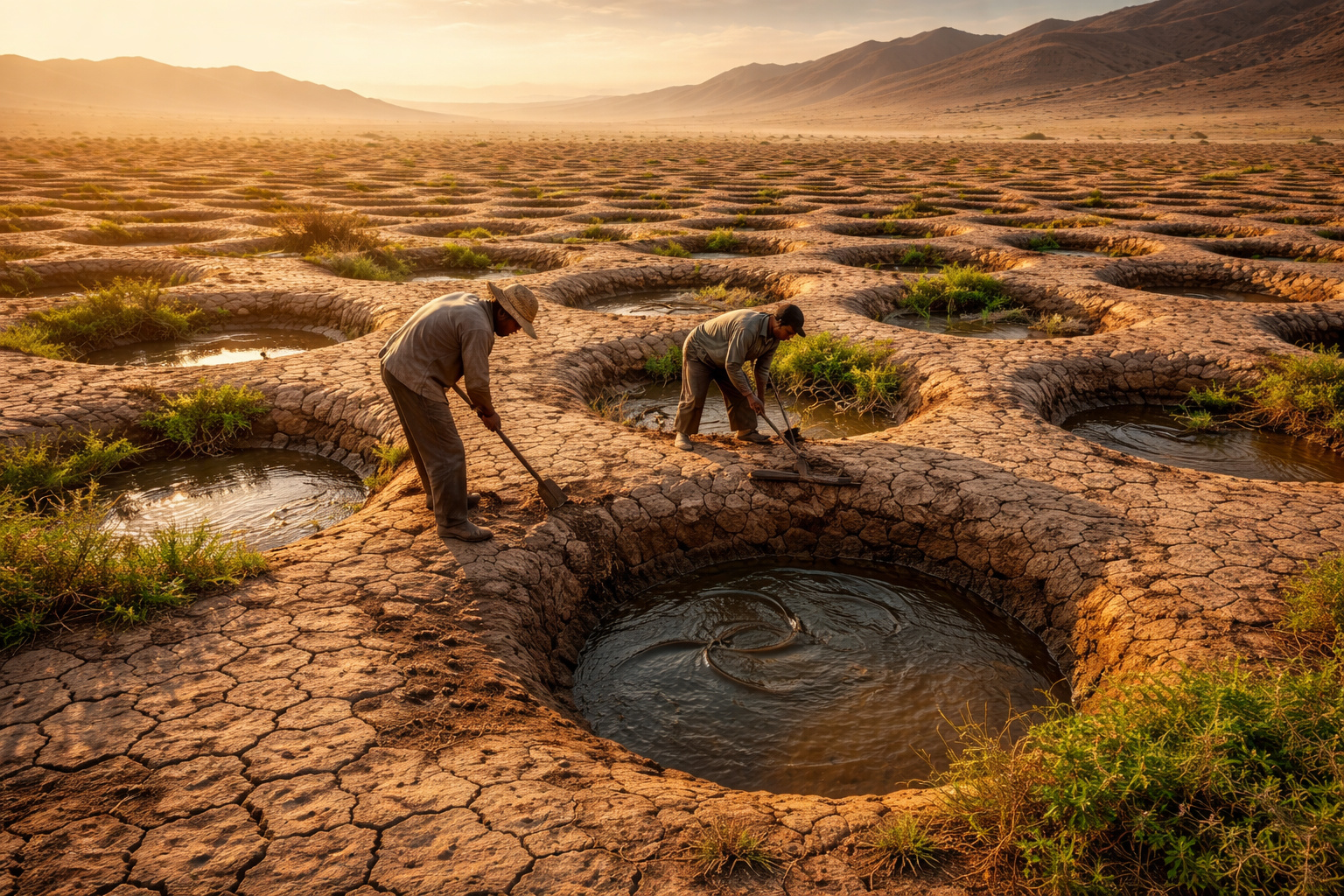
Amid Temperatures Above 40ºC, Annual Loss Of Up To 120 Thousand Hectares And Threat Of 90% Of Degraded Soils By 2050, Community Low-Cost Method Transforms Landscape And Challenges Billion-Dollar Models Against Desertification
If someone said it would be possible to make the desert “produce water” without deep wells, electric pumps, and million-dollar irrigation systems, the statement would sound absurd. However, that’s exactly what happened in Niger, a country in West Africa where about 80% of the territory is within or on the edge of the Sahara Desert. Instead of trying to bring water to the desert, farmers decided to keep the water exactly where it falls.
For decades, governments, scientists, and large international organizations invested billions of dollars in the fight against desertification. Heavy machinery, drilling 50 to more than 100 meters deep, diesel pumps, and sprinkler and drip irrigation seemed to represent the inevitable path of progress. However, reality showed a very different scenario.
Living Soil: Why 59% Of Earth’s Species Are Beneath Our Feet

When we talk about the environment, we usually think of forests and oceans. However, the true epicenter of life is beneath our feet. In 2006, scientists estimated that 25% of life on the planet was related to soil. However, more recent research, released in 2023, revealed an even more impressive figure: approximately 59% of all living species on Earth exist in the soil.
-
Friends have been building a small “town” for 30 years to grow old together, with compact houses, a common area, nature surrounding it, and a collective life project designed for friendship, coexistence, and simplicity.

-
This small town in Germany created its own currency 24 years ago, today it circulates millions per year, is accepted in over 300 stores, and the German government allowed all of this to happen under one condition.

-
Curitiba is shrinking and is expected to lose 97,000 residents by 2050, while inland cities in Paraná such as Sarandi, Araucária, and Toledo are experiencing accelerated growth that is changing the entire state’s map.

-
Tourists were poisoned on Everest in a million-dollar fraud scheme involving helicopters that diverted over $19 million and shocked international authorities.


Meanwhile, giant animals like blue whales, African elephants, and giraffes represent only about 3% of global biodiversity. In contrast, a simple teaspoon of soil can contain billions of bacteria, extensive networks of fungi, and microscopic organisms that work 24 hours a day.
Moreover, about 95% of the world’s food—from rice to bread—depends directly on soil. Without healthy soil, there is no agriculture. Without agriculture, there is no social stability. The problem is that approximately 30% of the planet’s soils are already degraded. And, according to international warnings, if the trend continues, by 2050 around 90% of the land may enter a process of degradation.
In Niger, this threat is even more urgent. The country has about 23 million inhabitants, and approximately 17 million live directly from agriculture. In other words, almost 7 out of 10 people depend on the soil to survive. However, the country loses between 100,000 and 120,000 hectares of agricultural land each year due to desertification.
Half-Moons In The Sahara: A 300 To 400-Year Technique That Challenges Million-Dollar Projects

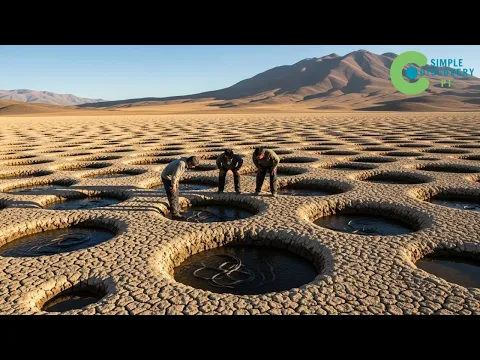
It was in this context that an ancestral technique known as “half-moons” re-emerged—semicircular cavities manually dug, also called Zai Pits in Burkina Faso or Demi Lunes in Niger. The method has existed for at least 300 to 400 years in West Africa.
Each pit is opened by hand, positioned with the opening facing the slope of the terrain. Thus, when it rains, the water does not rush away: it is retained and slowly seeps into the soil. Studies indicate that these structures can retain between 25% and 50% of rainwater, while exposed soil conserves only 5% to 10%.
However, the work is extremely demanding. Preparing 1 hectare can take 2 to 4 months of continuous work for a single family. Additionally, the technique does not work if the annual precipitation falls below 300 mm. It is also not recommended for slopes greater than 15% to 20%.
Even with these limitations, the results have been surprising. In just 4 years, areas considered unproductive changed from a gray sandy tone to visibly green fields. Small patches of vegetation first emerged. Then, with each rainy season, the soil began to regenerate.

FMNR: The Regeneration That Brought Back More Than 200 Million Trees
Alongside the half-moons, another decisive strategy emerged: FMNR (Farmer Managed Natural Regeneration). After independence in 1960, Niger tried to plant millions of seedlings to curb the advance of the desert. However, most died after a few dry seasons.
It was then that, in 1981, Tony Rinaudo realized something crucial: beneath the arid soil, there were still living roots of trees cut during the colonial period. Instead of planting new seedlings, farmers began to protect and prune already existing shoots.
The result was impressive. Since the 1980s and 1990s, in about 16 years, more than 200 million trees have naturally regenerated across millions of hectares of farmland. These trees reduced wind speeds, decreased evaporation, improved the local microclimate, and strengthened drought-resistant agriculture.
Furthermore, the cost is virtually zero. Unlike projects that cost hundreds of thousands of dollars per village, half-moons and FMNR require basically human labor and community organization.
Similar experiences have occurred in other regions of the world. In Rajasthan, India, traditional Johad systems helped raise the groundwater level by 4 to 6 meters. In China, retention techniques increased crop survival by 20% to 40%. In Mexico, corn and bean yields grew by 10% to 30% during dry years.
The information was released by international agricultural studies, as well as FAO field reports and environmental analyses on soil restoration in the Sahel, which point to Niger as one of the most emblematic cases of community ecological regeneration.
In contrast to projects that caused salinization of the soil and a drop in the water table between 1 and 3 meters in various irrigated areas, half-moons work with nature, not against it.
In the end, the question that remains is inevitable: if a technique nearly 400 years old managed to transform the Sahara in just 4 years in certain regions, why do we insist exclusively on expensive solutions that depend on external funding?









Seja o primeiro a reagir!