





 Português
  Inglês
  Espanhol
  3 min de leitura
  0 comentários


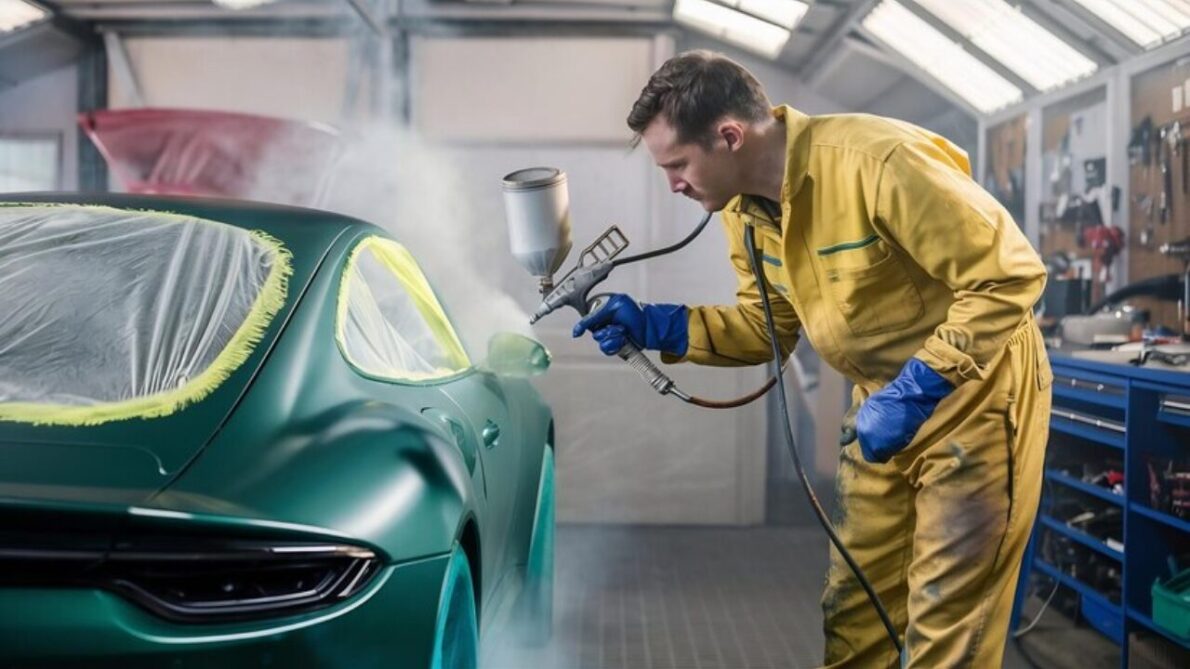
Nissan Develops New Paint That Promises To Reduce Fuel Consumption And Increase Electric Vehicles’ Range.
The Nissan, known for its innovations in the automotive sector, is testing a new automotive paint that promises to transform the way cars deal with high temperatures. In collaboration with Radi-Cool, a specialist in radiative cooling products, Nissan has developed a “cool paint” that can significantly reduce the internal temperature of vehicles exposed to sunlight. The paint was applied to a vehicle used by airport services to observe how it performs in real-world situations.
Performance And Benefits Of The New Paint
The preliminary results of the tests have been promising. Vehicles coated with Nissan’s cool paint showed a reduction of up to 12ºC in the external surface temperatures and a reduction of up to 5ºC in internal temperature compared to vehicles painted with traditional automotive paints.
This difference is particularly noticeable when vehicles remain parked in the sun for long periods.
-
OMODA & JAECOO grows in Europe in 2026 with an integrated strategy of sales, innovation, local production, and technological advancement in the United Kingdom, Italy, and Spain.

-
OMODA & JAECOO expands after-sales service in Brazil with competitive maintenance, a 7-year warranty, and high availability of parts for technological SUVs.

-
OMODA & JAECOO appoints Alessandra Souza as executive marketing director in Brazil and accelerates brand expansion with a focus on innovation, networking, and hybrid portfolio.

-
Jaecoo 7 with super hybrid SHS system exceeds 1,200 km of combined range with a 1.5 turbo engine, high-density battery, and intelligent energy management.


One of the main advantages of this innovation is the improvement in passenger comfort. A car with the new cool paint becomes more pleasant to enter after a period of sun exposure.
Additionally, the reduction in internal temperature means that the air conditioning system needs to work less to achieve a comfortable temperature.
This can lead to a reduction in energy consumption, benefiting both internal combustion engine vehicles and electric vehicles.
For electric cars, reduced use of air conditioning can extend battery range and improve overall vehicle efficiency.
How Nissan’s Cool Paint Works?
Nissan’s cool paint incorporates metamaterials, a technological advancement that enhances its cooling capacity.
The metamaterial used contains two microstructure particles that react to sunlight.
The first particle reflects near-infrared rays, which would normally cause heating in the vehicle.
The second particle creates electromagnetic waves that neutralize sunlight and redirect energy to the atmosphere.
These particles work together to reduce heat transfer to the surfaces of the vehicle, such as the roof, hood, doors, and panels.
The result is a paint that not only improves internal comfort but also contributes to the vehicle’s energy efficiency.
The Behind The Scenes Of Creation
The development of cool paint is not a new idea, but its application in vehicles represents a significant advancement.
Traditionally, radiant cooling paints are used in buildings and structures, and are often applied with rollers and without a clear finish, which can lead to unwanted residues.
To adapt the technology to the automotive sector, Susumu Miura, senior manager and specialist at Nissan’s Advanced Materials and Processing Laboratory, led a team that tested over 100 samples.
The team is currently evaluating a thickness of 120 microns, about six times thicker than conventional automotive paint.
They confirmed that the paint is resistant to salt, chipping, peeling, and scratching, while maintaining color consistency and repairability.
Miura and his team are working to develop thinner options that offer the same level of cooling performance.
They hope that in the future, the cool paint may be available in a variety of colors and for special orders, especially for light commercial vehicles that spend much of their time exposed to the sun.










Seja o primeiro a reagir!