





 Portuguese
  English
  Spanish
  5 min of reading
  0 comments


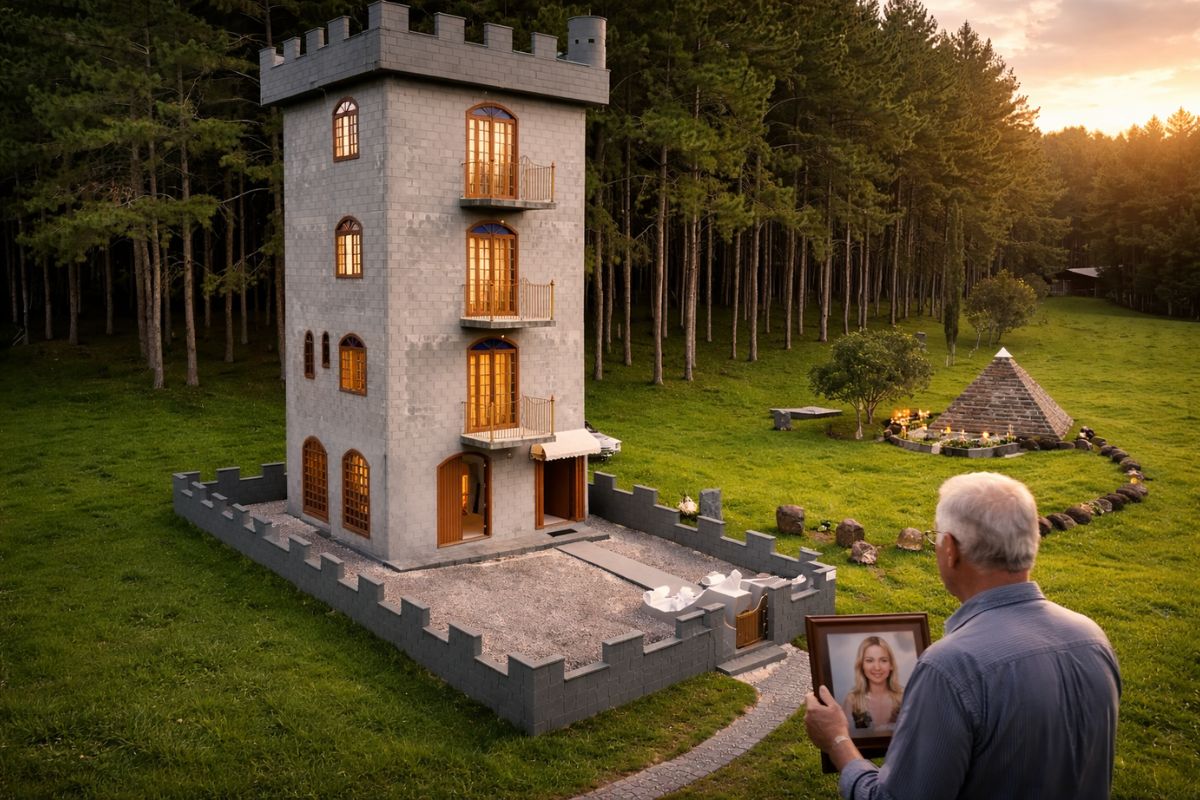
In The Agricultural Interior Of Taió, Santa Catarina, The Five-Story Castle Built By A 82-Year-Old Father Became A Weekend House, Memorial And Archive Of Antiques, Marked By 32 Cypress Trees, 64 Steps And A Room Dedicated To Daís Bianca, Where Numbers Try To Organize Grief
The five-story castle is located in the interior of Taió, Santa Catarina, and was built by Amélio, now 82 years old, after the death of Daís Bianca, his eldest daughter, at 32, in an accident during a trip. He turned absence into concrete, with a logic of symbols that repeats throughout the property.
The place contrasts with the agricultural landscape of Alto Vale do Itajaí: tower, suites, living rooms, kitchen, and a terrace above, all made of concrete blocks. It is not a public monument, but an intimate space, used by family and friends, mainly on weekends, as a refuge that mixes memory, routine, and silence.
A Five-Story Castle That Cuts Through The Rural Landscape

The castle-shaped tower appears in the middle of a reforestation and breeding area, and the first impression is one of displacement: something that shouldn’t be there, but is.
-
Friends have been building a small “town” for 30 years to grow old together, with compact houses, a common area, nature surrounding it, and a collective life project designed for friendship, coexistence, and simplicity.

-
This small town in Germany created its own currency 24 years ago, today it circulates millions per year, is accepted in over 300 stores, and the German government allowed all of this to happen under one condition.

-
Curitiba is shrinking and is expected to lose 97,000 residents by 2050, while inland cities in Paraná such as Sarandi, Araucária, and Toledo are experiencing accelerated growth that is changing the entire state’s map.

-
Tourists were poisoned on Everest in a million-dollar fraud scheme involving helicopters that diverted over $19 million and shocked international authorities.


In Taió, Santa Catarina, the construction has become a topic of discussion precisely because of this contrast between the rural setting and the idea of a five-story castle erected by a 82-year-old father’s own decisions.
Amélio presents himself as a retired businessman and farmer, the son of farmers, raised in a large family with ten siblings in the countryside.
He says he balanced the activities on the farm with selling auto parts until he was able to sustain a quiet life with his wife Ivoni, with whom he has been together for almost 60 years.
When he talks about Daís Bianca, he does not seek spectacle, he seeks permanence.
The Numbers That Organize The Tribute To Daís Bianca

The five-story castle was not designed to be just tall, but to carry an emotional mathematics. The central reference is Daís Bianca’s age: 32.
From that, Amélio scattered a sequence of marks through the entrance and the structure, as if the path to the door also needed to tell the same story.
He describes 32 cypress trees planted, 32 stones on the path, a house that is 16 meters high, half of 32, and 64 steps, double 32.
The built area is around 200 m², and the photos from 2004 show the work in its initial phase when the tower was just beginning to take shape.
The repetition of numbers is not a decorative detail; it is the method he found to give meaning to what doesn’t close.
How The Five-Story Castle Becomes A Home, Not Just A Memory

Despite the visual impact, the five-story castle functions as a livable space.
The structure includes suites, living rooms, and a kitchen, used by family and friends, especially on weekends, with a type of gathering that doesn’t require a script, just presence.
In Taió, Santa Catarina, the building ends up being both a home and a memorial, without a clear separation between living and remembering.
Right at the entrance, a room is dedicated to Daís Bianca, described by Amélio as a place for meditation, thought, and intimate conversation with his daughter’s memory.
He speaks of “communicating” with her in thought, as if visiting a room that should not have been left empty.
At this point, the five-story castle ceases to be an architectural curiosity and becomes a kind of emotional routine.
Antiques, Symbols And Historical Curiosity Inside The Tower
The interior of the five-story castle holds family and travel objects, such as old pots used in the house where he grew up, his father’s pocket knife and razor, coins, and items linked to relatives and acquaintances.
He also keeps a “gaitinha” that belonged to an aunt who played at night, a memory that, according to him, crossed his childhood and was the only thing he asked when the family was dividing the assets.
Amélio’s narrative mixes domestic memory with a fascination for history.
He mentions the last Inca emperor Atahualpa and attributes his death to Francisco Pizarro, and keeps a sword as a symbol of defense, recalling the custom of old houses that would leave the blade by the door.
There are also references to Egypt, including the idea of a minaret, where the “muezzin” would sound alerts with a horn, and a miniature pyramid, which he compares, in scale, to the great constructions of the past.
Not everything there intends to be a museum, but everything intends to be a sign.
A Site Called Santa Matilde And A Castle That Is Still Private
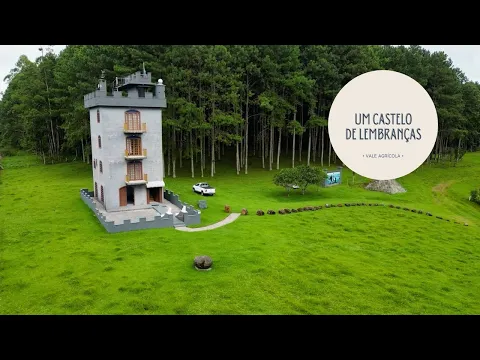

The site is named Santa Matilde, a tribute to Amélio’s mother, and also holds a memory of his father, whom he describes as a pioneer, and who today, according to his account, would be 116 years old.
Around the five-story castle, he points out the geography of Alto Vale do Itajaí, talks about the watershed, and describes the path that the rain would take to larger rivers, as if seeing the terrain as a map, not just a landscape.
Despite so many curiosities, the site is not open for visitation, at least for now.
Amélio says he prefers to keep the space reserved, to read, talk, and receive friends, especially those of the same age group, in gatherings where memory becomes the topic and time becomes company.
In Taió, Santa Catarina, privacy seems like part of the pact: the five-story castle exists to remember Daís Bianca, not to prove anything to anyone.
The five-story castle in Taió, Santa Catarina, does not draw attention only for its size or five levels, but for the logic that sustains it: 32 cypress trees, 32 stones, 16 meters, 64 steps, and a room where a 82-year-old father insists on keeping Daís Bianca close, at least in the form of symbols.
It is a type of work that does not resolve grief but changes the way to go through it.
If you could eternalize someone without turning it into an exhibition, what would be your path— a place like this, a kept object, a tree planted, a family tradition? And, looking at this five-story castle, what seems stronger to you: the architecture, the numbers, or the idea that memory can also be built with your own hands?










-

-

2 pessoas reagiram a isso.