





 Portuguese
  English
  Spanish
  3 min of reading
  0 comments


An Innovative Filter for Detecting Microplastics, Developed by Researchers at the National Center for Energy and Materials Research (CNPEm), Took Brazil to the Top of the iGEM Competition, Promoted by the Massachusetts Institute of Technology (MIT). The Team Won in the Bioremediation Category, Standing Out Among Projects from All Over the World with the Creation of an Ecological Filter Capable of Detecting and Removing Micro and Nanoplastics from Domestic Filtration Systems.
The solution, dubbed B.A.R.B.I.E. 4.0, combines cutting-edge biotechnology to combat one of the emerging problems in the environmental field: contamination by microplastics. The device, winner of the MIT award, uses a biological matrix based on an innovative protein called BARBIE1, which links plastic-binding proteins to a biosensor to identify these tiny particles in water. The success of the microplastic detection filter reinforces the importance of advances in research to address pollution from plastic particles that can, over time, accumulate in the human body.
How the Gold Medal-Winning Microplastic Detector Filter at MIT Works
According to Gabriela Persinoti, a researcher at CNPEm and the project leader, the developed filter is still in the testing phase, but already shows great potential. The technology consists of forming a hydrogel from the BARBIE1 protein, which can effectively bind to microplastic and nanoplastic particles. This hydrogel, when integrated into conventional filters, can retain these tiny particles that would normally escape traditional filtration methods.
Persinoti explains that the award-winning MIT device is designed to be attached to conventional household filters, operating in two stages: first, it retains larger particles and then microplastics and nanoplastics. This method, in addition to being efficient, facilitates application in filtration systems already installed in homes.
-
Man builds functional 5-meter submarine in his garage using gas cylinders, PVC pipes, and a refrigerator motor, and navigates with the vessel on a lake in Colombia.

-
Millions of people have been eating yam for centuries without knowing that this humble tuber contains a compound called diosgenin, which scientists have now discovered can improve memory and help control blood sugar levels.

-
Scientists from an international project drill 1,800 meters of ice in Antarctica using hot water and discover details about one of the most intriguing places on planet Earth.

-
Seen from space, a colossal volcano nearly 5,000 meters high in Russia has released 1,600 km of smoke over the Pacific, forming “devil’s horns” of lava and revealing the brutal force of the Ring of Fire.


Importance and Challenges of the Project
The awareness of the risks that microplastics pose to human health is relatively new, and Brazil still lacks regulation that determines the maximum allowable amount of microplastics in water.
This microplastic detection filter developed by CNPEm aims not only to provide a solution for the removal of these particles but also to raise awareness about the need to create regulations on this issue. According to Gabriela, the project is “at the frontier of knowledge,” bringing the discussion about the safety of microplastics in drinking water to the attention of regulatory bodies and the scientific community.
However, the researcher emphasizes that, although the project has received recognition from MIT, there is still a long way to go before the technology becomes commercially available. “We still need to expand testing with other types of plastic, in addition to polystyrene, which is the base of foam, to ensure greater robustness of the system,” says Gabriela.
Origin and Name of the BARBIE 4.0 Project
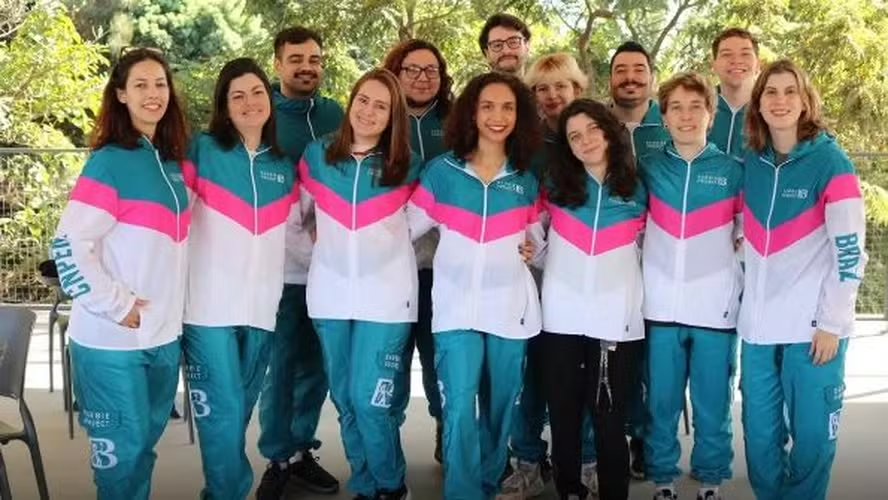
The name BARBIE 4.0 is an acronym representing the function of the microplastic detection filter: Bioengineered Aquatic Pollutants Removal and Biosensing through Integrated Eco-filter. The project was developed jointly by researchers from CNPEm, graduate students, and interns from Ilum School of Science, consolidating as a promising solution for complex environmental problems.
The success of the Brazilian team in the MIT iGEM competition highlights Brazil’s advancement in innovative sustainability technologies and reflects the commitment of researchers to creating effective solutions to protect water resources and human health.







Seja o primeiro a reagir!