





 Portuguese
  English
  Spanish
  4 min of reading
  0 comments


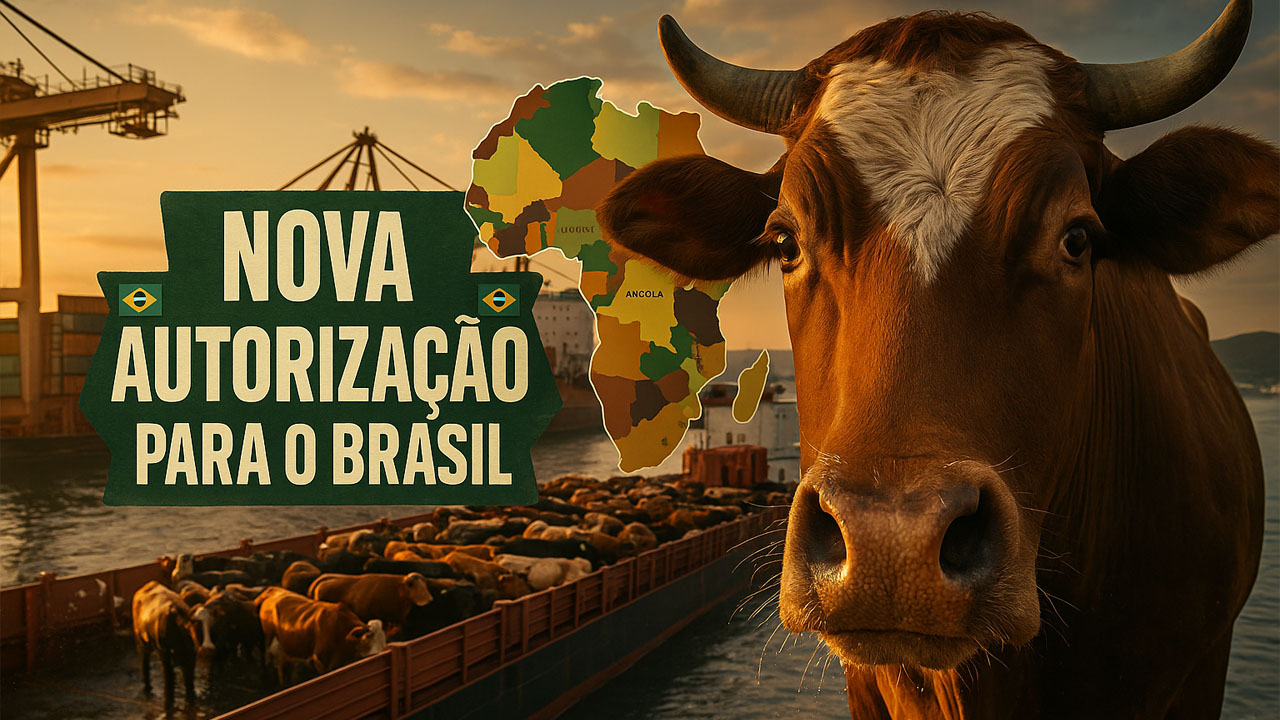
African Country Releases Import of Live Animals from Brazil; Port of Lomé, Among the 100 Largest in the World, Should Facilitate Logistics and Expand Business.
Brazil has received approval from Togo to export live cattle and buffalo. The authorization was officially announced by the Brazilian government on September 17, 2025, in a joint statement from the Ministry of Agriculture and Livestock (Mapa) and the Foreign Ministry. According to the same communication, Togo imported US$ 173 million in products from Brazilian agribusiness in 2024.
The move is part of the agribusiness market expansion strategy. Since 2023, Brazil has recorded 437 market openings in 72 destinations, according to official data. The announcement states that the Port of Lomé operates as a regional logistics hub, which could accelerate the arrival of Brazilian cargo to West Africa.
The Togolese capital has a port ranked among the 100 largest in containers. A report from Lloyd’s List ranked Lomé in 93rd place in 2024, with 1.9 million TEUs handled in 2023. This reinforces the distribution capacity to neighboring markets.
-
A new Brazilian shopping center worth R$ 400 million will be built in an area equivalent to more than 4 football fields, featuring 90 stores, 5 cinemas, a supermarket, a college, and parking for 1,700 cars, potentially generating 3,000 jobs.

-
Larger than entire cities in Brazil: BYD is building a 4.6 km² complex in Bahia with a capacity for 600,000 vehicles per year, but the discovery of 163 workers in conditions analogous to slavery has shaken the entire project.

-
With an investment of R$ 612 million, a capacity to process 1.2 million liters of milk per day, Piracanjuba inaugurates a mega cheese factory that increases national production, reduces dependence on imports, and repositions Brazil on the global dairy map.
-
Brazilian city gains industrial hub for 85 companies that is equivalent to 55 football fields.


For producers and exporters, the signal reduces uncertainties and allows them to prepare operations, respecting sanitary protocols and animal welfare requirements mandated by the importer and Brazilian legislation. The Mapa indicates that the opening strengthens bilateral relations and increases the insertion of Brazilian products in the region.
Togo’s Sanitary Authorization Opens Market for Live Cattle and Buffalo
The release from the Togolese sanitary authorities enables the shipment of live animals directly from Brazil. The announcement was highlighted in official government channels, dated September 17, 2025.
According to the Mapa, the decision creates new opportunities for the breeding, rearing, and genetics segments. Operations are dependent on sanitary certifications, property authorizations, and compliance with transportation regulations.
For shippers, the starting point is to map out documentation requirements, inspection flow, and any quarantines to avoid delays. The official nature of the opening reduces commercial risks and supports the negotiation of batches with Togolese buyers.
Port of Lomé: Logistic Hub for Exporting from Brazil to West Africa
The Port of Lomé serves as a distribution platform for countries in the Economic Community of West African States (ECOWAS). The Mapa emphasizes the port as a “hub” that should facilitate the entry of Brazilian products into the sub-region.
According to Lloyd’s List, Lomé held the 93rd position in the global ranking for 2024 and handled 1.9 million TEUs in the base year 2023, ahead of various African terminals. The scale and port efficiency favor regular maritime routes and short-distance connections.
For live cargo, this infrastructure does not eliminate sanitary controls but reduces logistical bottlenecks. The predictability of berthing and transshipment windows is a differentiator for minimizing travel time and preserving animal welfare.
Impact on Agribusiness: New Markets, Logistics, and Requirements
The new authorization adds to the recent cycle of market openings. According to official data, Brazil has achieved 437 new openings in 72 destinations since 2023, resulting from joint actions by the Mapa and the Ministry of Foreign Affairs. Togo appears on this map as a strategic point in West Africa.
Exporters should plan freights, insurance, and sanitary compliance in advance. The assessment of routes, seasonality of demand, and availability of livestock ships defines competitive costs and deadlines. Coordination among producers, trading companies, and authorities is essential to avoid hold-ups.
For Togolese buyers, Brazil offers volume, genetics, and consistent supply. The connection via Lomé may facilitate re-exportations to neighboring countries, expanding the reach of Brazilian agricultural products in the region.
Brazil–Togo Trade: Numbers, Products, and Opportunities
In 2024, Togo imported US$ 173 million from Brazilian agribusiness. Among the heaviest items are the sugar-alcohol complex, along with meat and fish. The entry of live cattle and buffalo diversifies this list.
The trend is that logistics through Lomé generates economies of scale and cost reductions per container and per animal, depending on routes and trade agreements. The hub status expands the regional reach of exports.
For 2025 and 2026, the focus turns to operational execution: alignment of certificates, shipping timelines, handling, and welfare. Regulatory predictability and port infrastructure are central variables for consolidating recurring business.
Leave your comment: does the export of live animals to West Africa strengthen Brazil’s presence, or would it be more strategic to sell processed meat with higher added value?










Seja o primeiro a reagir!