





 Portuguese
  English
  Spanish
  4 min of reading
  119 comments


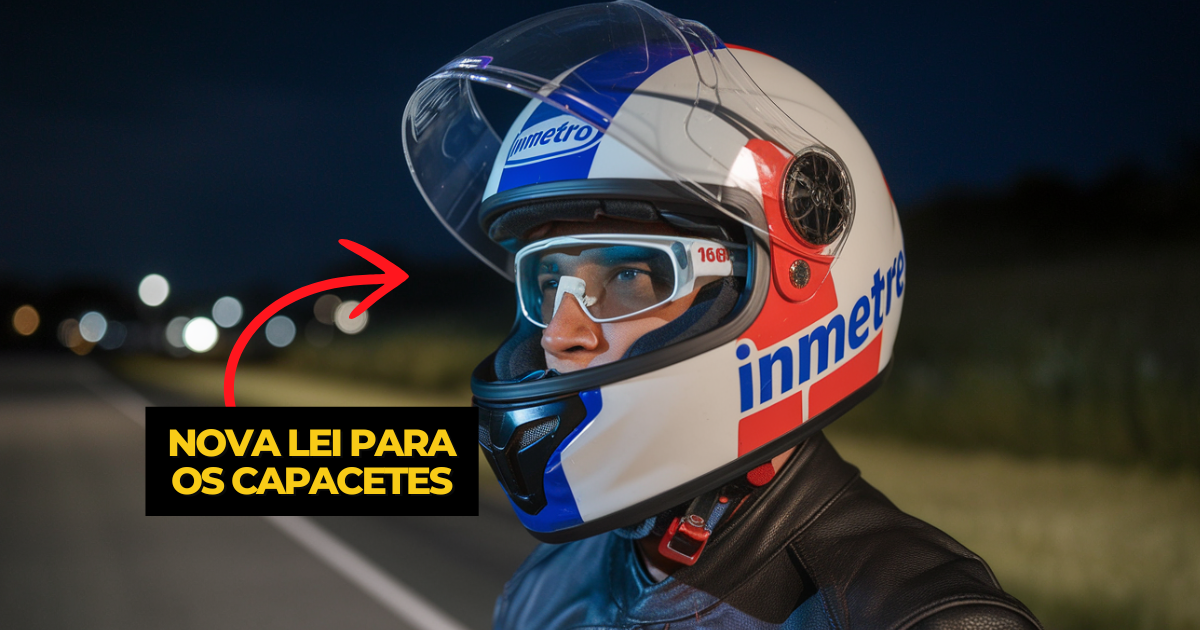


Resolution of the Contran Establishes Rigid Requirements for Helmets, Including Inmetro Certification, Retroreflective Devices, and Clear Visors at Night. Significant Fines Await Those Who Do Not Comply with the Standards.
Get ready for an impact on Brazilian traffic! A new resolution from the National Traffic Council (Contran) promises to change the relationship of motorcyclists with their protective gear, and it’s not just about safety.
The requirement for rigorous adjustments and the threat of heavy fines put many drivers on alert.
Even with the intention of protecting lives, the question that remains is: are all of them ready for these new rules?
-
Costing R$ 16,000, the new Yamaha features a 125 cc hybrid engine with electric assistance, delivers 8.3 hp, includes ABS, optimized fuel consumption, Y-Connect connectivity, 25 liters of storage space, and a surprising 4-year warranty in the urban segment.

-
Larger than entire cities in Brazil: BYD is building a 4.6 km² complex in Bahia with a capacity for 600,000 vehicles per year, but the discovery of 163 workers in conditions analogous to slavery has shaken the entire project.

-
With an investment of R$ 612 million, a capacity to process 1.2 million liters of milk per day, Piracanjuba inaugurates a mega cheese factory that increases national production, reduces dependence on imports, and repositions Brazil on the global dairy map.

-
Brazilian city gains industrial hub for 85 companies that is equivalent to 55 football fields.

Resolution 940/22, published in the Official Gazette, arrives with a clear mission: to increase safety on Brazilian roads.
Although based on already known standards, the measure details the requirements for helmets even further, now requiring Inmetro certification, retroreflective devices, and clear visors for night riding.
According to Contran, these measures are a response to the high number of accidents involving motorcyclists, who lead the statistics for fatalities in Brazilian traffic.
With the lack of enforcement and the improper use of helmets, many victims suffer injuries that could have been avoided with better quality and well-fitted equipment.
A Safe Helmet Now Requires a Seal from Inmetro
Certification by the National Institute of Metrology, Quality and Technology (Inmetro) has become mandatory for all helmets used on the road.
According to the agency, this seal is more than just a simple sticker: it ensures that the equipment has undergone rigorous testing for resistance, durability, and impact absorption.
This way, the aim is to minimize the risks of serious injuries in collisions.
Helmets must also be equipped with well-fitted retention straps and appropriate hooks to ensure they do not come loose during riding.
According to Contran, the misuse of these items continues to be a frequent problem, often resulting in situations that could be avoided with more care.
Retroreflective Devices: Visibility as a Priority
Another requirement that is already generating discussion is the obligation to have retroreflective devices on the sides and at the back of the helmet.
This measure, besides being an advancement in safety, aims to increase the visibility of motorcyclists at night or in low-light conditions, such as rain or fog.
Contran states that the intention is to make riders more noticeable to other drivers, thereby reducing the risks of collisions, especially in poorly lit areas.
Adequate Visors: An Essential Item for Safety
The resolution also establishes clear rules for the use of visors.
Now, it is mandatory for motorcyclists to keep the visors down during riding, ensuring protection against dust, wind, and debris that may hit the eyes.
According to the new standard, during nighttime, only clear visors are allowed.
The use of tinted films, quite popular among motorcyclists, is totally prohibited at night due to the risk of compromising visibility.
This prohibition, according to Contran, reinforces the necessity of a clear and unobstructed view to prevent accidents.
Alternative for Drivers Who Wear Glasses
Motorcyclists who wear prescription glasses or sunglasses need not worry. The resolution allows the use of specific protective glasses for motorcyclists as substitutes for visors.
These models are designed to provide additional protection against particles, wind, and other risks that may hinder riding.
Common sunglasses or corrective glasses do not meet the requirements of the standard, as they lack the necessary safety features for traffic.
Heavy Fines for Those Who Disregard the Rules
Failure to comply with the new requirements can be costly for motorcyclists.
In addition to the safety risk, those who ignore the rules will face strict fines that can significantly impact their budgets.
According to Contran, enforcement will be intensified, and the application of these penalties will be one of the ways to ensure that the rules are respected.
The intention behind these fines is simple: to reinforce the importance of the proper use of safety equipment and, consequently, save lives.
Impacts and Debates About the New Resolution
Although Resolution 940/22 aims primarily to reduce accidents, many motorcyclists question its effectiveness and criticize the financial impact of the changes.
One of the most debated points is the need to acquire new helmets to meet the requirements, especially among drivers who already have equipment that does not comply with the updated standards.
While some argue that the measure is essential to increase safety, others see the changes as yet another financial burden for a category that already faces economic challenges.
Worrying Statistics Driven Changes
The new rules are a response to the alarming numbers of accidents involving motorcycles in Brazil.
According to recent studies, motorcyclists account for a significant portion of fatal traffic victims, and a large part of these deaths could be avoided with the proper use of protective equipment.
For Contran, the resolution is not just a matter of individual safety, but also an important step towards reducing the social and financial costs associated with accidents.
A Necessary, but Challenging Change
Despite the criticisms, the new requirements have a clear objective: to save lives and make Brazilian traffic safer.
However, the effective application of these rules will depend on efficient enforcement and awareness campaigns that reach motorcyclists in all regions of the country.
It remains to be seen whether these changes will bring the desired impact or if they will be just another rule difficult to implement in practice.
And you, do you believe that these new requirements for helmets will save lives or just weigh on the pockets of motorcyclists?








Medidas que só traz custo para o motociclista. Se querem de fato ajudar retirem os impostos dos equipamentos, baixem o custo do combustível, nos concedam a dignidade que tanto aguardamos para a nossa categoria, isso sim seria demonstrar preocupação conosco.
Pura babaquice com motivação meramente arrecadatória. Sem falar que o capacete retira quase que totalmente a visão periférica. Sou do tempo em que era opcional e com motos tipo viúva negra, 7galo, etc. O vento no rosto sempre esteve presente inclusive nos comerciais de moto.
É mais uma maneira que acharam pra arrancar dinheiro do trabalhador, bando de urubus.