





 Portuguese
  English
  Spanish
  5 min of reading
  0 comments


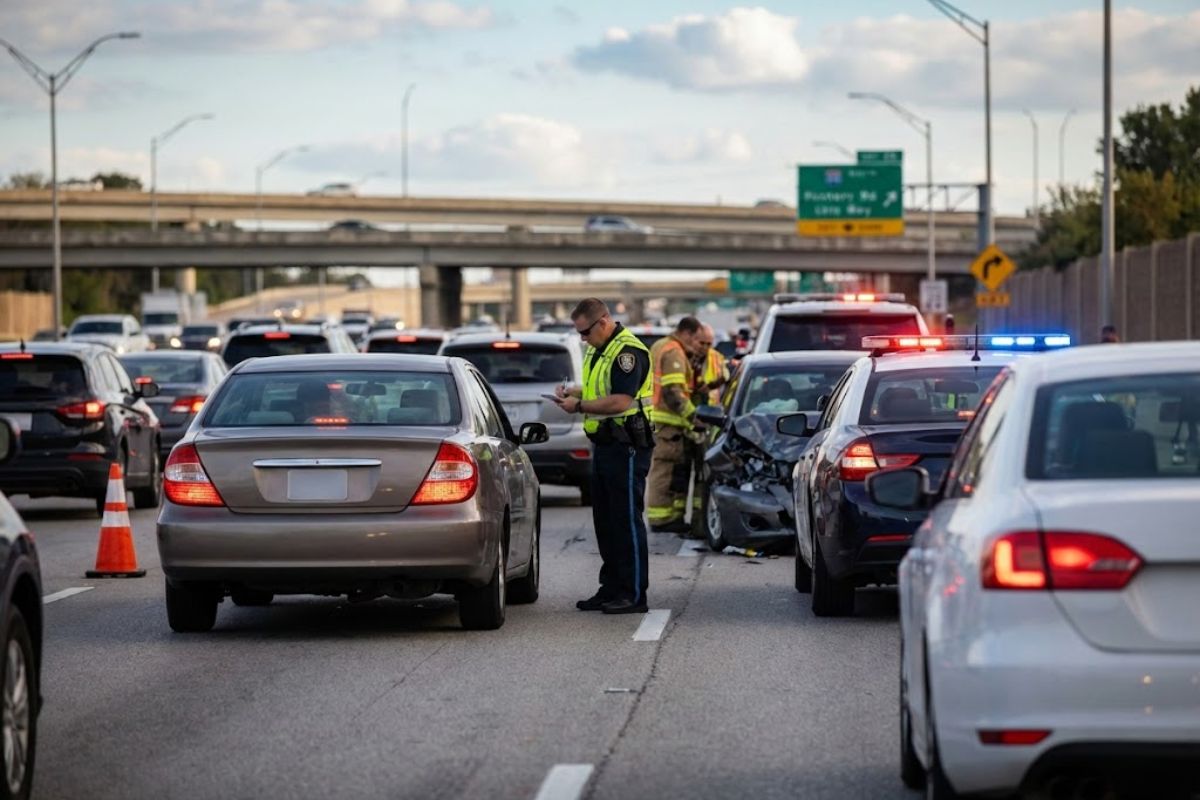
Driver Who Slows Down to Look at Accident, Film, or Take Photo May Be Target of New Rule in CTB After Advance of PL 4511/2024 That Requires Slowing Speed and Creating Safety Buffer for Responders, Police, and Workers.
The driver who slows down almost to a stop to look at accidents, film incidents, or take a quick peek on Brazilian highways may face punishment by law, with clear rules for reducing speed and the obligation to change lanes when approaching teams in service.
The proposal is in Bill 4511/2024, approved this week by the Transportation and Communications Committee of the Chamber of Deputies in Brasília, and it seeks to turn common sense into a legal obligation to protect police officers, responders, doctors, and workers who work on the roadside and are currently killed by vehicles.
The Quick Peek That Blocks the Road and Becomes Target of the Project
The described scenario is common on highways: stopped police car, lights flashing, cones on the road, maintenance or service team on the shoulder, and suddenly traffic comes to a halt.
-
The Senate approves a bill that criminalizes misogyny, hatred, or aversion towards women, and includes the crime in the Racism Law with a penalty of up to 5 years.

-
Chamber Approves Bill That Allows Pepper Spray for Women Over 16 and Imposes Strict Rules for Purchase, Possession, and Use as Self-Defense

-
Chamber Approves Law to Combat Leucaena, Fast-Growing Plant That Dominates Land and Threatens Native Species in Various Regions of the Country

-
Asset Division: Know What Cannot Be Divided in Case of Divorce


It’s not always because the lane is blocked.
Often, the congestion originates from a line of people who slow down too much just to look, film, or photograph the incident.
The proposal targets this behavior, seen as morbid curiosity and a lack of respect for those passing very close, “squeezing by” responders, law enforcement officers, and workers.
The goal is to reduce the risk created by drivers who turn a critical stretch into a stage for distraction and dangerous maneuvers.
What the Driver Would Have to Do Upon Seeing Flashing Lights, Cones, or Teams
The text approved by the committee is a substitute proposed by Deputy Diego Andrade (PSD-MG) and establishes objective duties.
Upon seeing flashing lights, cones, or maintenance teams, the driver must comply with two main requirements.
The first is mandatory speed reduction: to slow to 60 km/h or respect the speed limit of the road if it is lower.
The rule seeks to prevent high-speed passes alongside people in service or work, reducing the chance of accidents and side impacts.
The second is lane changing: if there is more than one lane, the driver must move to the adjacent lane that is farthest away, creating a safety buffer.
The intention is to increase the space between traffic and those vulnerable on the shoulder, minimizing the risk that a minimal detour could lead to tragedy.
What Happens to Penalties and What Changes in the Driver’s License
The project proposes different penalties depending on conduct. For the driver who does not adequately reduce speed, the infraction would be severe, with 5 points on the driver’s license and a fine of R$ 195.23.
For those passing “squeezing by” the incident, failing to change lanes or not maintaining safe lateral and frontal distances, the infraction would be medium, with 4 points on the driver’s license and a fine of R$ 130.16.
In practice, the project separates two types of risk: the risk of inadequate speed and the risk of dangerous proximity, addressing each with a specific penalty.
The Path of the Project Until It Becomes Law and the Adaptation Period
After approval in the Transportation and Communications Committee, the text still needs to pass through the Constitution and Justice Committee of the Chamber.
It will then go to the Senate and, finally, depend on presidential sanction.
If everything advances, the project proposes a period of 180 days, equivalent to 6 months, of educational campaigns before the law comes into effect.
This interval serves as a transition phase to inform the driver about new obligations and reduce claims of ignorance.
The American Inspiration and What the Proposal Tries to Copy
The declared basis of the proposal is the Move Over Law, which is already in effect in the United States.
The logic is similar: when there are teams in service or working on the road, the driver needs to slow down and move over to another lane when possible.
The U.S. data cited to support the idea is striking.
In 2023, there were about 28,008 traffic accidents on the shoulders of highways, with 585 fatalities.
Between 2020 and 2024, 237 highway patrol officers died in traffic accidents while on duty in the U.S.
In 2024, there were 44 on-duty deaths, with 17 struck outside their vehicles, marking a 113% increase compared to 2023.
In the 17 mentioned fatal accidents, the driver did not reduce speed or change lanes.
Why the Focus is to Protect Those Who Work on the Shoulder
The main target of the project is the most vulnerable stretch of the highway: the shoulder where service, maintenance, or inspection occurs.
Here, professionals are exposed, often with their attention focused on victims, equipment, or signaling while vehicles pass at high speed with distracted drivers.
The proposal aims to create a predictable behavior pattern for the driver: always reduce speed, always move away when there is an available lane, and maintain a safe distance.
The idea is to decrease improvisation, surprises, and late maneuvers that could result in runovers.
The Author’s Argument and the Attempt to Modernize the CTB
Deputy Diego Andrade stated that, in light of the increase in accidents involving professionals on highways and the need to modernize the CTB in accordance with international experiences, the approval of the project represents an important advance for Brazilian traffic.
The thesis is that Brazil already has the problem and already exhibits risky behavior, but still lacks a direct rule and standardized that requires the driver to change attitude when approaching incidents and teams on the shoulder.
In your opinion, will punishing the driver for the quick peek really reduce runovers on highways, or will it only work when there is intense enforcement and continuous educational campaigns?










Seja o primeiro a reagir!