





 Portuguese
  English
  Spanish
  5 min of reading
  0 comments


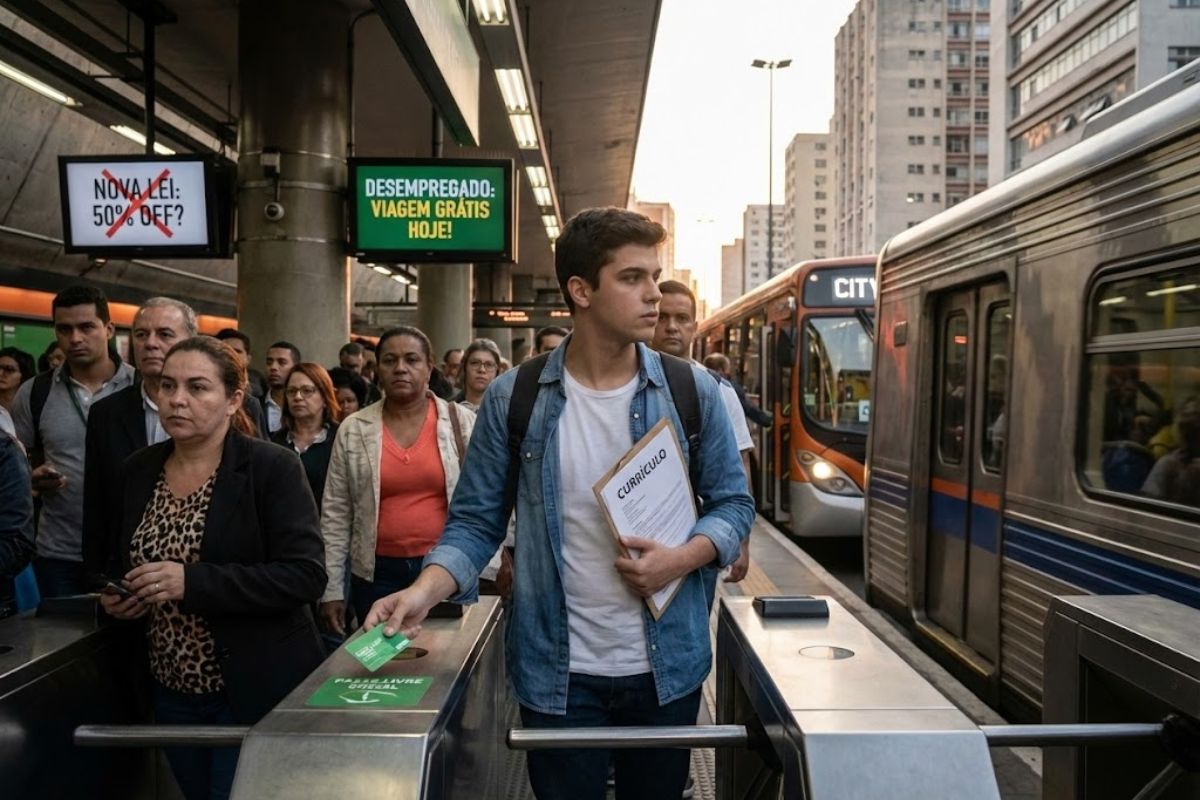
In 2025, the expression new government program promises 50% in public transport hides a more favorable scenario, in which registered unemployed individuals in the Social Free Pass and local programs can achieve total free transportation in subway, bus, and train while seeking employment in large Brazilian cities without lack of money being an impediment
Amid the debate about mobility and income, the new government program promises 50% in public transport has become a communication shortcut that does not always reflect the legal reality. While many people associate the benefit with the traditional half fare, the existing legislation for unemployed individuals usually goes further, allowing for total free transportation in subway, bus, and train systems in various capitals and metropolitan regions.
At the same time, projects like the Social Free Pass and Bill 589 of 2025 attempt to organize this mosaic nationally, linking the benefit to registrations like CadÚnico and CAGED and connecting the topic to the search for jobs and qualification courses. The result is a scenario in which the slogan new government program promises 50% in public transport coexists with local rules that, in practice, can eliminate the fare for those outside the job market.
50% Discount or Total Free, What Is Really at Stake
In practice, there is currently no single federal law that locks in the benefit at 50 percent discount for unemployed individuals.
-
A new Brazilian shopping center worth R$ 400 million will be built in an area equivalent to more than 4 football fields, featuring 90 stores, 5 cinemas, a supermarket, a college, and parking for 1,700 cars, potentially generating 3,000 jobs.

-
Larger than entire cities in Brazil: BYD is building a 4.6 km² complex in Bahia with a capacity for 600,000 vehicles per year, but the discovery of 163 workers in conditions analogous to slavery has shaken the entire project.

-
With an investment of R$ 612 million, a capacity to process 1.2 million liters of milk per day, Piracanjuba inaugurates a mega cheese factory that increases national production, reduces dependence on imports, and repositions Brazil on the global dairy map.

-
Brazilian city gains industrial hub for 85 companies that is equivalent to 55 football fields.


The expression new government program promises 50% in public transport often appears in headlines, speeches, and debates, but the legal framework in effect is made up of municipal and state laws that, in many cases, eliminate the fare for a determined period.
While classic benefits like ID Jovem or the elderly statute guarantee half fare on different services, the policy aimed at unemployed individuals has its own logic.
The central objective is to prevent the lack of money for transportation from interrupting interviews, courses, and travel for job placement, hence the recurring option for total free transportation instead of a fixed 50 percent discount.
Social Free Pass and Attempt to Unify the Benefit
On the national level, Bill 589 of 2025 seeks to transform the idea of the new government program promising 50% in public transport into something more structured, under the label of Social Free Pass.
The proposal is to grant totally free tickets to individuals registered in CadÚnico and listed in the unemployed databases, like CAGED, linking the benefit to a real condition of lack of formal income.
The logic is simple and direct.
Those who prove they are unemployed would have the right to travel without paying fare for job interviews, selection processes, qualification courses, and essential public services.
Instead of only discussing whether the new government program promises 50% in public transport, the project tries to consolidate a standard of temporary zero fare, tied to clear registration and data update requirements.
São Paulo, Salvador, and Curitiba Illustrate What Already Works Today
Some capitals and metropolitan regions already operate models that go beyond the rhetoric of the new government program promising 50% in public transport.
In São Paulo, the so-called Credential for Unemployed Workers guarantees free use of the subway, CPTM, and intercity buses from EMTU, usually for a period between 30 and 90 days after dismissal, within criteria defined by the São Paulo transportation system.
In Salvador, discussions are advancing around a Mobility Aid, structured in monthly ticket quotas for those who prove their unemployed status, bringing the practice closer to the concept of Social Free Pass.
Meanwhile, cities like Curitiba are testing zero fare models on specific routes or for vulnerable groups, focusing on those actively seeking reemployment.
In all these cases, the generic promise that the new government program promises 50% in public transport becomes less relevant than the concrete design of local free transportation.
Documents and Rules That the Unemployed Need to Present
Although each city has its own legislation, the documentary basis often follows a strict standard to avoid fraud.
In general, the worker needs to prove that they did not resign voluntarily and that they were dismissed without just cause, within minimum and maximum timeframes after the formal termination in the employment record.
Transportation authorities, such as SPTrans, Metrorec, or local equivalents, typically require:
Physical or digital Work Card, with the termination of the last contract recorded.
Termination Agreement, proving dismissal without just cause.
ID and CPF, for identification.
Recent proof of residence, in the applicant’s name, generally issued within the last three months.
Without this documentation, the discourse of new government program promises 50% in public transport becomes irrelevant since access to the Social Free Pass or an equivalent free fare depends precisely on the formal validation that the individual is unemployed and resides in the municipality served by the program.
When There Is No Local Law, the Way Passes Through the CRAS and the CadÚnico
In municipalities where there is still no specific norm of free transportation linked to the Social Free Pass, the first support point is usually the CRAS, the Center for Reference in Social Assistance.
Being registered in the CadÚnico does not automatically replace the transportation benefit but opens doors for municipal programs that can indirectly subsidize the fare.
Additionally, many mid-sized Brazilian cities are discussing or implementing Zero Fare policies, where public transportation becomes free for the entire population, regardless of employment status.
In these cases, the debate about the new government program promising 50% in public transport loses practical importance, as the cost of travel ceases to be an obstacle for the unemployed who need to circulate to search for work or qualify.
In this scenario, where the discourse of the new government program promises 50% in public transport coexists with programs that guarantee Social Free Pass and even zero fare in several cities, do you believe that the priority should be a single federal law or the expansion of local initiatives for total free transportation for unemployed individuals?









-

Uma pessoa reagiu a isso.