





 Portuguese
  English
  Spanish
  7 min of reading
  0 comments


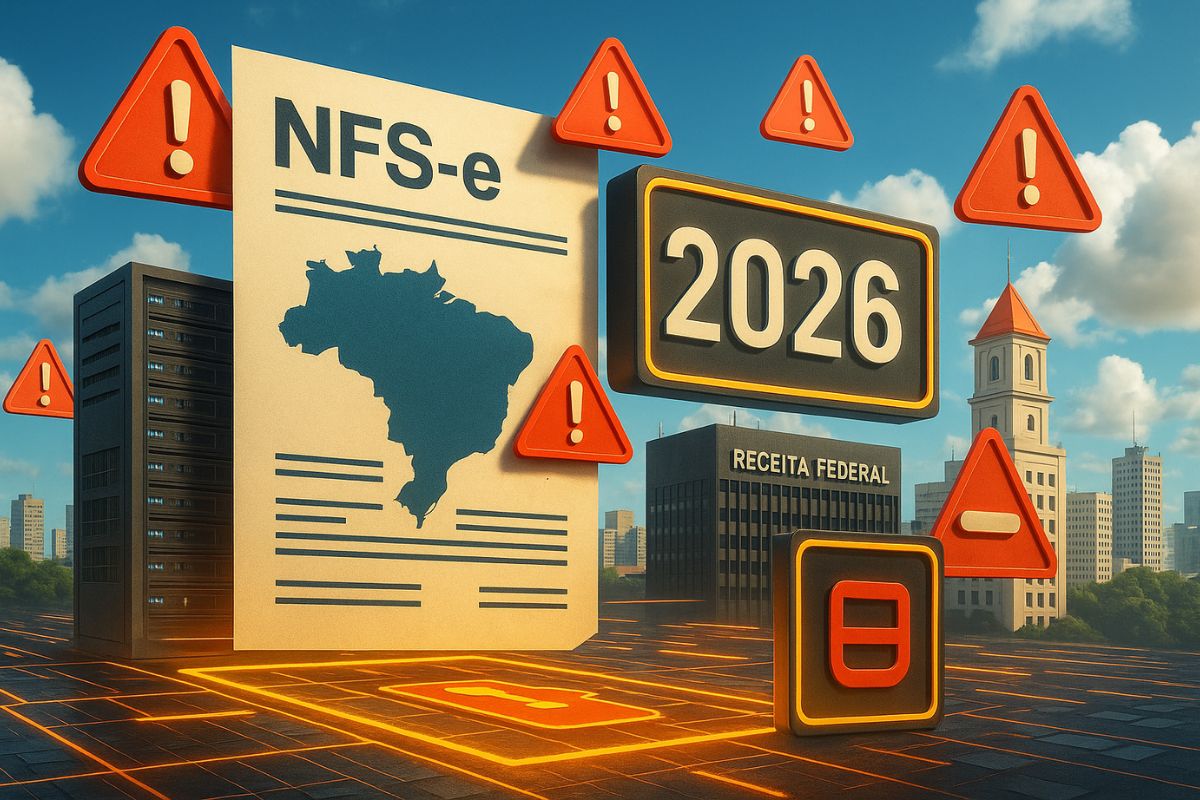
Starting in 2026, the issuance of the Service Invoice will depend on the national standard, putting pressure on municipalities and companies and opening the risk of blockage, penalties, and problems in the calculation of the tax reform.
The Service Invoice will enter a new phase in January 2026. All service-providing companies in the country must comply with the national standard for electronic service invoices, issued or registered via the National NFSe Portal. This change is not only technological but also tax-related: the new model will be the official basis for calculating the IBS and CBS taxes related to the consumption tax reform.
In practice, the Service Invoice becomes the “key document” for the pilot of the new taxes, forcing companies, accountants, and especially municipalities to adapt in a short time. The alert was reinforced by the Federal Revenue Service in a recent live stream, alerting to the risk of integration failures, emission blockages, and tax credit problems if the national standard is not implemented and aligned with local systems.
What Changes with the National Service Invoice Starting in 2026
As of January 2026, the first practical phase of the consumption tax reform will come into force, with real tests of IBS (Tax on Goods and Services) and CBS (Contribution on Goods and Services) in the Invoices. For the service segment, the requirement is clear:
-
Larger than entire cities in Brazil: BYD is building a 4.6 km² complex in Bahia with a capacity for 600,000 vehicles per year, but the discovery of 163 workers in conditions analogous to slavery has shaken the entire project.

-
With an investment of R$ 612 million, a capacity to process 1.2 million liters of milk per day, Piracanjuba inaugurates a mega cheese factory that increases national production, reduces dependence on imports, and repositions Brazil on the global dairy map.

-
Brazilian city gains industrial hub for 85 companies that is equivalent to 55 football fields.

-
Peugeot and Citroën factory in Argentina cuts production by half and opens a layoff program for more than 2,000 employees after Brazil drastically reduced purchases of Argentine vehicles.


Only the electronic Service Invoice in the national standard, issued or integrated via the National NFSe Portal, will be considered valid for the calculation of IBS and CBS related to the tax reform.
In other words, it will no longer be sufficient to issue the Invoice in the municipality’s system. The issuance will need to be connected to the national model to generate the data that will feed the tests of the new taxes.
Who is Required to Report IBS and CBS in Invoices in 2026
According to what was explained based on the Complementary Law that addresses the consumption tax reform, the obligation to report the values of IBS and CBS in 2026 falls on companies that are not part of the Simples Nacional and are not MEI.
These companies will need to fill in the test calculation fields for IBS and CBS in the fiscal documents, both in the electronic Service Invoice and in the electronic Invoice for goods. In this scenario, the Service Invoice ceases to be just a proof for the municipality and becomes a central piece in the tests of the consumption tax reform.
Meanwhile, Simples Nacional companies, including MEI, are exempt from this requirement to report the calculations of IBS and CBS in 2026, according to the cited interpretation of the relevant article of the law.
Simples Nacional and MEI: What Happens Regarding the National Invoice
Although Simples Nacional companies and MEI are not required to report IBS and CBS in the 2026 tests, there is no complete clarity in the commented text as to whether these categories are also exempt from using the national standard of the Service Invoice.
Today, the MEI service provider already uses the National NFSe Portal to issue their invoices, stopping the use of municipal systems.
The system at gov.br/nfse centralizes these issuances. The remaining question is whether, starting in 2026, Simples companies will also need to fully migrate to this standard or if there will be some local flexibility, which still depends on regulations and the integration of each municipality.
National NFSe Will Be the Official Basis for Tax Reform Credit
In the discussed live stream, the Federal Revenue Service emphasized that, in the case of services, only the electronic Service Invoice in the national standard will be considered as the official document for calculating IBS and CBS and for generating credits in the new model of the consumption tax reform.
This means that if the company issues an Invoice only in the municipal system, detached from the national standard, that invoice will not be used in the IBS and CBS tests and may fail to generate the expected credit.
The Invoice becomes, literally, the starting point for future tax credits in this new design of consumption taxation.
Municipalities May Block the Issuance of Invoice if They Do Not Adapt
The Federal Revenue Service also issued a direct alert to municipalities: many still operate with their own systems, some even issuing paper Invoices or with little digitalization.
If municipalities do not adapt in time, integrating their systems to the national standard of the Service Invoice or adopting the national system as the sole base, there is a concrete risk that companies will be unable to issue “valid” Service Invoices for tax reform purposes, blocking the fiscal routine and the flow of credits.
In a country with over 5,000 municipalities, many have not even started studies on integration or system changes, which raises a concern about tight deadlines and potential disorganization in 2026.
The Two Suggested Solutions for Municipalities
According to the presentation made in the live stream, the Federal Revenue Service proposed two main alternatives for municipalities:
- Maintain the local Service Invoice system
The municipality would continue issuing the Invoice in its local system, but would have to convert the model of the invoice to the national standard and send each document to the National NFSe Portal.
The problem: this would create two valid Invoices for the same service, with different numbering, generating risk of duplicity of fiscal documents and legal insecurity. - Directly adopt the national standard as the official base
Here, the municipality would start to consider the national model of the Service Invoice as its official standard. The provider would issue directly in the national system, and the information would be shared with the municipality.
The advantage: there would be a single fiscal document, with unified numbering, containing data for IBS, CBS, and municipal taxes, reducing friction in the assessment.
Limitations of the National Invoice System Today
Despite being the basis of the entire change, the national electronic Service Invoice system is still far from perfect. Problems such as:
- System instability at certain times, preventing the issuance of the Invoice
- Incomplete tax calculation in some scenarios
- Absence of important functionalities, such as:
- Batch export of invoices in XML
- Consolidated report of Invoices issued directly by the national system
From the perspective of professionals dealing with the day-to-day operations of MEI and small businesses, the system works, but is still “raw” to support all companies in Brazil at once, which makes the transition in 2026 a technical and operational challenge.
Mandatory Reporting of IBS and CBS: Risk of Penalties in the Invoice
For companies that are not part of the Simples and are not MEI, starting in 2026, reporting the values of IBS and CBS in fiscal documents will become an accessory obligation.
If the company fails to report these values on the Invoice, the interpretation presented is that this could be treated as noncompliance with the accessory obligation, leading to the requirement to pay the IBS and CBS value of that Invoice as a penalty, as provided for in the complementary law discussed in the live.
In the 2026 tests, the global rate of IBS and CBS will be 1% on operations, comprising 0.1% of IBS and 0.9% of CBS, with the possibility of offsetting these amounts with the monthly PIS and Cofins calculation. Even though it is a test, noncompliance with the obligations related to the Invoice may be costly.
Why Accountants and Companies Need to Study the Invoice Now
The final message from the specialist is direct: accountants, consultants, and companies cannot wait for 2026 to understand how the national Invoice will work within the tax reform.
The Federal Revenue Service has been sharing tests, live streams, and simulations of the calculation of IBS and CBS, showing in practice how the calculation will be done, the filling of fields, the reading of Invoices, and the formation of credit.
Those who work with service provision or tax consulting need to:
- Master the operation of the National NFSe Portal
- Understand how the Invoice will be used for the calculation of IBS and CBS
- Monitor whether the municipality is already in the process of integration or system change
- Start testing reports, XML integration, registrations, and credit verification now
The Invoice, which was already central in the relationship between businesses and the tax authorities, is expected to become the “heart” of the consumption tax reform, especially due to the concept of tax credit, cashback, and offsets between taxes.

In the end, the question that remains is simple yet heavy: do you think the country will be ready to depend on a single national standard for the Service Invoice in 2026, or will this change likely become a major bottleneck in the lives of businesses?








Seja o primeiro a reagir!