





 Portuguese
  English
  Spanish
  4 min of reading
  0 comments


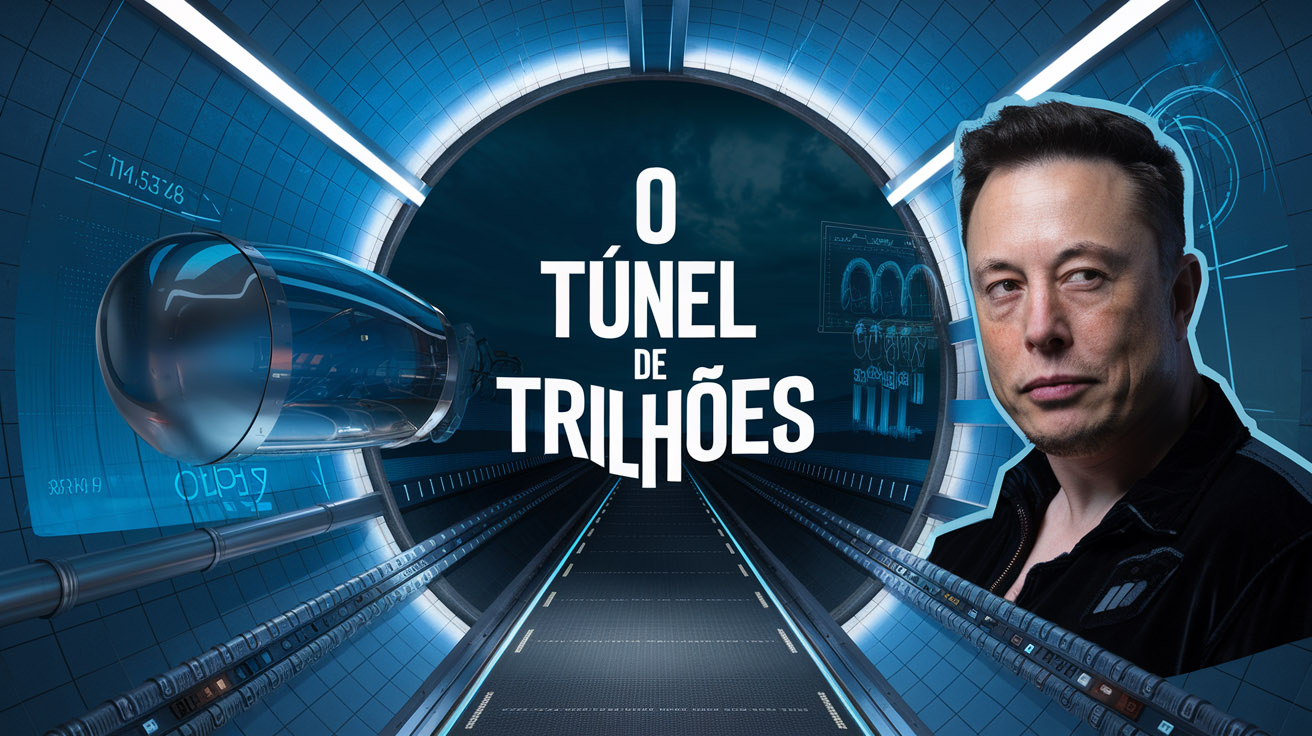
A Visionary Idea Promises to Revolutionize Global Transportation: A Transatlantic Tunnel That Would Connect New York and London in Just One Hour. Utilizing Vacuum Technology and Magnetic Levitation, the Project Faces Gigantic Challenges, Including an Estimated Cost of Trillions and a Construction Timeline of Centuries. But Will This Monumental Work Ever Leave the Drawing Board?
Imagine a future where the journey between New York and London, which currently takes about eight hours by plane, is reduced to just one hour.
This scenario, which seems straight out of a sci-fi movie, is being seriously discussed by engineers, scientists, and investors.
Although the concept is still in its early stages, it has already sparked significant interest due to its revolutionary potential and the immense challenges it presents.
-
A new Brazilian shopping center worth R$ 400 million will be built in an area equivalent to more than 4 football fields, featuring 90 stores, 5 cinemas, a supermarket, a college, and parking for 1,700 cars, potentially generating 3,000 jobs.

-
Larger than entire cities in Brazil: BYD is building a 4.6 km² complex in Bahia with a capacity for 600,000 vehicles per year, but the discovery of 163 workers in conditions analogous to slavery has shaken the entire project.

-
With an investment of R$ 612 million, a capacity to process 1.2 million liters of milk per day, Piracanjuba inaugurates a mega cheese factory that increases national production, reduces dependence on imports, and repositions Brazil on the global dairy map.

-
Brazilian city gains industrial hub for 85 companies that is equivalent to 55 football fields.


The Proposal for the Transatlantic Tunnel
The project involves the construction of a submerged tunnel over 5,500 kilometers long beneath the Atlantic Ocean, using vacuum technology and magnetic levitation.
This tunnel would be a virtually airless environment, eliminating air resistance and allowing pressurized capsules to travel at extremely high speeds, possibly exceeding 1,200 km/h.
This technology is based on the concept of the Hyperloop, introduced by Elon Musk in 2013.
According to Musk, the Hyperloop uses capsules that move within vacuum tubes, enabling fast and silent journeys.
Since its conception, various companies and research teams around the world have been exploring ways to make this idea viable, including the possibility of its application in a transatlantic connection.
How Would the System Work?
The transatlantic tunnel would be a landmark of modern engineering, utilizing magnetic levitation to support and move the capsules within the vacuum environment.
With a drastic reduction in friction and air resistance, the system could offer a more eco-friendly, silent, and incredibly time-efficient journey.
Additionally, the project envisions the use of advanced technologies to ensure the safety and stability of the infrastructure, considering the challenges of building a tunnel in such a vast and unstable area as the ocean floor.
The Gigantic Challenges
While the idea is inspiring, its execution faces logistical, financial, and technical challenges.
The estimated cost for the construction of the tunnel is £15.5 trillion, and the construction time could exceed 700 years.
These figures alone highlight the complexity of the project. Among the main obstacles are:
- Developing technologies to maintain a vacuum environment over such a large expanse;
- Ensuring the stability and safety of the underwater structure against adverse conditions;
- Minimizing environmental impacts since construction could affect sensitive marine ecosystems;
- Finding solutions to make the project financially viable in the long term.
According to experts, the progress in developing the tunnel depends on significant advancements in technology and engineering. International collaboration will be essential to overcome financial and technical barriers.
Environmental and Ecological Impacts
Another crucial aspect is sustainability. While tunnel transport may be more eco-friendly than air travel, the environmental impact of large-scale construction cannot be overlooked.
The installation of such extensive infrastructure on the seafloor would require detailed studies on how to mitigate environmental damage.
Moreover, the energy consumption to keep the tunnel operational would be significant. However, proponents of the project argue that using renewable sources could help make the system more sustainable.
The Role of Elon Musk and the Future of Transportation
Elon Musk, known for his visionary projects like Tesla and SpaceX, is often associated with revolutionary transportation ideas.
Although he has not officially announced his direct involvement in the construction of a transatlantic tunnel, his contribution to popularizing the Hyperloop concept places his name among the leading visionaries who could drive this type of innovation.
Companies around the world continue to explore the potential of vacuum tunnel transport, while debates about its economic and technical viability remain open.
Even though no concrete timeline exists, the project represents humanity’s ability to dream big and imagine the impossible.
Perspectives and International Collaboration
For this project to come to life, unprecedented international cooperation will be necessary.
Governments, businesses, and researchers will need to join forces to tackle the technical and financial challenges.
The transatlantic tunnel, for now, is a symbol of human ambitions in engineering and innovation.
Although realizing this plan is still distant, the idea is already influencing how we think about transportation and global connectivity.
The quest for faster, more eco-friendly, and efficient solutions reflects the direction the world may take in the coming decades.
Do you believe that a transatlantic tunnel between New York and London could become a reality? What would be the impacts of this monumental work on the world? Share your thoughts in the comments!







-

-

-

3 pessoas reagiram a isso.