





 Portuguese
  English
  Spanish
  5 min of reading
  1 comment


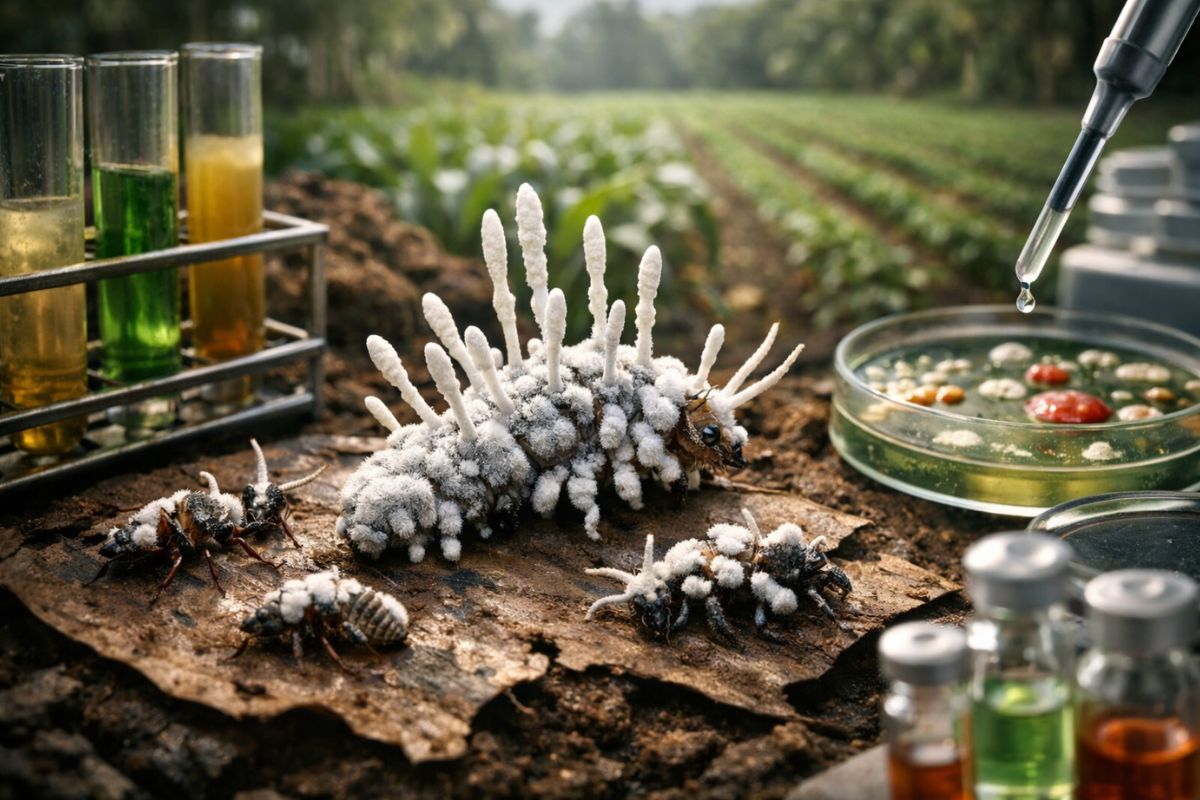


The Fungus Trichoderma Agriamazonicum, Identified in the Amazon by Researchers from Embrapa, Combines Biological Pest Control, Production of Novel Compounds, and Antimicrobial Activity Against Bacteria Associated with Pneumonia, with Promising In Vitro Results for Sustainable Agriculture and Possible Development of Bioproducts That Reduce Dependence on Pesticides and Antibiotics in Brazil.
The fungus Trichoderma Agriamazonicum has come onto the radar of Brazilian research as a discovery with a dual interest: to protect plants in agricultural systems and to provide bioactive molecules with potential medical applications. Found in the Amazon and deeply studied by Embrapa Amazônia Ocidental, it is now observed as a strategic candidate for bioproducts.
Attention to this species has grown because the results gathered so far do not point to a single isolated effect, but to a set of technical capabilities: control of phytopathogens, production of novel peptides and action against bacteria related to pneumonia. It is precisely this convergence between field and laboratory that transforms the discovery into a central theme for agriculture and biotechnology.
From Collection in the Amazon to Recognition of a New Species

Trichoderma Agriamazonicum was identified from samples collected from a native Amazonian timber species, within a research line focused on applied microbiology.
-
Motorola launched the Signature with a gold seal from DxOMark, tying with the iPhone 17 Pro in camera performance, Snapdragon 8 Gen 5 that surpassed 3 million in benchmarks, and a zoom that impresses even at night.

-
Satellites reveal beneath the Sahara a giant river buried for thousands of kilometers: study shows that the largest hot desert on the planet was once traversed by a river system comparable to the largest on Earth.

-
Scientists have captured something never seen in space: newly born stars are creating gigantic rings of light a thousand times larger than the distance between the Earth and the Sun, and this changes everything we knew about stellar birth.

-
Geologists find traces of a continent that disappeared 155 million years ago after separating from Australia and reveal that it did not sink, but broke into fragments scattered across Southeast Asia.

The work was conducted by Thiago Fernandes Sousa and Gilvan Ferreira da Silva, with identification in 2023 and analytical deepening in the following years, including consolidated data in a thesis defended in 2025.
The name of the species was not chosen by chance: “Agriamazonicum” connects territorial origin and use vocation. By belonging to the Trichoderma genus, known for its history in biological control, this fungus is already part of a relevant scientific basis.
The difference appears when the morphological and phylogenetic data show unique genetic characteristics, formally supporting the proposition as a new species and expanding the range of possible applications.
Biological Pest Control with Combined Mechanisms
In the agricultural environment, in vitro tests indicated the fungus‘s efficiency against nine different species of phytopathogens. This number is noteworthy because it indicates a broad action, not limited to a single disease agent. Practically speaking, the broader the scope, the greater the interest for future biological formulations for different production chains.
The observed inhibition occurred through at least two central mechanisms: mycoparasitism and production of volatile organic compounds. Simply put, this means that the microorganism does not rely on a single action pathway to contain the pathogen.
Among the highlighted targets are Corynespora Cassiicola and Colletotrichum spp., which affect crops such as soybeans and fruits. This multifactorial action is technically valuable because it reduces the dependence on single responses in high disease pressure scenarios.
Novel Compounds and the Genome’s “Chemical Factory”
One of the strongest points of the research lies in genomic mining of BGCs, the biosynthetic gene clusters. These sets function as modules capable of guiding the production of molecules of interest, including for defense and environmental interaction. In the case of Trichoderma Agriamazonicum, the analysis of these blocks revealed the possibility of compounds not yet described.
From there, a bioinformatics strategy was applied using the PARAS algorithm, which was used to predict the amino acid sequence of peptaibols before classic isolation.
In the next step, the predicted compounds were chemically synthesized through an approach called syn-BNP (synthetic bioinformatics natural products).
The advantage of this path is to accelerate the discovery of bioactive molecules, reducing lengthy steps of extensive cultivation and traditional purification, without sacrificing precision in initial screening.
When the Same Fungus Crosses the Border Between Agriculture and Medicine

The peptaibols linked to the genome of Trichoderma Agriamazonicum showed antimicrobial activity comparable to, and in some experimental scenarios, superior to that of commercial antibiotics.
In controlled trials, a peptaibol of 18 amino acids, synthesized based on genomic prediction, exhibited activity against Streptococcus sp. and Klebsiella pneumoniae, bacteria related to infections such as pneumonia.
This result does not automatically turn the molecule into an ready-to-use medication, but repositions the fungus as a promising source for a pharmaceutical innovation pipeline.
The decisive technical point is that the same species that acts in agricultural biocontrol also provides robust signals for antimicrobial research, something rare in early discoveries.
In parallel, the same 18 amino acid peptaibol also showed antifungal efficiency against Pseudopestalotiopsis sp., associated with leaf spot in guaraná trees, reinforcing the dual utility of the system.
Plant Growth: Concrete Advancement, Without Simplifications
In the axis of promoting plant growth, a lineage of Trichoderma Agriamazonicum recorded production of 60.53 µg/mL of IAA (indole-3-acetic acid), an important phytohormone for plant development. This data positions this isolate among the highest producers of IAA tested in the experimental set and helps explain the agronomic interest in the species.
At the same time, tests in a greenhouse with bell peppers showed that this high production of IAA did not significantly convert into superior performance compared to the negative control. Far from devaluing the result, this clarifies an essential point: plant growth promotion is a multifactorial phenomenon, and a single biochemical marker does not guarantee agronomic gain under all conditions.
This overview strengthens a more solid scientific reading: the primary value of the fungus may lie less in universal promise and more in specific applications, with the correct formulation and context.
What This Discovery Could Change in Practice
For agriculture, the most plausible scenario is the advancement of bioproducts capable of integrating sustainable management, with potential to reduce dependence on pesticides in certain systems and crops.
This does not mean total and immediate replacement, but opens the way for combined control strategies, especially in programs that already incorporate bioinputs and phytosanitary monitoring.
For health and biotechnology, the gain lies in opening new routes for prospecting antimicrobial molecules at a time when the search for therapeutic alternatives is urgent.
When a newly described species delivers novel compounds and consistent activity in the laboratory, it ceases to be merely a scientific curiosity and becomes a strategic asset for applied research. The emerging question is not whether there is potential, but how to transform that potential into validated, safe, and scalable technology.
Trichoderma Agriamazonicum places the fungus from the Amazon at the center of an agenda that unites agricultural production, industrial innovation, and antimicrobial investigation.
The available data supports a balanced conclusion: there are strong signs of practical utility, with relevant technical results, and there are also clear limits that require continuous validation under different experimental and productive conditions.
Now I want to hear your thoughts on social media: in your reality, which issue weighs more today, fungal disease in crops or bacterial resistance in health? And, thinking in the short term, would you trust in fungi-based bioinputs to reduce chemicals in the field, or do you think the transition is still far off?








O Brasil tem recursos inesgotáveis, basta incentivos governamentais, tais como Embrapa, para explorar infindáveis produtos que dormem na biodiversidade da nossa Amazônia.