





 Portuguese
  English
  Spanish
  6 min of reading
  0 comments


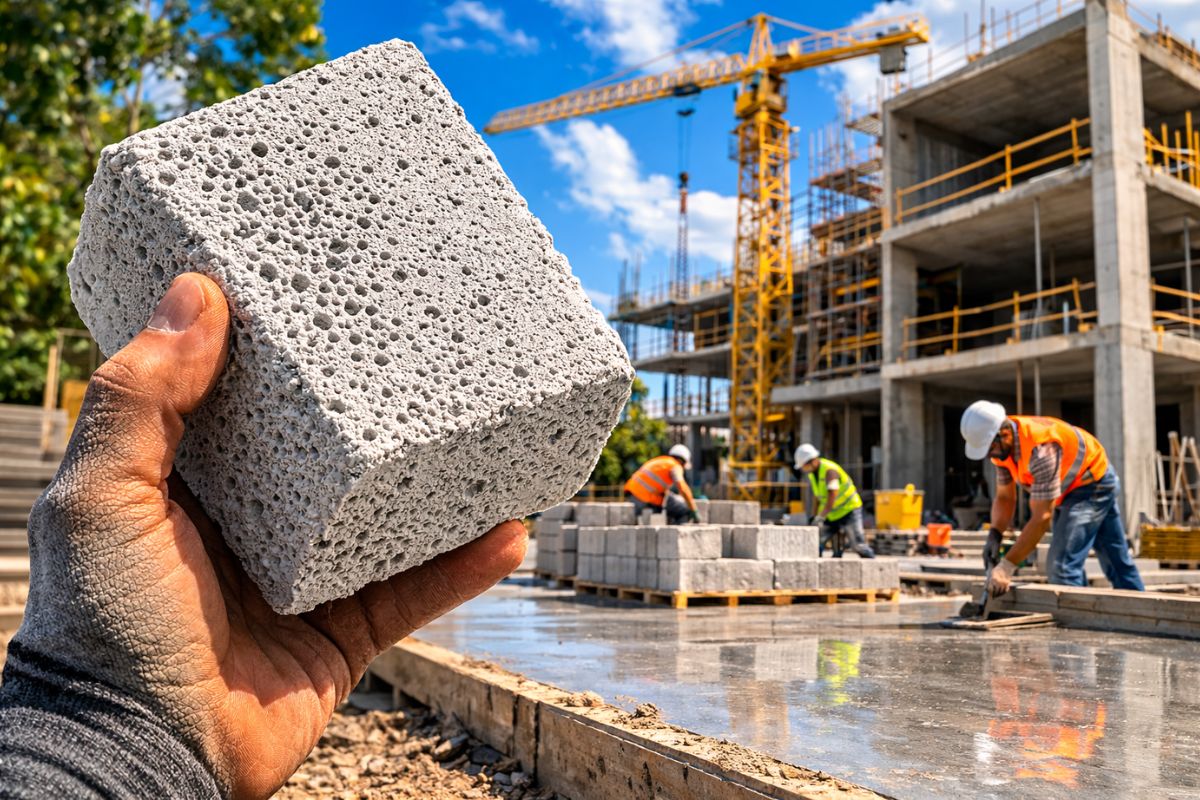
The New Building Material Developed by Researchers at the Worcester Polytechnic Institute Uses Enzyme to Turn Carbon Dioxide into Solid Minerals, Cures in a Few Hours, and Emerges as a Cleaner, Recyclable and Repairable Alternative to Traditional Concrete.
The new building material created by engineers at the Worcester Polytechnic Institute may pave a different path for the construction industry by combining carbon capture, rapid curing, and lower energy consumption in production. Instead of releasing large volumes of CO₂ as conventional concrete does, the proposal is precisely to remove that carbon from the air and incorporate it into the manufacturing process itself.
This building material has been developed with an enzyme capable of transforming carbon dioxide into solid mineral particles, which are then bonded and cured under milder conditions. The result is a strong, durable, recyclable compound with the potential to drastically reduce construction emissions, provided it can advance to large-scale use.
How the New Building Material Works
The project presented by the Worcester Polytechnic Institute describes the so-called enzymatic structural material, known by the acronym ESM in English.
-
New CCR concrete paving technology promises roads up to 3x more durable, less maintenance, and cost reduction in Brazil.
-
Made from recycled plastic, plastic wood is gaining space in the construction industry because it does not rot, resists moisture, and reduces maintenance costs over the years.

-
Florianópolis will receive a million-dollar BRT that will begin construction in 2026 with nearly 400 million in funding from the federal government and the Inter-American Development Bank, and the map already shows the routes for the exclusive bus corridors.

-
Without a blueprint, without an engineer, and using scrap from the dump, a father spends 15 years building an 18-room castle for his daughter, featuring tram tracks, 13 fireplaces, and over 700 m², which may now be demolished.


The basis of the innovation lies in the use of an enzyme that helps to convert CO₂ into solid minerals, creating a process different from that seen in traditional materials.
Once these mineral particles are formed, they are bonded in a system capable of generating structural pieces in a matter of hours. This means that the building material does not depend on extreme conditions to reach the point of use.
This change is important because it addresses two bottlenecks at once: emissions and curing time.
In practice, the advance proposes a logic opposite to that of conventional concrete, which requires very high temperatures to be produced and still demands a much longer period until complete curing.
Why Concrete Is at the Center of the Comparison
The comparison with concrete is inevitable because it remains the building material most used on the planet. Precisely for that reason, its environmental impact carries immense weight within global construction emissions.
According to the data provided, concrete production accounts for nearly 8% of global CO₂ emissions. This data helps explain why any viable alternative draws so much attention from researchers, engineers, and the productive sector.
When the most used material in the world is also one of the most polluting, any efficient substitute gains immediate relevance.
It is at this point that ESM emerges as a promising candidate. Rather than merely reducing damage, it was designed to sequester carbon during production, which completely changes the environmental logic of the process.
Building Material Captures Carbon Instead of Emitting
One of the most striking points of the new system is that it removes more carbon from the atmosphere than it produces.
This characteristic makes ESM a building material with a negative emissions profile, something rare in a sector historically associated with high energy consumption and significant pollution volume.
According to the explanation from Professor Nima Rahbar, the project leader, the production of one cubic meter of this new material sequesters more than 6 kilograms of CO₂. In contrast, conventional concrete emits about 330 kilograms in the same comparison. This difference helps to quantify the scale of the proposed change.
If this type of technology moves out of the experimental environment and achieves significant industrial adoption, the impact could surpass the scale of the product and affect the entire logic of the construction industry, especially in large-volume projects.
Rapid Curing Can Speed Up Construction and Reduce Bottlenecks
Another important differential of ESM is the curing time. While conventional concrete can take weeks to achieve complete curing, this new building material is molded and cured in a matter of hours.
This doesn’t just mean a technical gain. It also points to direct effects on schedule, productivity, and organization of the construction site. In a sector where delays are costly and each stage depends on the previous one, shortening curing time can represent a significant operational gain.
This characteristic also helps expand usage possibilities, especially in modular solutions and components that need to be produced more quickly. The time gain, in this case, does not appear in isolation. It comes accompanied by a smaller environmental footprint.
Resistance, Repair, and Recycling Increase Interest in the New Material
The proposal does not rely solely on ecological appeal. The enzymatic structural material has been designed to be strong, durable, and recyclable, as well as allowing repairs.
This gives the new building material an important advantage over solutions that may reduce emissions but do not deliver structural performance compatible with real applications.
This combination is strategic because the sector does not adopt a novelty just because it is cleaner. It is necessary for the material to withstand usage, maintenance, and lifecycle demands.
In the case of ESM, the proposal is precisely to deliver a more environmentally friendly alternative without sacrificing practical functionality.
The fact that it is also repairable reinforces this potential. Instead of always depending on complete replacement, the material can facilitate maintenance while also reducing waste over time.
Where This Building Material Can Be Applied
According to the provided data, ESM can be used in roof slabs, wall panels, and modular construction systems. This indicates that the new building material is already born with a vocation for concrete applications, not just as a laboratory concept.
In addition to conventional construction, researchers also see opportunities in affordable housing, climate-resilient infrastructure, and disaster recovery efforts.
As the material can be produced quickly and with lightweight components, it tends to fit well in scenarios where speed and efficiency are decisive.
This versatility greatly increases interest in the technology, as it shows that the innovation is not limited to a specific niche. It can serve both permanent works and emergency solutions.
Low Energy Consumption Reinforces the Sustainable Proposal
One of the reasons why ESM attracts so much attention is the fact that it requires much less energy than traditional materials. The process occurs under milder conditions, without relying on the high temperatures typical of cement and concrete production.
This means that the new building material is not only a carbon captor but also a solution aligned with a lower energy impact manufacturing.
In other words, it helps on multiple fronts. It reduces emissions, sequesters carbon, and also decreases the environmental cost of production.
This set aligns the material with broader goals related to carbon neutrality, circular economy, and the use of renewable biological inputs, all topics that are gaining traction in the debate about the future of construction.
What Could Change in the Construction Industry If the Technology Advances
The construction industry is one of the most challenging areas when it comes to decarbonization. Therefore, the arrival of a building material that manages to combine performance, speed, and CO₂ capture has the potential to alter priorities within the sector.
If even a small share of global construction starts to adopt materials with negative emissions, the cumulative effect could be considerable.
This is especially true for repetitive works, modular systems, and large-scale ventures, where the volume of material used is enormous.
The impact would not only be on the individual project but also on the industrial logic of the sector. Instead of thinking solely about compensating for emissions afterwards, part of the solution would be embedded in the very material used for construction.
Building Material Points to a New Type of Construction
More than an isolated innovation, ESM suggests a change in direction. It shows that the future of construction may involve materials that not only support structures but also contribute to reducing environmental damage right from the start.
The new building material still represents a technical advancement in development, but the concept behind it is strong: transform atmospheric carbon into part of the structural solution.
This idea breaks with decades of dependence on more polluting processes and points to a cleaner, faster, and potentially smarter construction.
If it manages to scale up, maintain performance, and genuinely enter the routine of the industry, this type of material could change not only what is built but also how the entire sector views efficiency, emissions, and environmental responsibility.
In your opinion, does this new building material have a real chance of replacing some concrete in the future, or will it take a long time to leave research and reach construction sites?









Seja o primeiro a reagir!