





 Portuguese
  English
  Spanish
  4 min of reading
  4 comments


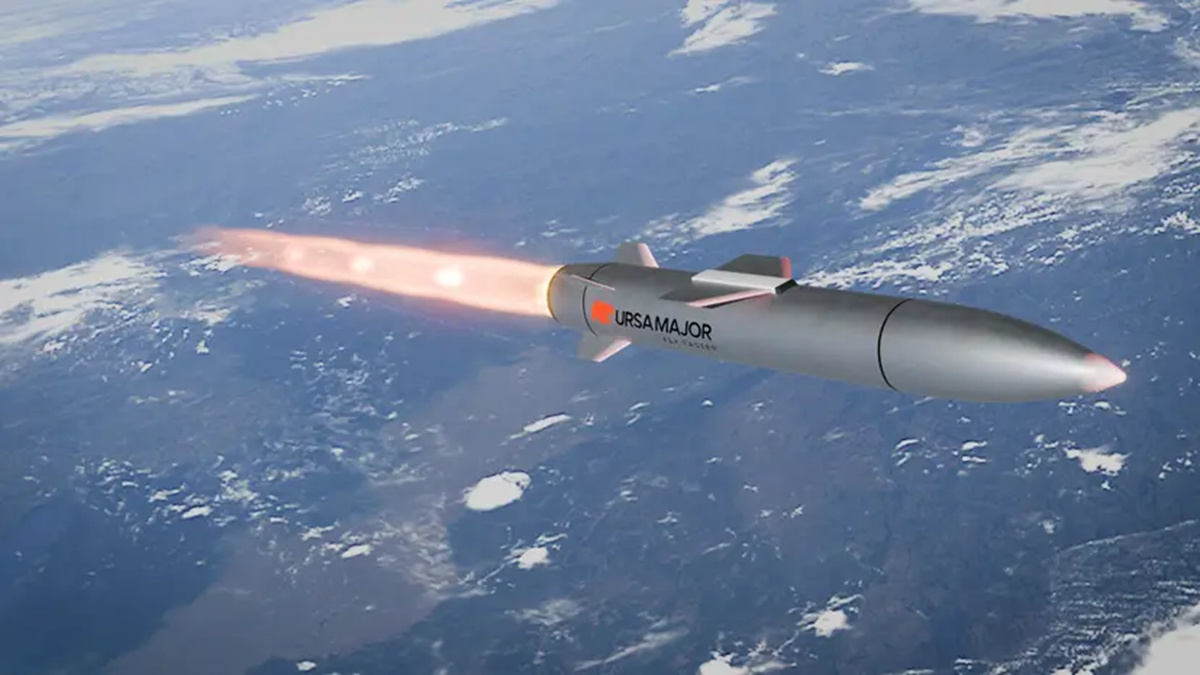


Presented on February 24 during the Air War Symposium, the new hypersonic missile HAVOC was designed for large-scale production, with Draper storable liquid-fuel engine, air, sea and land launch capability, and range measured in hundreds of kilometers
The American company Ursa Major presented, on February 24, a new hypersonic missile called HAVOC, designed for large-scale production, with launch from jets, ships, and land, aiming to provide faster and more accessible high-speed weapons.
The new hypersonic missile was revealed during the Air War Symposium of the Air and Space Forces Association, an event that brought together leaders in the defense area to discuss next-generation air power. The presentation highlighted the focus on industrial scale and accelerated delivery.
According to the company, the new hypersonic missile was conceived both as a combat weapon and as a hypersonic target for testing and training. The dual-use proposal seeks to meet urgent operational needs while strengthening the industrial base of the United States.
-
Motorola launched the Signature with a gold seal from DxOMark, tying with the iPhone 17 Pro in camera performance, Snapdragon 8 Gen 5 that surpassed 3 million in benchmarks, and a zoom that impresses even at night.

-
Satellites reveal beneath the Sahara a giant river buried for thousands of kilometers: study shows that the largest hot desert on the planet was once traversed by a river system comparable to the largest on Earth.

-
Scientists have captured something never seen in space: newly born stars are creating gigantic rings of light a thousand times larger than the distance between the Earth and the Sun, and this changes everything we knew about stellar birth.

-
Geologists find traces of a continent that disappeared 155 million years ago after separating from Australia and reveal that it did not sink, but broke into fragments scattered across Southeast Asia.

New Hypersonic Missile Is Designed for Mass Production and Rapid Delivery
The HAVOC system of the new hypersonic missile is based on the Draper liquid rocket engine, developed by the company itself. The engine uses storable propellants and was designed to be safe and tactical, according to information released by the manufacturer.
According to the aerospace company, the cost of the engine represents a fraction of atmospheric breathing hypersonic propulsion systems. This cost difference is part of the new hypersonic missile’s strategy to enhance accessibility and enable large-scale production.
The company stated it relies heavily on additive manufacturing and modern processes to reduce costs and accelerate production. The new hypersonic missile was designed from the outset for rapid and large-scale manufacturing, and not as a limited batch of high-quality prototypes.
CEO Chris Spagnoletti stated that keeping up with adversaries requires speed in delivery, affordable prices, and the ability to build at scale. According to him, the new hypersonic missile HAVOC was planned to be produced quickly and in large quantities.
The company reported that the system combines high performance in speed with production scalability. The declared goal of the new hypersonic missile is to meet urgent needs of fighters, uniting performance and industrial capability.
Throttle Control Increases Flexibility of the New Hypersonic Missile
One of the main features of the new hypersonic missile is the ability to control the power and restart the engine in all phases of flight. This includes the stages of propulsion, cruise, and terminal, allowing for more advanced mission profiles.
This flexibility differentiates the new hypersonic missile from traditional cruise and glide systems. The control during flight allows for expanded maneuvers and different operational configurations along the trajectory.
Since the engine can be controlled during flight, the system does not require the expensive thermal protection systems typically associated with extreme thermal loads at hypersonic speeds. Eliminating this need contributes to overall cost reduction.
Simplification also impacts supply chain requirements. According to the company, the new hypersonic missile was structured to reduce logistical complexity without compromising performance at high speeds.
New Hypersonic Missile Operates In and Out of the Atmosphere
The system was designed to operate both in and out of the atmosphere. This endo and exo-atmospheric capability expands the mission options of the new hypersonic missile across different engagement profiles.
The company reported that the system allows for long-range engagements measured in hundreds of kilometers, depending on the engine configuration. The possibilities vary according to the arrangement chosen for each operational application.
Modular Architecture of the New Hypersonic Missile Allows Multiple Launch Platforms
The HAVOC features modular architecture that allows integration with various solid-fuel rocket boosters. This design makes the new hypersonic missile compatible with a wide range of launch platforms.
The system can be launched from fighters and bombers, as well as being fired from vertical launch systems on ships or from ground launchers. Long-range options are available depending on the selected booster.
The company declared it has accumulated over a decade of experience in hypersonic development and flight. Its Hadley liquid rocket engines have already flown in hypersonic conditions, validating performance in real-world scenarios.
The company has also worked with the Air Force Research Laboratory on the Fast and Affordable Missiles Demonstrator program, aimed at proving quick design and production of complete systems.
With the presentation of the new hypersonic missile HAVOC, Ursa Major highlighted the combination of large-scale production, operational flexibility, and cost reduction as central elements of the system, reinforcing the positioning of the new hypersonic missile in the hypersonic defense landscape.








Claro. Você sabe tudo do programa militar americano..kkk
É bom lembrar que oficialmente os EUA não têm nenhum míssil hipersônico, já que ao contrário de Rússia, China, Índia e Irã, as tentativas de testes desse tipo de armamento dos EUA foram falhos em todas as vezes. Os EUA ainda têm que correr atrás desses outros países que já têm a tecnologia testada e operacional.
Falou o especialista 🤣🤣🤣
Nunca vi tanta ****