





 Portuguese
  English
  Spanish
  2 min of reading
  48 comments




Aviation Revolution: New Chinese Hypersonic Engine Reaching 20,000 Km/h Redefines Global Engineering, Promising Worldwide Travel in Just 2 Hours
Imagine crossing continents in less time than it takes to watch a movie. China has announced a revolutionary milestone in aviation that challenges the limits of possibility: the development of a hypersonic aircraft engine capable of reaching the unprecedented speed of Mach 16.
In addition to promising to transform military aviation, this new engine is set to revolutionize commercial air travel, enabling trips around the world in just two hours. This technological milestone, confirmed by the South China Morning Post, marks a remarkable leap since the project’s inception in 2018, according to details published in the Chinese Journal of Propulsion Technology.
The Most Powerful Hypersonic Engine in the World
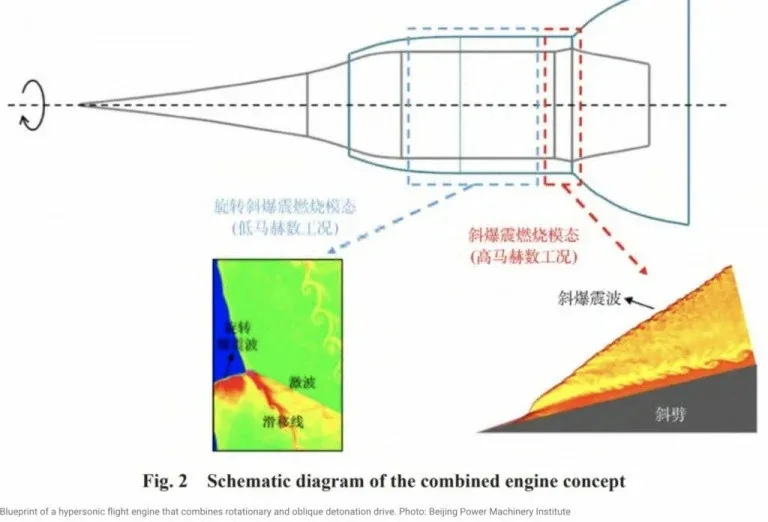
This advancement did not come from nowhere. The South China Morning Post highlights the engine capable of reaching 20,000 km/h, calling it “the most powerful hypersonic engine in the world.” The duality of its functionality is impressive: up to Mach 7, it utilizes rotating detonation for maximum efficiency; beyond that, it transitions to oblique detonation, ensuring stability and exceptional performance.
-
A “silent skill” is allowing Brazilians to earn up to R$ 22,000 per month without a degree and become indispensable for companies that rely on millions of data to survive.

-
Researchers at the Toyota Research Institute found that if a human uses robotic arms to flip a pancake 300 times in an afternoon, the robot learns to do it on its own the next morning, and this is currently the most promising method to solve the biggest bottleneck in modern robotics.

-
Goodbye iron: a common item in households is starting to lose space to technology that smooths clothes in minutes without an ironing board and with less energy consumption.

-
Antarctica reveals an unusual clue high in the Hudson Mountains, and what appeared to be just an isolated rock began to expose a secret hidden under the ice for ages.

Delving into the Mechanics of the New Hypersonic Engine
Delving into the mechanics of this advancement, the engine operates in two distinct modes. Initially, up to the Mach 7 mark, it employs rotating detonation – a method already known but effective. Surpassing this speed, oblique detonation comes into play, an advancement that promises unrivaled stability at extreme velocities.
This ability to switch between modes, perfected by Chinese engineers, not only demonstrates the engine’s versatility but also its potential to revolutionize the aviation industry.
A Future at Mach 16: What Does This Really Mean for the World?
The impact of such technology on aviation is immense. China, by mastering this technological frontier, positions itself to lead the global market for hypersonic aircraft. Beyond the obvious military interest, the implications for the transportation of goods and passengers are vast. Imagining near-instant global delivery or record-breaking intercontinental trips is no longer science fiction, but an imminent possibility.
This development not only redefines the concept of global proximity and accessibility but also highlights China’s position as an innovative tech giant. As we move closer to realizing these ultra-fast travels, the world watches, hopeful and amazed, at the next chapter in aviation history.







Vale lembra que o grafeno já é considerado um material resistente ao calor, e que já é aplicado em **** de motores pra ajudar na diminuição do atrito.
Isto é assunto para Eng. Aeronáutico ou para a NASA só eles é que entendem…..
Bem, já existe materiais potencialmente resistivel e que poderia contribuir para o futuro de motores como esse, é o caso do grafeno.
Uma maneira de morrer mais rápido isso sim, qualquer acidente aí, o passageiro nem vai sentir, já vai estar nas nuvens