





 Portuguese
  English
  Spanish
 4 min of reading
  0 comments


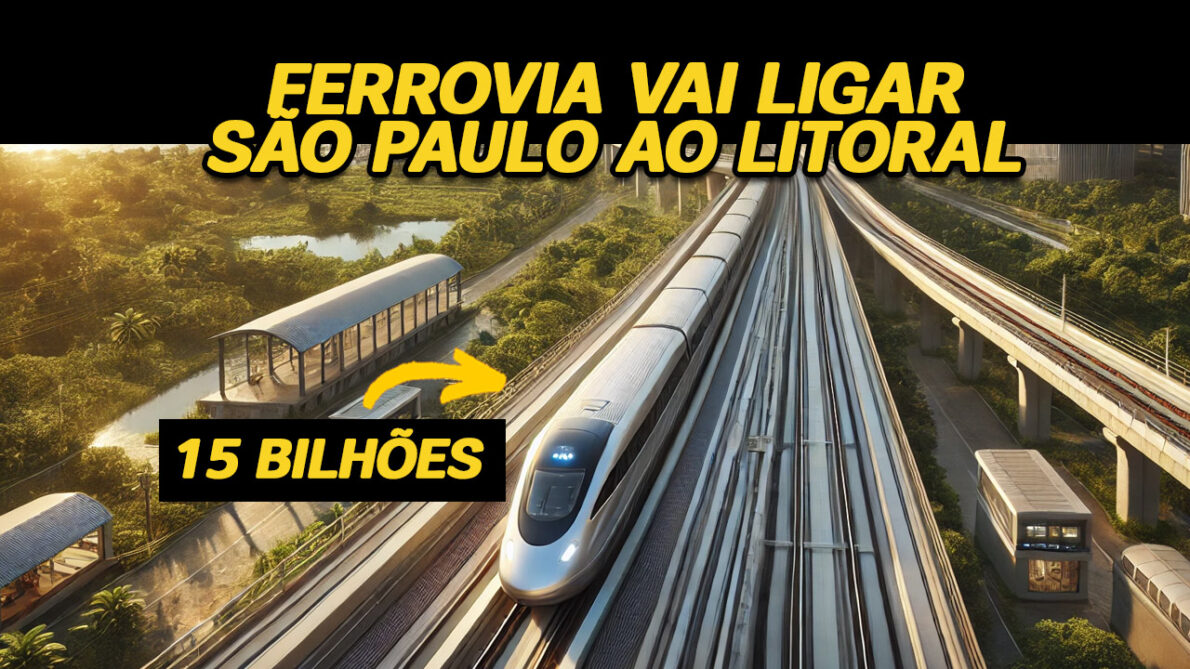
São Paulo Government Advances with a R$ 15 Billion Railway Project to Connect the Capital to the Coast. With a length of 80 to 130 km, the journey will take about 90 minutes, serving nine municipalities and benefiting 1.8 million people.
The government of the state of São Paulo is advancing with an ambitious project that aims to connect the capital to the coast of São Paulo through a modern and efficient railway line.
Currently, the project is in the final stage of contracting the feasibility studies, a crucial phase to ensure the success of the initiative.
After qualification in June 2024, the project still needs to go through public hearings, publication of the announcement, auction, and contract signing before being implemented.
-
A new Brazilian shopping center worth R$ 400 million will be built in an area equivalent to more than 4 football fields, featuring 90 stores, 5 cinemas, a supermarket, a college, and parking for 1,700 cars, potentially generating 3,000 jobs.

-
Larger than entire cities in Brazil: BYD is building a 4.6 km² complex in Bahia with a capacity for 600,000 vehicles per year, but the discovery of 163 workers in conditions analogous to slavery has shaken the entire project.

-
With an investment of R$ 612 million, a capacity to process 1.2 million liters of milk per day, Piracanjuba inaugurates a mega cheese factory that increases national production, reduces dependence on imports, and repositions Brazil on the global dairy map.

-
Brazilian city gains industrial hub for 85 companies that is equivalent to 55 football fields.


The total estimated cost is R$ 15 billion, with execution planned in partnership with the private sector.
Route Characteristics
According to the government of São Paulo, the train will have a route with a length of 80 to 130 kilometers, covered in approximately 90 minutes.
The line will directly benefit around 1.8 million people, serving nine municipalities along the route.
Mobility Benefits
The governor Tarcísio de Freitas (Republicans), responsible for announcing the project last year, highlighted the transformative potential of the initiative for regional transport.
In addition to facilitating travel between São Paulo and the coast, the project promises to significantly reduce vehicle flow on the Anchieta-Imigrantes System, which is currently the main connection route between the regions.
The expectation is that the train will become a faster, safer, and more sustainable alternative, especially during high season periods when heavy traffic often creates long lines and congestion.
Economic Impact and Job Creation
The economic impact is also significant. It is estimated that the project will generate 13,000 direct and indirect jobs, fostering the development of the served cities.
Boost to Tourism
In addition to the direct benefits for passengers, the Intercity Train project (TIC) Southern Axis also aims to boost tourism in the region.
With an efficient railway connection, an increase in the number of visitors to coastal cities is expected, promoting local economic growth.
Sustainability
Sustainability is another strong point of the project. By providing an alternative to road transport, the train will help reduce pollutant gas emissions, aligning with the state’s environmental goals.
Deadlines and Financing
The state government is committed to ensuring that the project is executed within the established deadlines, with the expectation that construction will begin after the bidding and contracting stages are completed.
The participation of the private sector will be essential to enable the necessary investments and ensure operational efficiency of the service.
Safety and Integration
The safety of passengers will be a priority, with the implementation of cutting-edge technologies and strict protocols to ensure safe and reliable journeys.
Additionally, the project provides for integration with other transportation modes, facilitating user access to stations and promoting more integrated mobility in the metropolitan area.
A Reference for Mobility in Brazil
The expectation is that the Intercity Train Southern Axis will become a model for future mobility projects in Brazil, demonstrating the viability of investments in railway infrastructure as a solution to transportation challenges in large metropolitan areas.
Future Perspectives
With the successful completion of this project, São Paulo could establish itself as an example of innovation and efficiency in public transport, improving the quality of life for its residents and serving as a reference for other regions in the country.
Society Participation
Civil society and urban mobility experts are closely monitoring the development of the project, emphasizing the importance of transparent and participatory management at all stages.
The holding of public hearings will be an opportunity for the population to contribute suggestions and actively participate in the process.
Expansion of the Model to Other Regions
The success of the Intercity Train Southern Axis could pave the way for new similar initiatives in other regions of the state and the country, promoting a more efficient and sustainable transportation network.
Regional Development
The regional integration provided by the train has the potential to strengthen the local economy, facilitating the flow of people and goods between the capital and the coast.
This could result in new business opportunities and strengthen regional commerce.
Impact on Business Migration
The reduction in travel time between São Paulo and the coast could also encourage business and professional migration to the cities served by the train, promoting more balanced development in the state.
Coordination Between Government and Private Sector
The implementation of the project will require efficient coordination among different levels of government and the private sector, ensuring that investments are applied responsibly and that the benefits are maximized for the population.
A Long-Term Vision
In the long term, it is expected that the project will contribute to a cultural shift, encouraging the use of public transport and reducing dependence on automobiles, which will bring environmental and social benefits.
The modernization of the transportation infrastructure is essential for São Paulo to continue developing sustainably, and the Intercity Train Southern Axis represents a fundamental step in that direction.









-

-

5 pessoas reagiram a isso.