





 Português
  Inglês
  Espanhol
  5 min de leitura
  0 comentários



Economist Celso Furtado Warns That Brazilian Growth Loses Social Strength When The Income Of Those At The Base Remains Compressed, The Minimum Wage Fails To Keep Up With Economic Expansion, And Millions Remain Distant From Consumption, Stability, And Real Participation In The Gains That The Country Produces Year After Year.
Economist Celso Furtado points out that the heart of the Brazilian impasse is not just to grow, but to grow without distributing the benefits of economic advancement in a minimally balanced way. When the economy expands and most of the population continues with tight incomes, development ceases to be shared and becomes a concentrated process.
This observation gains weight when noting that a large portion of workers remains between two and three minimum wages or less, even after long periods of growth. The result is a country that produces more, but does not incorporate the majority into the fruits of this movement, maintaining limited consumption, stalled social mobility, and persistent inequality.
The Growth That Appears In Numbers, But Not In Daily Life
The criticism made by economists stems from a direct contradiction: Brazil has grown significantly over decades and, notably, in the last 20 years, but this advance has not translated into compatible improvement for those who live off work. The central point is not to deny the existence of growth, but to show that growth alone does not guarantee balanced development.
-
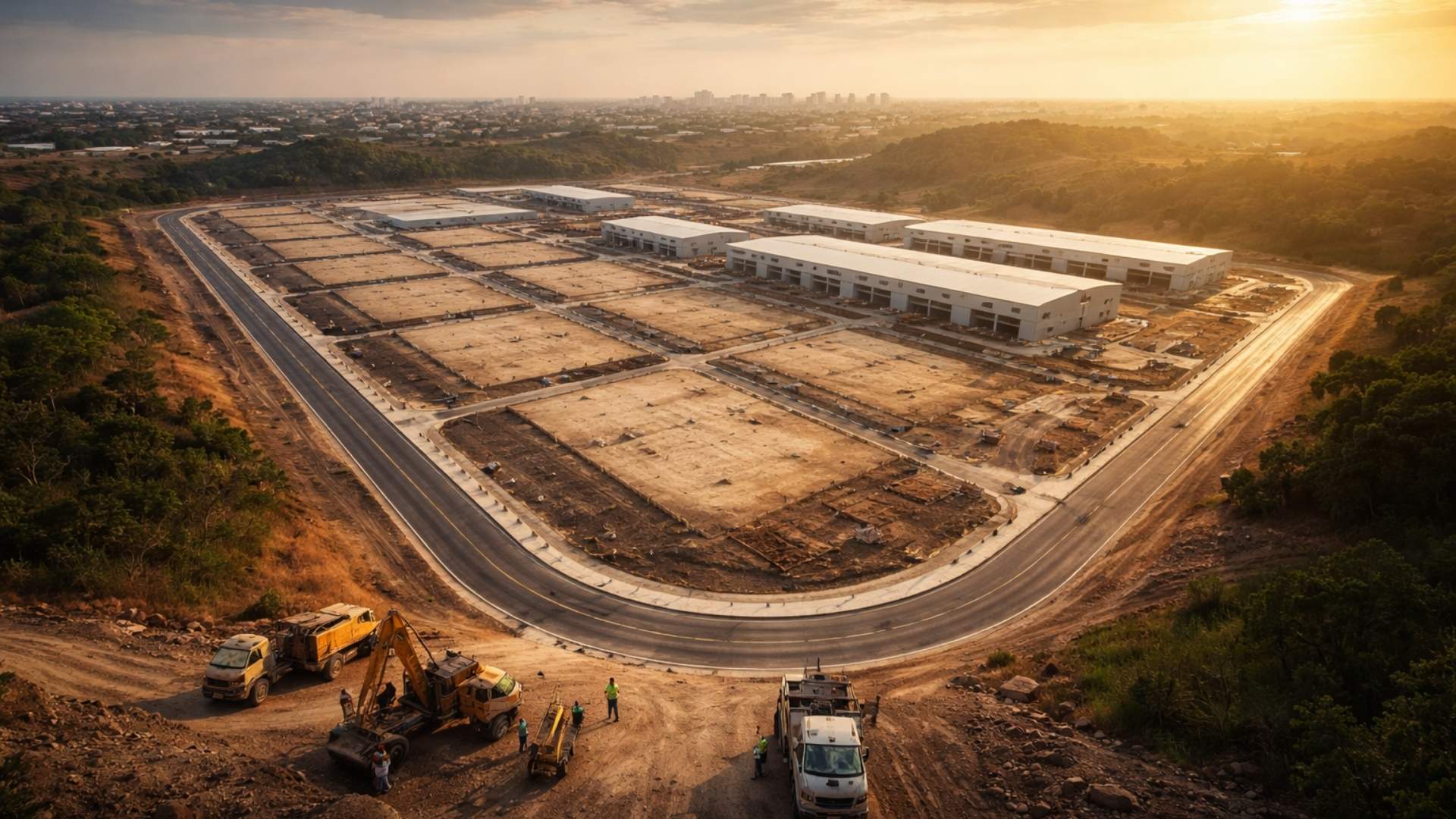
Brazilian city gains industrial hub for 85 companies that is equivalent to 55 football fields.
-
Peugeot and Citroën factory in Argentina cuts production by half and opens a layoff program for more than 2,000 employees after Brazil drastically reduced purchases of Argentine vehicles.

-
A Brazilian city gains a factory worth R$ 300 million with the capacity to process 200 thousand tons of wheat per year, a mill of 660 tons/day, silos for 42 thousand tons, and an industrial area of 276 thousand m².

-
Havan will leave the shopping mall in Blumenau to inaugurate something that the chain has never done before: a megastore in half-timbered style in the Historic Center of the city, which is expected to be completed in May and change the landscape of local retail.


When the minimum wage remains stagnant and the wage base continues to be compressed, the economy may still move, but the practical life of millions remains stalled. This helps explain why the country expands production, activity, and wealth but fails to make this dynamic broadly felt in the pockets of the population. Without income circulating at the base, growth loses social depth.
The Weight Of Keeping 2/3 Of The Population With Very Low Income
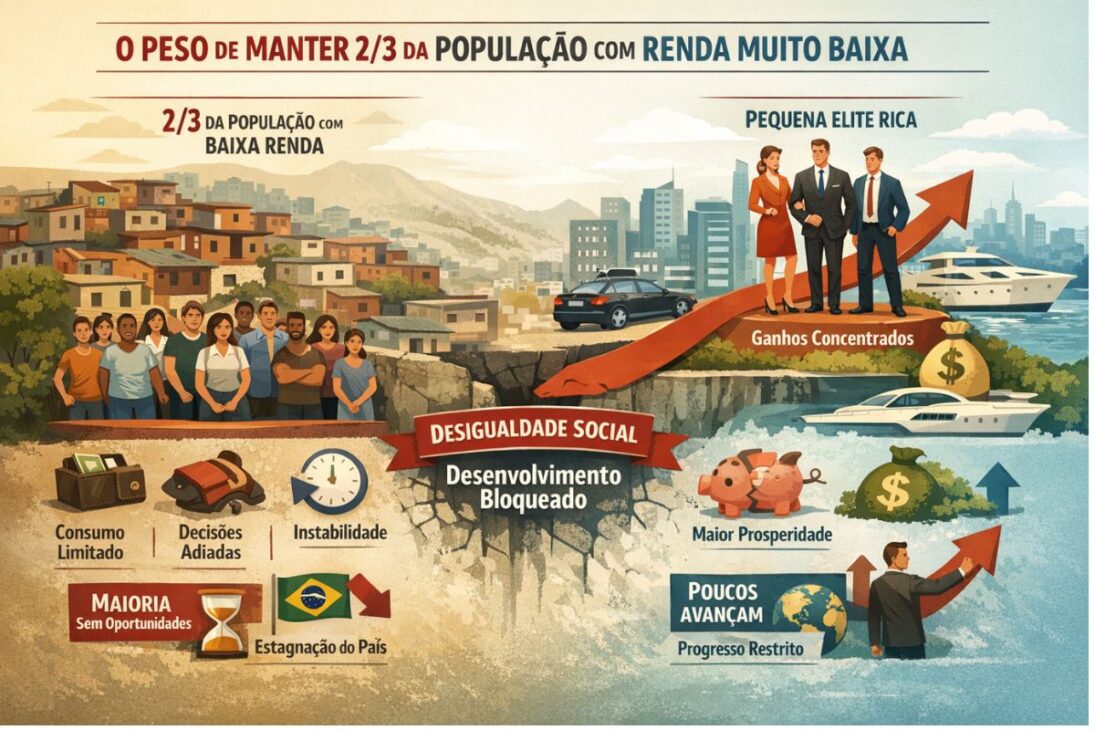
The observation that around 2/3 of the population receives between two, three minimum wages or less helps to gauge the problem. This means that a huge portion of the country participates little in the benefits of growth, consumes less than it could, postpones basic material life decisions, and remains distant from a more stable condition. This is not a statistical detail, but a structural blockage.
In this logic, development becomes twisted. Instead of forming a more homogeneous society, with gradual expansion of well-being and reduction of distances, the country preserves an unequal structure where a few advance more quickly and many remain limited. The warning from economists is simple and harsh at the same time: no country develops solidly when the majority is excluded from the gains generated by its own economy.
Why Low Wages Do Not Solve The Development Problem


The basis of this wage policy has been associated with a view that bets on compressing production costs as a way to export more, contain inflationary pressures, and facilitate economic adjustments. In practice, this means placing a significant portion of the stability effort on the wages of those at the base. It is the easiest way to sacrifice the people when one wants to adjust numbers without reorganizing the structure of growth.
The problem is that this exit, although it seems functional in the short term, pays a high price in the medium and long term. When popular income is kept under pressure, the country limits its own internal market, restricts the majority’s ability to consume, and turns growth into a narrower phenomenon. Economists insist that reducing wages does not create shared prosperity; it only postpones facing inequality and weakens the foundation of development.
What The Most Developed Countries Show In This Debate
The comparison presented in the argument is revealing: in more developed economies, wages tend to rise with growth, and the lowest wages need to rise even more to reduce distances. This helps form a less unequal and more integrated social profile. Development, in this model, does not happen despite the improvement of the wage base, but precisely with it.
The example of France illustrates this reasoning by showing a smaller gap between the salary of a university professor and the lowest minimum wage. The point is not to idealize another country, but to highlight a more balanced social proportion, where the top does not move so radically away from the base. For economists, it is in this type of arrangement that the economy stops growing just for a few and starts to build a development with real social participation.
The Brazil That Grows Without Overflowing Income
The portrait painted by this analysis is of a country that produces, advances, and accumulates, but fails to transform this movement into broad improvement for its population. When growth does not overflow into wages, it does not consolidate a stronger, more integrated, and less unequal society. The economy rises, but the social structure remains stalled.
That is why the debate about wages cannot be treated as a secondary theme. It is at the heart of the discussion about what kind of country Brazil wants to be: a country where growth is concentrated and separates, or a country where the majority participates in the benefits generated by their own work. Without this correction, development remains incomplete and inequality persists as the norm.
In the end, the economists’ warning goes straight to the point: growth without consistent improvement in popular income is not enough to develop the country in a balanced way. And, in their view, this is one of the keys to understanding why Brazil advances so much in certain numbers, but so little in the concrete life of a large part of the population.
In your opinion, does the country err by treating low wages as an economic solution, or has this model already shown that it deepens inequality?









Seja o primeiro a reagir!