





 Portuguese
  English
  Spanish
  4 min of reading
  0 comments



Scientists From NASA Explain The Mysterious Brightness Of Uranus, Suggesting That The Planet May Be Going Through Surprising Activity
In 1986, the Voyager 2, a NASA spacecraft, flew close to Uranus and became the first to observe the planet in detail. This historic mission revealed several peculiarities about Uranus’ magnetosphere, igniting the curiosity of scientists.
Since then, researchers have been trying to understand what causes the planet’s peculiar brightness, which remains an enigma. Recently, new discoveries have helped to clarify this mystery and opened doors for future explorations.
The Historic Encounter With Uranus
Launched in 1977, NASA’s Voyager 2 made history by approaching Uranus in 1986. During its mission, the probe collected valuable information about the planet’s magnetic field. Uranus’ magnetic field is unique: it is offset from the planet’s rotation axis and has an unusual tilt. Unlike other planets, Uranus has a horizontal rotation axis, causing peculiar behavior in its magnetosphere.
-
What can really trigger large volcanic eruptions? Research suggests that gas returning to the magma may be more dangerous than gas escaping from it.

-
Found in one of the most radioactive places on Earth, this Chernobyl fungus may be doing something with radiation that no one has been able to explain to this day.

-
A bright yellow mushroom imported from Asia escaped from a cultivation farm in the United States in 2010 and is now aggressively spreading across 25 states, destroying entire communities of native fungi in American forests.

-
Buried under China, a colossal machine weighing 20,000 tons began operating as the largest neutrino detector on the planet and, in just 59 days, surpassed results that science took half a century to achieve.


These characteristics attracted scientists’ attention even before the arrival of Voyager 2. However, the results obtained by the probe were surprising. Uranus’ magnetosphere, generated by the planet’s natural forces, turned out to be completely different from any other observed in other bodies of the solar system.
Instead of a protective layer formed by plasma and high-energy particles, as is the case around other planets, Uranus exhibited belts of electrons with extremely high energy levels.
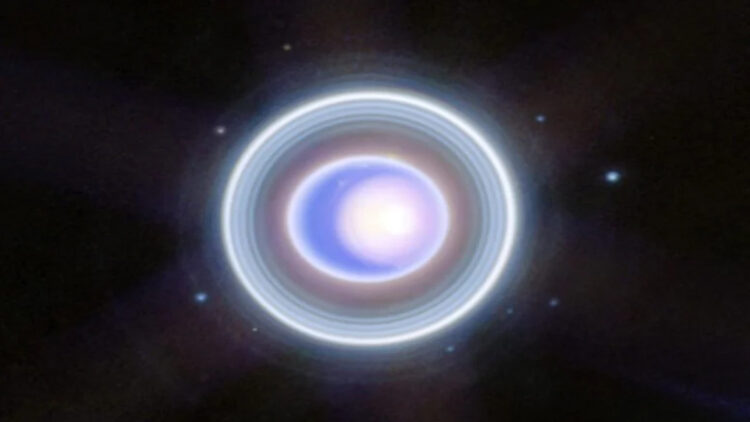
The Magnetosphere Of Uranus: An Unanswered Mystery
Another factor that left scientists perplexed was the lack of plasma vapor, which would normally be expected, especially around the planet’s moons. The moons of Uranus, like those of Jupiter, should have generated water ions, but none were detected. This unexplained phenomenon raised significant questions among researchers at the time.
An explanation for this unusual behavior began to emerge in 2024, when new studies were published. According to the November 2024 edition of Nature Astronomy, a rare space climate anomaly may have altered the conditions at the time of Voyager 2’s encounter with Uranus.
The solar wind, which is a current of charged particles traveling through space, may have compressed Uranus’ magnetosphere, modifying its magnetic field in an unprecedented way. This rare phenomenon may have caused the unusual conditions observed by the probe.
The Impact Of Space Weather On The Magnetosphere
The interaction between the solar wind and Uranus’ magnetosphere caused a temporary compression that expelled plasma from the planetary system. This resulted in the elimination of the usual sources of particles that would help maintain the radiation belts.
As a result, the electron belts appeared more active than they really were, further confusing scientists. This rare “space storm” not only altered the dynamics of the magnetosphere but also created an illusion of increased activity, complicating data interpretation.
This event is one of the reasons why the discoveries made by Voyager 2 were so challenging for scientists. However, this discovery also brought good news: further study of Uranus’ magnetosphere revealed that the planet’s moons may not be as inactive as previously thought.
The Moons Of Uranus: New Perspectives For Research
With the new data, scientists now believe that Uranus’ moons may be geologically active. Although they had been considered “dormant” so far, new information indicates that these moons may significantly contribute to the planet’s magnetosphere.
They may generate ions that feed the dynamics of Uranus’ magnetic field, opening new research possibilities for future space missions.
This discovery is especially exciting for scientists, as it suggests that Uranus still has many mysteries to unravel. With new technologies and new missions planned for the future, researchers are more confident that they will be able to better understand the behavior of the planet and its moons.
The resolution of the mystery of Uranus’ magnetosphere is a significant advance for planetary science. Now that scientists know more about the rare conditions affecting the planet’s magnetic field, this could transform how we explore the solar system. The discoveries made so far not only clarify doubts that have lasted for decades but also open up a range of possibilities for future explorations.
With technological advancements, it is possible that in the coming years, NASA and other space agencies will send more advanced missions to study Uranus and its moons. Research on the planet is now a priority, and this may lead to new discoveries that will transform our understanding of the solar system and the behavior of distant planets.
As the exploration of Uranus continues, planetary science advances, and human curiosity about space expands. What seemed an unsolvable mystery has now become an open door for new discoveries that could change the future of space exploration.








Seja o primeiro a reagir!