





 Portuguese
  English
  Spanish
  5 min of reading
  18 comments


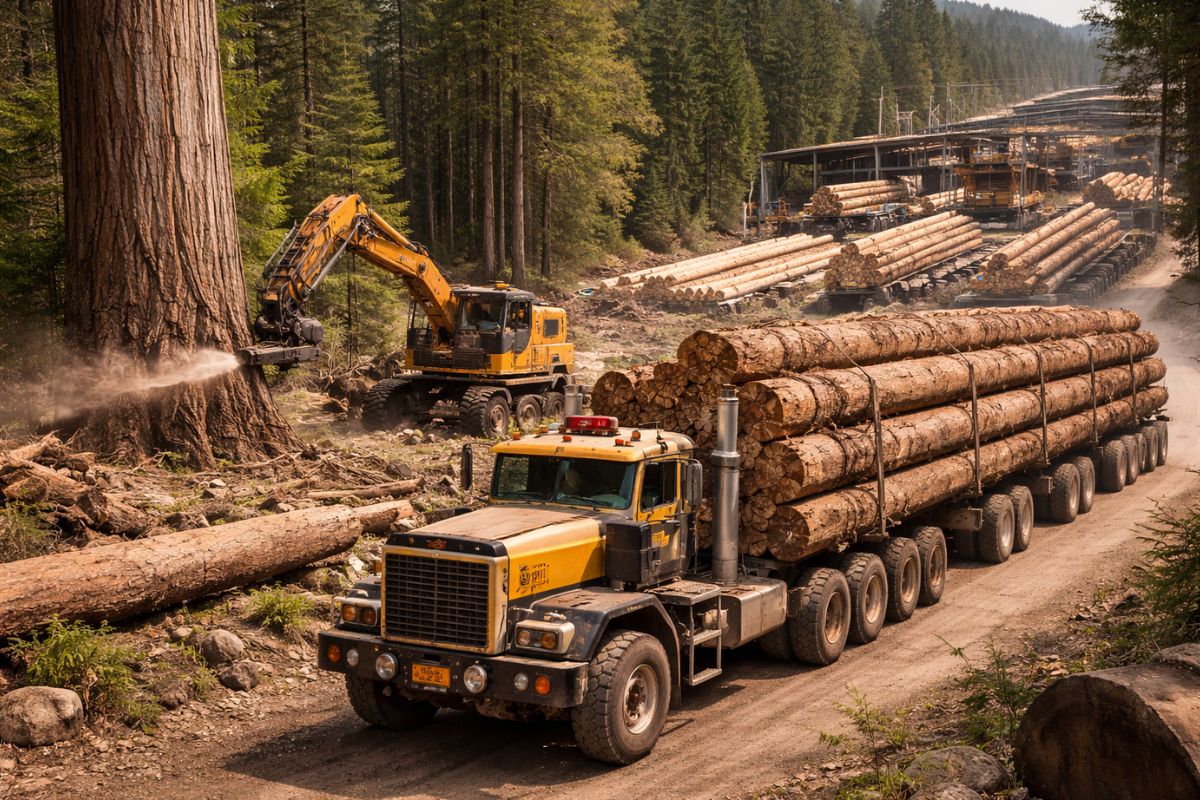


In Western Canada, The Largest Trees Of The North Leave The Forest Through Precision Logging And Enter A Supply Chain, Heavy Transport, And Hot Presses: The Pacific P16 Paves The Way To The Nearly Automatic Factory Where LVL Beam Gains Strength, Length, And Certification Under Continuous Sensor Control.
Largest Trees Of The North Don’t Become Beams By Chance: Before Any Cutting, The Work Starts With Terrain Measurement, Wind Reading, Slope Analysis, And Choosing Straight Specimens With Uniform Grain And Structural Value. In This Routine, Precision Logging Becomes Less Spectacle And More Risk Calculation, Because One Mistake Compromises Not Only One Trunk But The Surroundings.
What Stands Out Is The Contrast Between Forest And Industry: After The Controlled Fall, The Chain Goes Through Heavy Load Transport, Historical Machines, And A Nearly Automatic Factory That Transforms Raw Wood Into Engineering Material. On The Way, The Pacific P16 Appears As A Symbol Of Power, And The LVL Beams Emerge As The Final Product Of A Process That Exchanges Improvisation For Repeatability.
The Precision Logging That Begins In The Silence Of The Forest

Precision Logging Is Presented As A Method, Not As An Adjective. Trained Loggers Enter With Safety Equipment, Precision Chainsaws, And Marking Tools To Decide Where The Tree Should Fall, At What Angle, And With Which Margin For Unforeseen Events.
-
Friends have been building a small “town” for 30 years to grow old together, with compact houses, a common area, nature surrounding it, and a collective life project designed for friendship, coexistence, and simplicity.

-
This small town in Germany created its own currency 24 years ago, today it circulates millions per year, is accepted in over 300 stores, and the German government allowed all of this to happen under one condition.

-
Curitiba is shrinking and is expected to lose 97,000 residents by 2050, while inland cities in Paraná such as Sarandi, Araucária, and Toledo are experiencing accelerated growth that is changing the entire state’s map.

-
Tourists were poisoned on Everest in a million-dollar fraud scheme involving helicopters that diverted over $19 million and shocked international authorities.


Each Notch Has A Function Because The Lower Cut Guides The Fall And The Back Cut Determines The Moment When The Weight Overcomes The Trunk.
The Scene Is Often Reduced To “Cut And Done,” But In Practice, The Objective Is To Avoid Collateral Damage: Preserve Nearby Vegetation, Reduce Impact On The Soil, And Keep The Operational Area Open For Retrieval.
When Talking About The Largest Trees Of The North, Size Amplifies Everything: The Energy Accumulated In A Thick Trunk Requires Planning, And Precision Logging Becomes The Difference Between An Organized Flow And Chaos That Halts Logistics.
Pacific P16, 150 Tons And The Forest Turning Into Road

The Pacific P16 Enters When The Forest Needs To Communicate With The Factory. Described As A 150-Ton Tractor And Associated With Decades Of Legacy, It Is Presented As A Machine Capable Of Pulling Colossal Logs Through Difficult Terrain, Uphills, And Mountain Roads.
It’s The Type Of Equipment That Doesn’t Exist To Be Beautiful, It Exists To Move Mass.
This Stage Often Determines The Pace Of The Entire Chain. Marked And Measured Logs Leave Remote Areas For Consolidation Points And Then Proceed To Processing.
In Large-Scale Operations, Repetition Matters: The Pacific P16 Serves As A Reference Precisely Because It Keeps The Work Flowing When The Terrain And Weather Try To Impose The Opposite.
Inside The Nearly Automatic Factory, The Trunk Loses Its Shape And Gains Method

The Nearly Automatic Factory Begins “Disassembling” The Trunk: Peeling, Measuring, Cutting, And Feeding Lines Where Blades Slide As If Pointing A Giant Pencil, Producing Long Veneers.
Sensors And Inspections Remove Imperfections Because The Consistency Of The Veneer Is What Allows The Wood To Stop Being Just Wood And Become An Engineering Product.
Then, The Sequence Is Alignment And Pressure. Layers Are Organized Grain To Grain, Receive Adhesive, And Enter Hot Presses With Control Of Humidity, Temperature, And Time.
The Promise Here Is Not Magic, It’s Standardization: Repeating A Result At Scale And Turning Natural Variability Into Predictable Performance.
LVL Beams, What They Are And Why They Became The Target Of The Process
LVL Beams Appear As The End Point Of This Transformation: Glued And Pressed Layers Form A Long And Strong Structural Piece, Designed For Large Spans And Loads.
The Gain Is Not Only In Strength But In Consistency: When The Material Is Produced By Repeatable Criteria, It Becomes Easier To Design, Calculate, And Approve.
In Practice, LVL Beams Require A “Manufacturing Control” That Begins With The Veneer And Ends With The Finishing. After Pressing, The Pieces Are Cooled, Trimmed, And Precisely Cut Using Saws And Scanners To Maintain Constant Dimensions.
That’s Where The Industry Demands What The Forest Cannot Deliver Alone: Repetition, Tolerance, And Traceability.
Certification, Tracking, And The Invisible Part Of The System
The Described System Insists On Tracking: Each Step Marks, Follows, And Records From The Cut To The Exit Of The Line. The Idea Is To Reduce Uncertainty In Batch, Origin, And Performance.
This Does Not Eliminate Environmental Debate But Creates An Audit Language That The Market And Engineering Understand: Standards, Tests, Reports, Compliance.
In Quality Control, Samples From Each Batch Are Subjected To Checks Such As Flexural Strength, Rigidity, And Adhesive Integrity.
Ultimately, The Narrative Emphasizes That Each Beam Leaves With A Certificate Meeting North American Standards For Strength And Safety. When The Chain Is Long, Trust Needs To Be Documented, Not Just Assumed.
Nothing Is Wasted, But Nothing Disappears, The Fate Of Bark And Sawdust
The Presented Industrial Logic Says Nothing Is Wasted: Bark, Sawdust, And Scraps Become Biomass Energy, Chips, Or Input For Paper.
This Reutilization Appears As An Efficiency Strategy Because It Reduces Discard And Takes Advantage Of What Does Not Become Structural Pieces.
Still, The “Utilize Everything” Has Physical Limits And Economic Choices. Not All Waste Is The Same, And Not All Markets Absorb The Same Fraction.
Therefore, The Management Of Byproducts Becomes Part Of The Project: What Falls To The Ground Needs To Have A Destination, Or The Cost And Impact Will Return Through The Back Door.
What Changes When The Largest Trees Of The North Become Engineering
When The Largest Trees Of The North Enter A Production Line, The Perception Of The Forest Tends To Divide: For Some, It’s Proof Of Management And A Renewable Resource; For Others, It’s Pressure On Ancient Ecosystems And What Remains Of Primary Forest.
The Narrative Itself Blends National Pride And The Need To “Do It Right,” As If The Scale Demanded Stricter Rules.
The Final Result, However, Is Concrete: LVL Beams Come Out Ready To Become The Base For Houses, Bridges, And Industrial Structures, And This Repositions Wood In Contemporary Construction.
Precision Logging, The Pacific P16, And The Nearly Automatic Factory Become Chapters Of The Same Narrative: Transforming A Living Organism Into A Standardized Component Without Losing Account Of Everything That Was Necessary For That.
Among Chainsaws, Presses, And Certificates, Canada Designs A Model Where The Largest Trees Of The North Enter And Exit Through Well-Defined Routes, But The Fundamental Question Remains Open: What Is The Acceptable Limit To Transform Landscape Into Industrial Supply.
The Precision Logging Provides Security To The Process; It Doesn’t Alone Resolve The Debate.
If You Had To Choose An “Inevitable Cost” Of This Chain, Would It Be The Precision Logging, The Dependence On The Pacific P16, The Weight Of A Nearly Automatic Factory, Or The Fate Of The Waste That Does Not Become LVL Beams? And What Kind Of Rule Would You Demand To Accept That As Normal?










É muito bonito ver outros países cortando árvores milenares, enquanto no Brasil famílias de colonos acentados a mais de 40 anos são expulsos de seus lares em nome da ecologia. Se o mundo desse exemplo quem sabe isso refletiria nos outros países,
E igual a justiça brasileira no Brasil, a esquerda pode deitar e rolar enquanto a direita é vigiada com lupa.
Este mundo é uma vergonha.
Colonos praticamente levaram a floresta de Araucária à extinção completa , junto com os desgovernos das épocas passado as … colono é uma praga !!
Destroying old growth should have such a large fine
Gozado, vejo muitos comentários no sentido de que, só porque os outros países não preservam, nós não deveríamos ser incomodados pelos nossos desmatamentos. Este pessoal precisa entender que as florestas são responsáveis pelas nossas águas, pelo microclima da região, controla o ritmo das chuvas e até colaboram com nossa produção agrícola. Então, ter florestas preservadas, são uma abenção para o Brasil e se alguém quiser saber o que o desmatamento faz com uma nação, de uma olhada em Bangladesh com toda a sua miséria e procure saber sua história com as madeireiras japonesas, aí vão entender o que acontece com países que perdem suas florestas.