





 Portuguese
  English
  Spanish
  7 min of reading
  2 comments


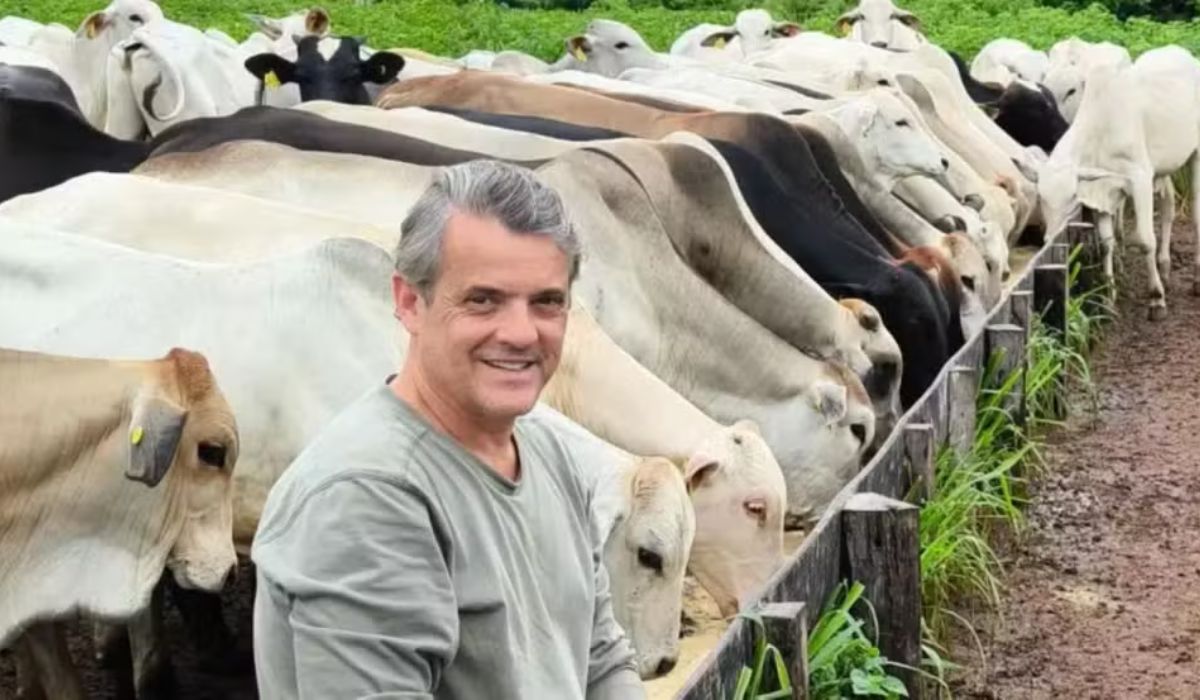


Upon Leaving USP and Acting on the Amazon Frontier, a Veterinarian Began Testing a Livestock Model with Pasture Recovery, Trees, and Intensive Management, Aiming to Increase Productivity in Already Cleared Areas and Reduce Pressure for New Clearings.
The veterinarian Luís Fernando Laranja Fonseca left a position as a professor and researcher at the University of São Paulo (USP) and moved to northern Mato Grosso with the intention of working, in the field, on a subject that concerned him during his academic life: the relationship between the opening of areas for livestock farming and the advance of deforestation in the Amazon.
The decision was made in 2002, when he was 35 years old, leading him to Alta Floresta, a municipality situated in an area marked by decades of agricultural expansion.
At the time, Fonseca settled in the region with his wife and their first child, then six months old.
-
Friends have been building a small “town” for 30 years to grow old together, with compact houses, a common area, nature surrounding it, and a collective life project designed for friendship, coexistence, and simplicity.

-
This small town in Germany created its own currency 24 years ago, today it circulates millions per year, is accepted in over 300 stores, and the German government allowed all of this to happen under one condition.

-
Curitiba is shrinking and is expected to lose 97,000 residents by 2050, while inland cities in Paraná such as Sarandi, Araucária, and Toledo are experiencing accelerated growth that is changing the entire state’s map.

-
Tourists were poisoned on Everest in a million-dollar fraud scheme involving helicopters that diverted over $19 million and shocked international authorities.


Years later, he described that period as a sharp shift in his professional and personal trajectory.
“My reading was that we needed to develop businesses that were associated with forest conservation. If we couldn’t generate good businesses that valued the standing forest, it would be difficult to drastically reduce deforestation,” he said.
His stay in the Amazon lasted six years.
During that time, their second child was born, and Fonseca began working directly with communities in the extraction and commercialization of Brazil nuts, an activity that gave rise to his first venture in the region, Ouro Verde.

Impact Businesses and Investments in the Amazon
Although the nut business found viability, Fonseca claims he began to see limitations when comparing the initiative’s reach with the pace of forest loss observed in the region.
From this perspective, he decided to direct efforts toward a model that, he reports, could increase the volume of resources allocated to projects with socio-environmental goals.
It was in this context that he founded Kaeté Investimentos, a management company aimed at mobilizing funds for impact businesses in the Amazon.
Later, in 2019, he structured Caaporã, a holding that, according to information from the group itself, manages about 20 thousand hectares distributed across six farms in the states of Mato Grosso, Tocantins, and Bahia.
Back in the state of São Paulo, Fonseca also took on the coordination of the Agriculture and Environment Program at WWF-Brasil.
Today, he maintains a work routine between the holding’s office in Piracicaba (SP) and the rural properties.
Born in São Borja (RS), he has a doctorate in Animal Reproduction and conducted postdoctoral research at the University of Kentucky in the United States.
Pasture Expansion and Deforestation in the Amazon
The expansion of pastures appears in technical surveys as one of the main drivers of deforestation in the Amazon.
Data from MapBiomas indicate that the area dedicated to pastures was the land use that advanced the most in the biome between 1985 and 2023, growing by over 363%, from approximately 12.7 million hectares to 59 million hectares during this period.
Reporting what he saw in northern Mato Grosso, Fonseca says the landscape was marked by the predominance of extensive cattle ranching, with animals in large pasture areas and a lower level of investment in management and technology.
In degraded pastures, the grass tends to offer fewer nutrients, which can prolong the time needed for cattle to gain weight.
In this context, land use experts often point out that low productivity can increase the demand for land to sustain production.
Fonseca argues that if the sector can produce more in already cleared areas, the activity can reduce the pressure to convert new areas of native vegetation.
Recovery of Degraded Pastures and Integration with Trees
On the farms managed by Caaporã, the strategy reported by Fonseca begins with the recovery of degraded pastures, areas that have already been cleared and lost some fertility.
The management includes soil corrections and changes in pasture design, with diversification of plants and inclusion of trees.
According to him, the system combines grasses with legumes, such as forage peanuts.
Due to their ability to fix nitrogen in the soil, these plants can reduce the need for nitrogen fertilizers, such as urea, whose production and use are also associated with emissions.
Fonseca also mentions the adoption of exotic trees like eucalyptus, and natives like paricá, in arrangements that create shade and alter the microclimatic conditions of the pasture.
The presence of shade, the entrepreneur asserts, helps to reduce the thermal stress on animals during hot periods, which reflects on weight gain.
With changes in management and feeding, he says the goal is to shorten the productive cycle: while traditional systems may take about four years to reach slaughter weight, the model applied on the group’s farms aims to reach approximately two years.
The relationship with emissions, according to Fonseca, is linked to the animal’s lifespan.
“If you have a cow that fattens in four years, it spends four years literally burping methane,” he explained, while explaining the project’s logic.
Methane in Livestock and Greenhouse Gas Emissions
Livestock occupies a central space in the climate debate in Brazil because of the methane released during the digestion of ruminants.
Data from SEEG indicate that agriculture and livestock accounted for about three-quarters of national methane emissions in 2023, with most of this volume attributed to livestock.
Based on this, Fonseca argues that increasing productivity in already cleared areas can reduce the need for pasture expansion.
He also states that if the model spreads, low-productivity areas could be redirected for forest restoration, in line with Brazilian commitments related to recovering native vegetation within the Paris Agreement.
Regarding the footprint per kilogram of meat, the entrepreneur presents estimates from his own method.
According to him, a traditional system can emit about 35 kg of CO2 equivalent per kilogram of carcass, while production on farms managed by Caaporã would be around 20 kg, which he points out as a reduction of over 40%.
These figures, says Fonseca, are calculated internally based on the characteristics of management and the slaughter time.
The work has been observed by researchers for about two decades, according to reports cited in the original text.
André Pereira de Carvalho, from the Center for Sustainability Studies at FGV, frames the initiative within the field of regenerative agriculture, considering that food production can align with environmental services.
In his assessment, besides emissions, impacts on water and biodiversity are also included in the equation.
Silvia Ferraz Nogueira De Tommaso, a professor at the professional doctorate in Business Management at FIA Business School, states that the topic involves a balance between economic weight and environmental impacts.
For her, discussing damage reduction without neglecting the role of the sector in income and employment is part of the challenge, especially in regions where the activity organizes the local economy.
Meat Traceability, Carbon Credits, and Domestic Market
The migration to more intensive and technologized systems faces practical barriers, according to Fonseca.
He cites the need for technical knowledge, the cost of recovering degraded pastures, and the resistance of some producers to altering established routines.
In his view, credit lines for sustainable practices could help, but access, he claims, tends to be bureaucratic.
From a commercial standpoint, Fonseca says that the meat produced with lower-impact practices still does not systematically receive a price premium in the market.
In light of this, he states he is studying the possibility of supplementing income with carbon credits.
The company, according to reports, is developing a methodology linked to the voluntary market, with certification.
Slaughterhouses have also begun mentioning the topic.
Minerva Foods reports that it purchases part of Caaporã’s production and seeks to promote regenerative livestock practices among suppliers, associating this type of management with an emissions reduction strategy.
The discussion on traceability in the beef supply chain gained visibility during COP30, a climate conference held in Belém (PA) from November 10 to 21, 2025, according to the event’s organizing body.
In this environment, transparency initiatives aimed at consumers were cited as attempts to connect data on the origin and socio-environmental performance of products sold in the country.
The Do Pasto ao Prato app presents itself as a tool to identify the origin of beef available in the Brazilian market and describes the initiative as an international partnership.
In the material released by the project and in reports that addressed the topic, traceability appears as a sensitive point, especially in the domestic market, where accountability tends to be lower than in some importing markets.
Looking ahead to the coming years, Fonseca states he works under the premise that the demand for meat will continue to exist and cites projections from international organizations like the OECD and FAO to support this scenario.
He also expresses skepticism about a widespread substitution with lab-grown meat in the short term, citing cost and consumer adaptation as factors of uncertainty.









👏👏👏👏👏
As vezes dá certo deixar uma fazenda no nome de um laranja……