





 Portuguese
  English
  Spanish
  4 min of reading
  0 comments


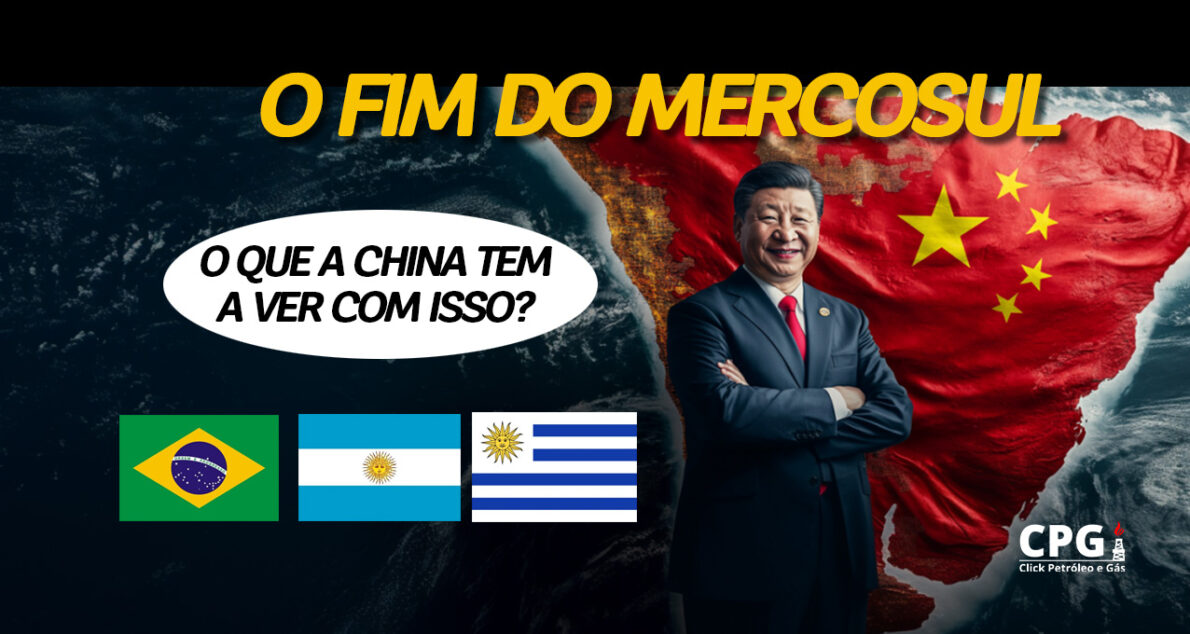
Mercosur Faces Its Biggest Crisis, With the Economic Bloc on the Brink of Collapse Due to Differences Between Argentina, Brazil, and Uruguay. The Growing Influence of China in the Region Increases Tensions, and the Possibility of a Dissolution of Mercosur Becomes More Real. How Will This Impact the Future of South America?
At a time when the global geopolitical landscape becomes increasingly volatile, Mercosur, the economic bloc that has united the largest economies of South America for decades, is under threat like never before.
The political crisis that has arisen between Argentina, Brazil, and Uruguay, exacerbated by the growing influence of China, suggests that the end of this cooperation agreement may be closer than many imagine. But what is really behind this imminent rupture? And how might this impact the economic and political future of the region?
Mercosur and the Growing Internal Crisis
According to the channel “Let’s Talk About History”, the recent 64th Summit of Mercosur Heads of State, held in Asunción, Paraguay, highlighted the differences among member countries, especially between Brazil, Argentina, and Uruguay. With the inauguration of Javier Milei in Argentina, relations among South American countries have become even tenser, putting the future of Mercosur at risk.
-
With an investment of R$ 612 million, a capacity to process 1.2 million liters of milk per day, Piracanjuba inaugurates a mega cheese factory that increases national production, reduces dependence on imports, and repositions Brazil on the global dairy map.

-
Brazilian city gains industrial hub for 85 companies that is equivalent to 55 football fields.

-
Peugeot and Citroën factory in Argentina cuts production by half and opens a layoff program for more than 2,000 employees after Brazil drastically reduced purchases of Argentine vehicles.

-
A Brazilian city gains a factory worth R$ 300 million with the capacity to process 200 thousand tons of wheat per year, a mill of 660 tons/day, silos for 42 thousand tons, and an industrial area of 276 thousand m².


During the event, leaders debated the delicate issue of bilateral trade agreements within the bloc. Uruguay, in particular, has expressed strong interest in establishing a free trade agreement with China, challenging Mercosur rules that require such negotiations to be conducted collectively.
Tensions Among Member Countries:
According to “Let’s Talk About History,” Uruguay’s intention to negotiate directly with China has caused discomfort among the other members, especially Brazil and Argentina. Before Milei’s rise to power, the Argentine government, under Alberto Fernández, aligned itself with Brazil in opposition to these bilateral agreements.
However, with Milei in charge, Argentina has adopted a more flexible stance, advocating for the autonomy of Mercosur member countries to enter into individual agreements if it is more convenient for their economies.
The Argentine Foreign Minister, Diana Mondino, who represented President Milei at the summit, argued that Mercosur should allow greater flexibility in its rules, especially regarding bilateral agreements.
She stated: “Let’s consider the possibility of bilateral agreements. It is very difficult for everyone to agree on all issues. Eventually, there may be a case where a bilateral trade agreement is convenient.”
The Rise of China in the South American Scenario
The growing interest of China in South America, particularly in Mercosur, is not new. According to recent data from July 2024, the Asian giant has become the main trading partner of several countries in the region, including Brazil and Uruguay.
The possibility of direct trade agreements between China and Mercosur countries, such as Uruguay, may pose a threat to the bloc, further destabilizing relations among its members.
The Impacts of a Possible Dissolution of Mercosur
The possible exit of Uruguay and Argentina from Mercosur would raise serious concerns about the future of the bloc. According to international trade experts, the exit of these two countries would significantly weaken Mercosur, both economically and politically.
The departure of founding members like Argentina, which along with Brazil forms the core of the bloc, could create a dangerous precedent, encouraging other countries to follow suit.
How Brazil Positions Itself
The Brazilian government, in turn, remains steadfast in its position to defend the unity of Mercosur and the joint negotiation of trade agreements. According to the channel “Let’s Talk About History,” Brazil fears that the relaxation of the bloc’s rules may lead to its fragmentation, making it less relevant in the global arena.
Recently, the Brazilian Foreign Minister emphasized that Mercosur should be viewed as a platform for regional integration and that cooperation among members is crucial for facing economic and geopolitical challenges.
For experts, the crisis in Mercosur reflects not only the internal divergences among its members but also the growing influence of external powers, such as China, in the region.
As tensions increase and individual interests prevail, the future of Mercosur seems uncertain. If the bloc fails to find a solution that balances the interests of its members, the collapse of Mercosur may become an imminent reality.
With the growing influence of China in South America and the internal crisis in Mercosur, are we about to witness the end of this economic bloc? How might this possible dissolution impact Brazil and the rest of South America? Share your thoughts in the comments!








Seja o primeiro a reagir!