





 Português
  Inglês
  Espanhol
  2 min de leitura
  0 comentários



Successful Test of General Atomics and Kepler Communications Uses Laser Beam to Transfer Data Between Moving Aircraft and Low Earth Orbit Satellite.
An innovative communication between air and space has been successfully carried out. In a recent test, General Atomics Electromagnetic Systems (GA-EMS) and Kepler Communications used a laser system to connect a standard aircraft to a low Earth orbit satellite, establishing a new milestone in data transfer.
Innovative Test Establishes Unprecedented Link
The experiment successfully united sky and space. The connection was established between a De Havilland Canada DHC-6 Twin Otter and a satellite from Kepler. The test represents a significant advance, validating optical communication under real flight conditions.
Overcoming the Limitations of Traditional Radio
Radio communication, despite being revolutionary, has limitations. Its main disadvantage is the restricted bandwidth, which processes a limited amount of data per second. This is a critical issue in space exploration, where downloading data from probes can take days. Laser optical communication emerges as a solution to this slowness.
-
A bright yellow mushroom imported from Asia escaped from a cultivation farm in the United States in 2010 and is now aggressively spreading across 25 states, destroying entire communities of native fungi in American forests.

-
Buried under China, a colossal machine weighing 20,000 tons began operating as the largest neutrino detector on the planet and, in just 59 days, surpassed results that science took half a century to achieve.

-
Iran enters the center of a climate alert after the war emitted 5.6 million tons of CO2 in two weeks, surpassing the annual pollution of entire countries.

-
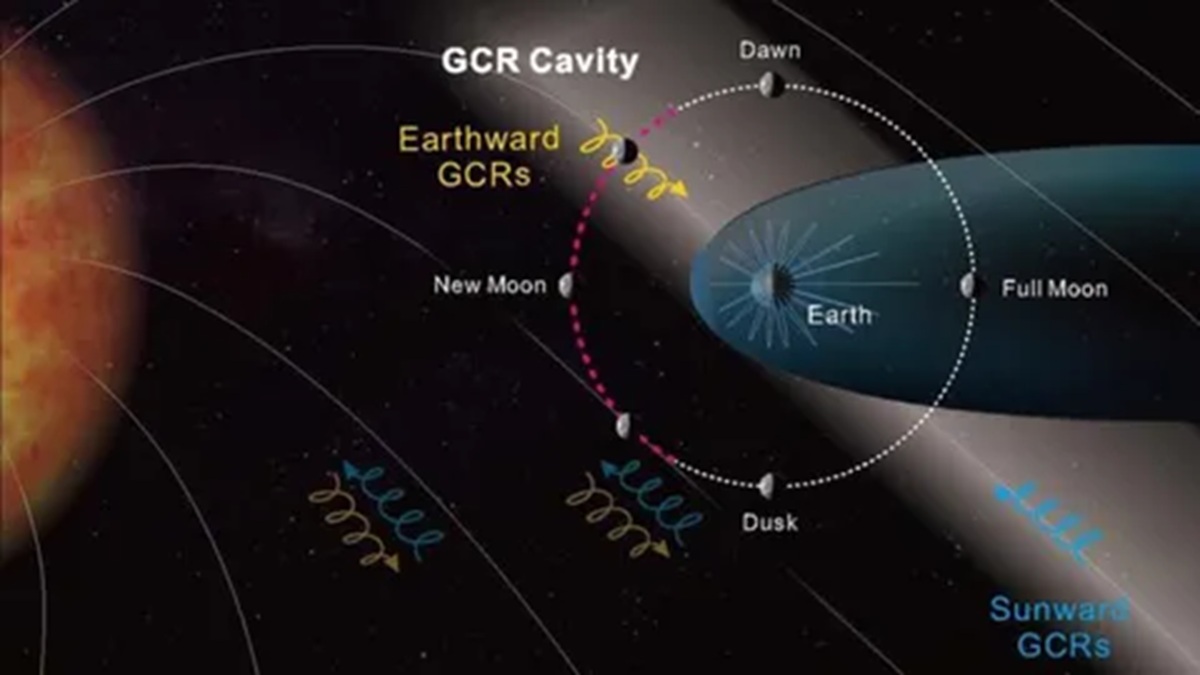
Lunar exploration may change after a Chinese probe finds a “cavity” of radiation that reduces the impact on astronauts by up to 20% at certain times on the Moon.

Strategic Importance for Defense Applications
Optical communications are vital for defense. The modern combatant relies on a global digital network, where satellites are a key link. Maintaining a laser connection with a moving aircraft is a significant technical challenge. The success of this test opens doors for secure and robust data transfers in tactical missions.
Technical Details of the Laser Connection
To overcome the challenge, General Atomics used its Optical Communication Terminal (OCT). The 30 cm system was mounted on the aircraft and established contact with the Kepler satellite. The OCT uses a 10-watt laser, capable of sending data at 2.5 Gbps over a distance of up to 5,500 km. During the test, the data transmission rate peaked at approximately 1 Gbps.
A Decisive Milestone for Global Connectivity
“Our team has achieved a proof of concept milestone“, said Scott Forney, president of GA-EMS. He confirmed that the airborne OCT completed the pointing, acquisition, tracking, and data transfer, validating the uplink and downlink capabilities. Robert Conrad, president of Kepler US, added that the achievement demonstrates what is possible when airborne and space systems work together, enhancing the ability to provide secure and high-throughput connectivity for defense and commercial sectors.






Seja o primeiro a reagir!