





 Portuguese
  English
  Spanish
  8 min of reading
  0 comments


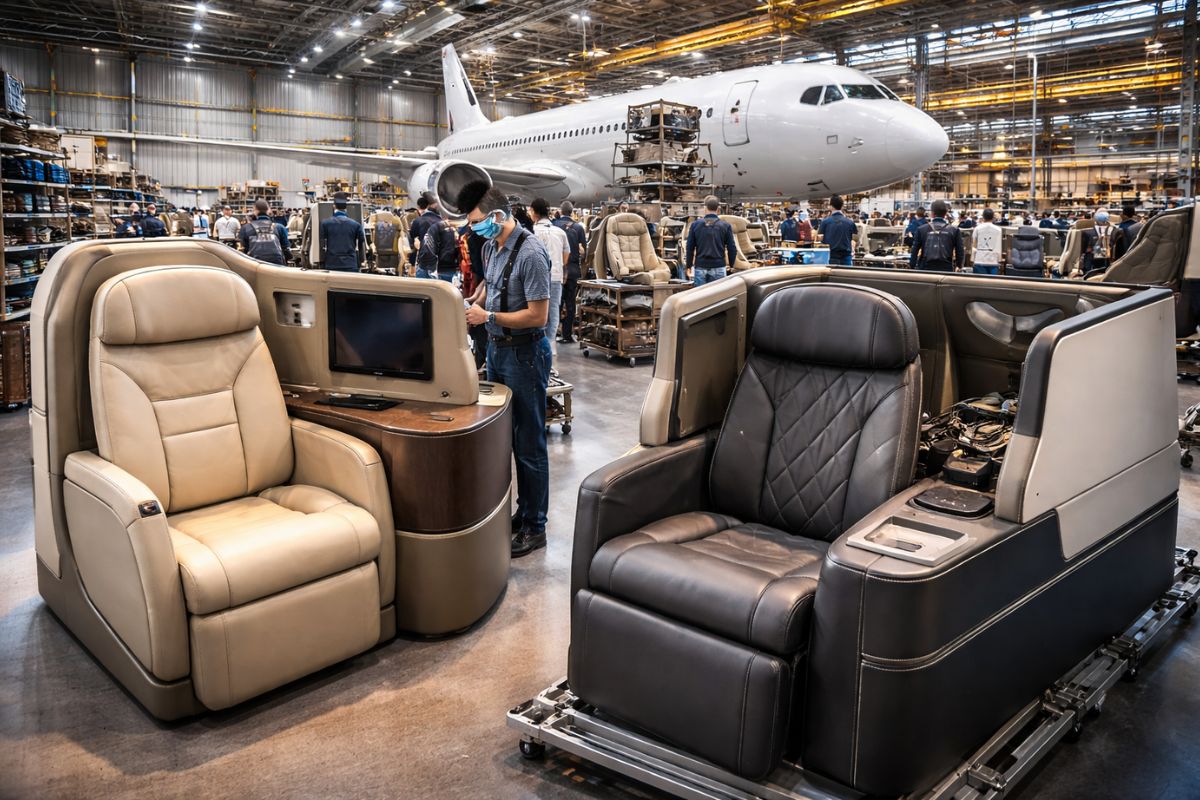
In Aviation, The Seat Crisis Left The Cabin Finish And Entered The Core Of Production Because Each Premium Seat Can Gather 3,000 Pieces From 50 Suppliers In 15 Countries, Depend On Rigorous Certification And Still Be Redesigned To Meet Airlines Obsessed With Differentiation, Revenue And Private Label.
In aviation, a flight delay can start at a point that the passenger almost never sees as an industrial problem: the seat. What seems like a relatively simple cabin item has become one of the most sensitive brakes in the delivery of new aircraft, especially in long-haul jets, where the pressure for comfort, exclusivity, and profitability has elevated the technical complexity to a hard-to-scale level.
The impact is no longer restricted to the interior of the plane. When seats are delayed, manufacturers like Airbus and Boeing hold deliveries, airlines postpone route launches and fleet renewal, and the cost of this friction spreads throughout the chain. The bottleneck lies in a component visible to the passenger but hidden under an industrial, regulatory, and commercial architecture that is much heavier than it seems.
A Premium Seat Stopped Being A Detail And Became A Critical System

In a Safran Seats factory in Cwmbran, South Wales, the challenge appears almost symbolically under the armrest of a business class seat.
-
50 viaducts, 4 tunnels, 28 bridges, and 40 kilometers of bike paths: BR-262 in Espírito Santo will receive 8.6 billion reais for the largest engineering project in the state’s history, inspired by the Immigrant Highway in São Paulo.

-
Brazil produces too much clean energy and doesn’t know what to do with it: over 20% of solar and wind capacity was wasted in 2025 while investors flee and 509 renewable generation projects were abandoned in the last year.

-
Piauí will produce a new fuel that replaces diesel without needing to change anything in the truck’s engine and reduces pollutant gas emissions by half: truck drivers from all over the Northeast are already celebrating the news that will arrive later this decade.

-
A new Brazilian shopping center worth R$ 400 million will be built in an area equivalent to more than 4 football fields, featuring 90 stores, 5 cinemas, a supermarket, a college, and parking for 1,700 cars, potentially generating 3,000 jobs.


Before the passenger sees finish, comfort, and design, there is a manufacturing puzzle that can involve up to 3,000 pieces from 50 suppliers in 15 countries.
This transforms the seat into a highly integrated product, with dependencies spread across various layers of the global chain.
This scale helps explain why aviation has come to treat the seat as a structural item for the pace of deliveries.
It’s not just about assembling foam, fabric, and casing. There are chips, screens, motors, mechanisms, supports, certifications, and installation interfaces that need to communicate with no significant margin for error.
When a single link fails, the effect does not just halt the cabin, but the entire aircraft.
The economic weight of this component adds to the pressure. Industry sources point out that a business class seat can cost between US$ 80,000 and US$ 100,000, while a first-class suite can reach US$ 1 million.
This happens because the cabin of a long-haul jet hosts some of the most valuable revenue-generating spaces in the world, making seating decisions a strategic commercial issue, not just an aesthetic one.
Carsten Spohr, CEO of the Lufthansa Group, summarized this logic by stating that there are few truly differentiating things on board: crew, seat, and service.
The aircraft itself, for the passenger, weighs less as a brand differential. That is precisely why the most discreet item in the cabin has become one of the hardest to simplify.
Slow Certification And Extreme Customization Formed The Most Toxic Combination

The problem did not start yesterday. Willie Walsh, director-general of the International Air Transport Association, stated that this difficulty has existed for about 20 years, although it has worsened.
What has changed is the intensity of the combination of customization demands, scarcity of certification engineers, and regulatory rigidity aimed at safety, including head impact testing and structural validation.
In practice, aviation has come to require increasing uniqueness within an environment that functions poorly with excessive singularity.
Airlines want their own cabins, exclusive layouts, distinct materials, better connectivity, additional comfort, and premium experiences that can reinforce the brand.
The result is an industry that needs to operate at scale but remains stuck in a nearly artisanal model.
The commercial ambition of airlines has collided with the actual capacity of seat manufacturers to industrialize.
This tension becomes even clearer in the premium segment. The greater autonomy of smaller aircraft has intensified the race to adapt sophisticated seats to compact spaces.
Even the sleek shape of the fuselage and the differences between the left and right sides of the plane mean that few luxury seats are exactly alike. This erodes standardization and increases engineering efforts in each program.
John Walton, an aircraft interiors specialist and founder of the publication The Up Front, described this situation as a “perfect storm” of problems that, individually, might not paralyze the sector. Together, however, they halt the fluidity of production.
In aviation, a product that seems repeatable has come to be treated as an almost exclusive project, and that is the heart of the current bottleneck.
The Market Grew, But The Industry Is Still Trying To Reorganize
With the resumption of travel after the pandemic, the pressure on this niche has increased rather than diminished.
A study by Tronos Aviation Consultancy with AeroDynamic Advisory projects that airlines will need more than 8 million seats in the next decade, in a market estimated at US$ 52 billion over ten years.
The volume is enormous, but the industrial base is still trying to regain its footing, workforce, and predictability.
In May, Airbus warned clients that delivery delays could persist for another three years, attributing the accumulation of difficulties mainly to engines and seats.
Boeing, for its part, acknowledged that certification bottlenecks related to interiors would continue to be a challenge for the remainder of the year. This shows that the problem has ceased to be localized and now interferes directly with the production cadence of the two largest aircraft manufacturers in the world.
Safran has become an example of this forced reset. Its seating division reached breakeven only in the fourth quarter of 2024 after being heavily hit by the drop in demand during the pandemic.
Victoria Foy, CEO of Safran Seats, stated that the company had to practically restart the sector, recover operations at high speed, and deal with the loss of experienced professionals who migrated to other activities.
Even so, the company claims to have produced 2.5 times more in 2024 than the previous year. The data shows that there is some capacity for acceleration, but it does not resolve the central tension.
In the factory, chips, screens, and motors are assembled in individual compartments, not in a traditional continuous line, precisely because few premium seats are identical. The scale grows, but the logic of production still carries strong traits of specialized workshops.
Standardizing Without Destroying Differentiation Became The New Equation
To unlock production, seat manufacturers have begun to rethink how they design their products.
Instead of developing each seat from scratch, the strategy has been shifting towards repurposing basic platforms, in a logic similar to automakers that use the same chassis across different models.
The idea is to anticipate engineering and certification over a common base, reducing the risk of delays later.
This simplification attempt is central to aviation because it allows addressing the bottleneck without entirely abolishing customization.
Stan Kottke, president of the interiors division at Collins Aerospace, advocates for building platforms deliberately designed to differentiate in various directions.
In other words, the industry is trying to offer commercial variety on top of a less chaotic technical skeleton.
The sector has already understood that it cannot continue treating each cabin as if it were an irreplaceable prototype.
The challenge is that passenger preferences have also changed. In the Middle East, more families are traveling in business class. In the United States, retirees are seeking ergonomic seats. Millennials invest in high-end experiences.
Airlines, in light of this, want to adapt product, visual language, and comfort to increasingly segmented audiences, sometimes even at different times of the day.
However, seats do not follow the aircraft’s lifecycle. Generally, chairs last about seven years, while the aircraft flies for 20 to 25 years. This means that even when the jet is finally delivered, the pressure for cabin renewal returns relatively quickly.
Aviation is not only facing an initial delivery bottleneck but a continuous replacement cycle that keeps the sector under permanent stress.
Negotiations Got Tougher And The Leasing Sector Entered The Debate
The quest for industrial discipline has also changed the tone of business conversations. According to people with direct knowledge of these negotiations, seat manufacturers have started to refuse more business, instead of pursuing all available opportunities.
The response “no proposal” has become more common in bids, in an attempt to avoid financial and operational risks that may explode later.
This has elevated the tension among three actors that already lived in a delicate balance: aircraft manufacturers, seat suppliers, and airlines.
Typically, the airline purchases the seat directly from companies like Safran, Collins, or Recaro, but hires Airbus or Boeing to install the item in the aircraft.
When something delays within this arrangement, responsibility becomes a point of dispute. Airbus is even studying ways to charge penalties to seat manufacturers when delays hinder aircraft delivery.
In this environment, the leasing sector has emerged as a more direct voice for standardization. Aengus Kelly, CEO of AerCap, recommended that airline presidents stop “inventing more seats” and choose already certified, good-quality products to put the aircraft into operation faster.
It is a tough message, but consistent with a market that has begun to value predictability as much as differentiation.
However, airlines do not seem ready to give up one of their strongest marketing weapons. Tony Douglas, CEO of Riyadh Air, rejected any retreat from customization and stated he wants a unique brand reflected in the cabin.
This deadlock summarizes the sector’s dilemma: aviation needs to standardize to deliver, but continues to commercially reward those who can appear different.
The seat has become one of the best portraits of how modern aviation has become a hostage to its own sophistication. The product that should crown the passenger experience has come to concentrate conflicts between engineering, certification, global supply chain, brand design, and production pace.
Behind a premium seat lies a fragmented industry, pressured by deadlines, margins, and commercial expectations that no longer fit into an almost artisanal model.
If the cabin is today one of the few areas where the airline can really appear unique, to what extent is it worth insisting on extreme customization when it delays aircraft, prolongs the use of outdated planes, and can increase the entire operation’s costs? In your view, does the passenger really perceive this difference on board, or is aviation paying too much for a degree of exclusivity that few can notice?









Seja o primeiro a reagir!