





 Portuguese
  English
  Spanish
  3 min of reading
  8 comments


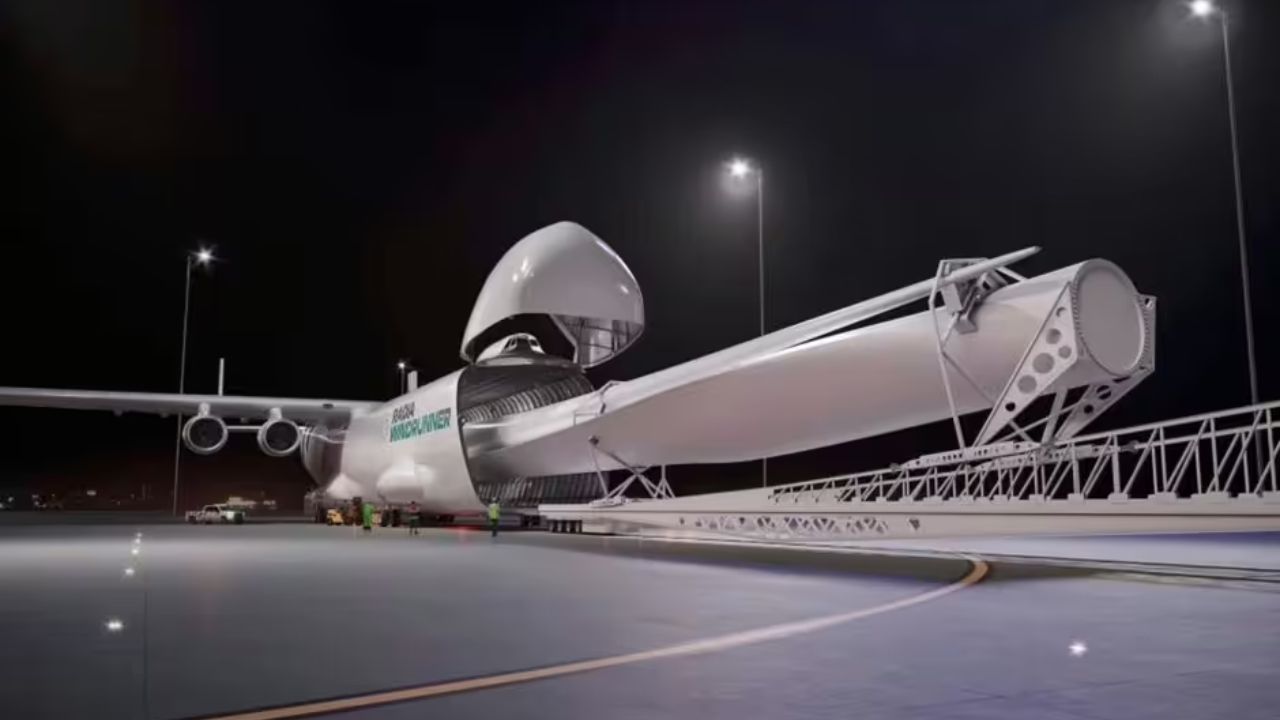


At 108.5 Meters Long, The Largest Airplane In The World Can Carry Wind Turbine Blades Up To 105 Meters And 26 Tons, Revolutionizing Renewable Energy And The Air Transport Of Gigantic Cargo!
If you think the Boeing 747 is already an absurdly large machine, it’s because you haven’t seen the WindRunner, the largest airplane in the world. This sky monster is 38.7 meters longer and was created for an unusual purpose: to transport the largest wind turbine blades ever built to remote locations.
Now, think with me: how do you take a 105-meter-long piece weighing 26 tons to a wind farm in the middle of nowhere? You can’t just shove that in a truck and drive off, right? That’s exactly why the company Radia decided to build a gigantic airplane to solve this problem once and for all.
WindRunner: The Largest Airplane In The World That Will Carry The Impossible

The WindRunner is not just big – it is a true colossus. At 108.5 meters long and 79.6 meters wide, it can carry loads 12 times greater than a Boeing 747.
-
Historic bankruptcy of Centauro shocks the market, and the century-old company puts more than 500,000 products, machines, and complete infrastructure up for online auction.

-
New shoe factory in Ceará is expected to create 400 jobs and strengthen the local economy.

-
No one imagined it, but a mixture of sawdust with a mineral that fights fires surprises scientists with a result that changes the course of fire-resistant construction.

-
From empty land to a high-end house, wooden construction uses a lightweight system, metal structure for the foundation, ventilated ceramic cladding, and special windows to create an efficient and comfortable living space throughout the year.


But here’s a curious detail: despite its absurd size, it was designed to carry only one wind turbine blade at a time. This is because these blades are simply enormous and can’t fit any other way.
And there’s more: as turbine technology continues to evolve, there are already talks of blades up to 104 meters in the future. And guess what? The WindRunner will be there, ready to get the job done.
Why Is This Giant Airplane So Necessary?
Transporting wind turbine blades is a real headache. Today, the only viable way to do it is by land, and the process can take up to a year and a half just for planning. The reason? Simple:
The blades are too long to make turns on regular roads.
Bridges, traffic signs, and even houses may need to be removed along the way.
Transportation costs are extremely high, and any mistake in the route can delay everything.
In other words, it’s a logistical nightmare. And that’s where the WindRunner comes in: instead of spending months planning each delivery of every blade, the largest airplane in the world simply picks up the piece, takes off, and delivers it directly to the destination. No fuss, no roadwork, no unnecessary costs.
What If I Told You That This Airplane Could Have Other Uses?
The initial idea of the WindRunner is focused on wind energy, but Radia’s engineers are already thinking of other applications – some quite unexpected.
Rocket scientist Mark Lundstrom, one of the brains behind the project, believes that the airplane can be used to transport F-16 fighters without disassembling them. This would be a revolution in military transport, as today these planes need to be taken apart into several parts before being moved from one country to another.
Additionally, the WindRunner can be extremely useful for the oil and gas industry, carrying giant equipment to isolated regions where platforms need to be set up.
The Environmental Impact – Yes, This Airplane Can Help The Environment!
We tend to think that giant airplanes are a problem for the environment, right? But in the case of the WindRunner, it’s exactly the opposite.
The logic is simple: if it is easier to transport wind turbine blades, more wind farms will be built. This means more clean energy being generated and less reliance on fossil fuels.
Radia’s vice president, Paul Hanna, has already made it clear the impact of this project:
“We have the opportunity to remove a dramatic and lasting amount of CO2 from the atmosphere.”
In other words, the largest airplane in the world could be a key player in the fight against climate change. If everything goes well, the first flights are expected to occur before 2030.










Pela chamada da matéria eu achava que esse avião já estava em uso.
Talvez daqui a 04 anos, afinal estamos em 2025 e pelo que eu li ele pode está em operação antes de 2030
José..eu acho que vc tá correto. Se forem na wiki o An-225 vai ter a descrição de maior avião do mundo e parece que ele é ignorado desde que ele foi destruido em 2022
Chegando com as pas até o aeroporto do destino, como será o transporte até o local? Ou todos os destinos tem aeroporto próprio? De qualquer forma a logística vai ser complicada. Kkk Ma já ajudou bastante no tempo