





 Portuguese
  English
  Spanish
  4 min of reading
  3 comments


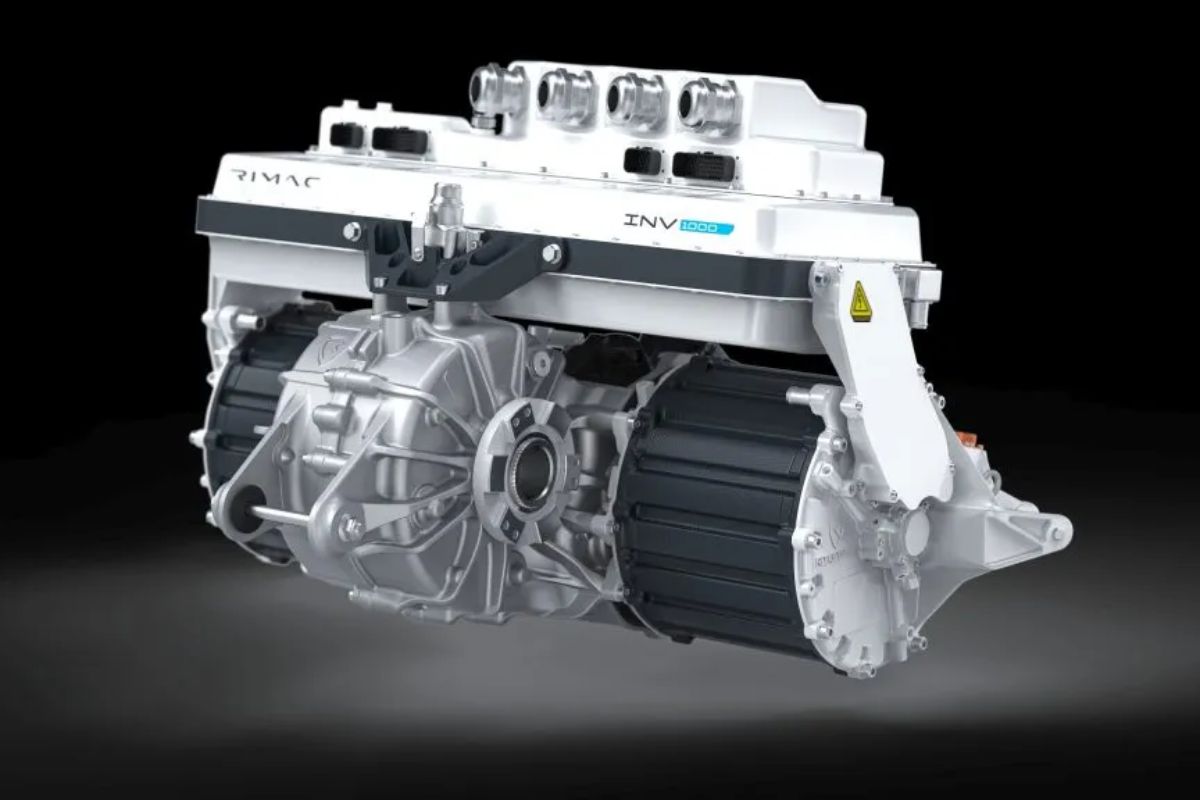


Understand How Rimac Masters The Instant Power Of Its Hypercar With A Torque Vectoring Technology That Adjusts Each Wheel More Than 100 Times Per Second
The Electric Motor of the Rimac Nevera is a feat of engineering that pushes the limits of automotive performance. With a combined power of 1,914 horsepower and an instant torque of 2,360 Nm, the concern that such force could simply “detach” the tires from the wheels is legitimate. However, the Croatian hypercar not only controls this power but uses it to break records.
The secret lies in an architecture of four independent motors and a sophisticated electronic system called R-AWTV. This technology is the real reason why the Nevera can translate its brutal force into record-breaking acceleration, redefining what is possible for an electric vehicle and establishing a new paradigm for the future of hypercars.
The Four-Motor Architecture: The Source of the 1,914 HP Power
The heart of the Rimac Nevera is its set of four permanent magnet electric motors, one for each wheel. This distributed configuration eliminates the need for heavy and complex mechanical differentials. The result is a total power of 1,408 kW, equivalent to 1,914 horsepower, and a torque of 2,360 Nm available almost instantly.
-
Son of a seamstress from the rural area of Ceará who did not speak English wins a scholarship of over 2 million reais at Williams College, one of the top 10 universities in the United States, covering everything including dormitory, meals, and annual trips to Brazil.

-
Bill Gates revealed that the true secret behind every great achievement is not a brilliant leap but rather small improvements repeated over the years, and the data from his own career and the fight against climate change prove that he is right.

-
With 22 thousand tons of steel, a height nearly three times greater than the Eiffel Tower, and a cost of R$ 1.6 billion, China is building the highest bridge on the planet over a colossal canyon, reducing a crossing time of over 2 hours to just over 2 minutes.

-
Goodbye expensive popular car: electric vehicle for less than R$ 70,000 starts being sold in Brazil with a range of 200 km and targets those looking to escape gasoline.

The system is intelligently divided: the two front motors produce 299 hp each, while the two more powerful rear motors generate 653 hp each. Each motor has its own single-speed gearbox, ensuring efficient power delivery and unprecedented control over the vehicle’s dynamics.
What Is The R-AWTV Torque Vectoring System?
To manage the colossal force of the Electric Motor of the Rimac Nevera, the company developed the R-AWTV (Rimac All-Wheel Torque Vectoring) system. This “brain” electronics is what prevents the car from simply turning into tire smoke. It adjusts the torque sent to each wheel individually more than 100 times per second.
Using data from nine cameras, LIDAR sensors, and radar, the system “reads” the road and distributes power to the wheel with the most grip. This technology completely replaces traditional ABS and stability control (ESP) systems, offering a much faster and more proactive response, which is crucial for taming the instant torque of electric motors.
The Numbers That Broke 23 Records In A Single Day
The effectiveness of the Electric Motor of the Rimac Nevera and its control system is proven by the numbers. The hypercar accelerates from 0 to 100 km/h in just 1.81 seconds and reaches a certified top speed of 412 km/h, making it the fastest production electric car in the world.
In a landmark event in 2023, the Nevera set 23 performance records in a single day. This feat, which involved around 30 full-throttle accelerations in less than 8 hours, demonstrated not only speed but also the incredible durability and thermal management of the setup, which showed no performance drop.
The Engineering Behind The Power, The “H”-Shaped Battery, And The Carbon Monocoque
The power of the Nevera is supported by structural innovations. The 120 kWh battery is shaped like an “H,” allowing occupants to sit in a lower and sportier position. The battery cooling system is equally innovative, with plates that wrap around the cells to ensure efficient and consistent cooling.
The car’s structure is the world’s most advanced carbon fiber monocoque, being the largest single carbon piece ever used in a car. It is so rigid that the Nevera’s chassis is twice as resistant to torsion as “common” supercars. This extreme rigidity is essential for the torque vectoring system to operate with maximum precision.
The Electric Motor Of The Rimac Nevera Against Its Rivals: Who Wins The Hypercar Battle?

In the exclusive segment of electric hypercars, the Nevera faces heavyweight competitors. The Pininfarina Battista, which uses a battery supplied by Rimac itself, offers 1,900 hp. The Lotus Evija reaches 2,039 hp, while the Aspark Owl, focused on acceleration, has 1,980 hp.
Even mass-produced electric cars, like the Tesla Model S Plaid, with its 1,020 hp, enter the contest. What sets the Nevera apart is its holistic approach, where the extreme power of the Electric Motor of the Rimac Nevera is perfectly integrated with a hyper-rigid chassis and cutting-edge control software, establishing a new standard of dynamic performance.







Tudo muito bonito.E a bateria pra fazer esse demônio se mover??
Em forma de H ??!!
Quero ver a bateria para sustentar tanta potencia
Dura 35segundos
Esse dos carros elétricos Nilton mts para kilos tem que dividir por 10 aí você não vê grandeza e o inversor tem mandar isto tudo os normais é 50% a mais .