





 Português
  Inglês
  Espanhol
  8 min de leitura
  0 comentários


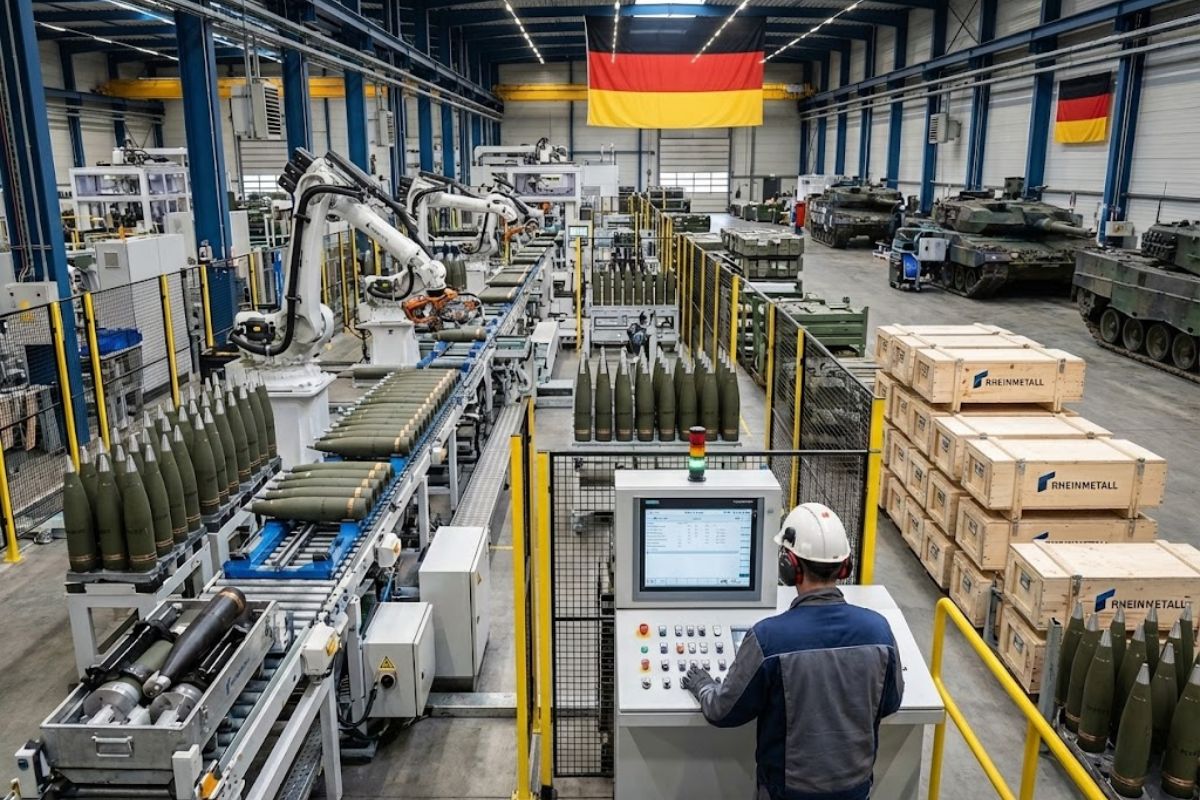
The New German Industrial Miracle Took Shape After Russia’s Invasion of Ukraine and the Doubt About Automatic U.S. Protection, Leading the Country to Prioritize Defense. In Four Years, the Workforce Jumped from 63,000 to Nearly 83,000, and Contracts Totaled €207 Billion.
The new German industrial miracle has quietly progressed over four years, but is already reflected in concrete indicators: open positions, factories adjusting lines, supply chains being reoriented, and a volume of orders treated as the new normal. What was once a political taboo and social discomfort, rearmament, has become a driver of labor and productive capacity, with companies preparing to produce at scale.
In the new German industrial miracle, the idea of temporary demand has given way to a horizon of years, driven by strategic urgency and industrial ambition. The feeling that U.S. protection is no longer automatic has combined with the geopolitical shock of war and pushed Germany toward a logic of faster production, with long-term planning and strong expansion of public contracts.
War as a Driver and the Shift in Priorities

Germany, for decades associated with the economic self-esteem of civilian exports and the automotive industry, has shifted its center of gravity to defense. This shift is not only reflected in speeches: it reorganizes investment priorities, hiring, and production structure, with companies and sector associations describing a change that tends to last.
-
Brazilian city gains industrial hub for 85 companies that is equivalent to 55 football fields.

-
Peugeot and Citroën factory in Argentina cuts production by half and opens a layoff program for more than 2,000 employees after Brazil drastically reduced purchases of Argentine vehicles.

-
A Brazilian city gains a factory worth R$ 300 million with the capacity to process 200 thousand tons of wheat per year, a mill of 660 tons/day, silos for 42 thousand tons, and an industrial area of 276 thousand m².

-
Havan will leave the shopping mall in Blumenau to inaugurate something that the chain has never done before: a megastore in half-timbered style in the Historic Center of the city, which is expected to be completed in May and change the landscape of local retail.

In the new German industrial miracle, defense is now competing for political attention, budget, and talent with traditional sectors. Rearmament is no longer an exception and has become industrial policy, with direct impacts on employment, factories, and suppliers, in an environment where Europe has spent years discussing spending and now operates under perceived urgency.
Mass Hiring and the Jump from 63,000 to Nearly 83,000

The most visible data of the new German industrial miracle is in the labor market. German defense companies have entered a hiring race, increasing the workforce by about one-third in four years. The picture consolidated by a representative group of large companies and startups shows a jump of approximately 63,000 workers to nearly 83,000 in defense-focused divisions.
This represents a 30% growth in four years, a pace suggesting accelerated and continuous expansion. Even with caveats about the survey’s coverage, the direction is unequivocal: this is not just about one-off purchases but a rebuilding of industrial power to manufacture, maintain, and modernize armaments, with the labor market reorganizing around this priority.
In the new German industrial miracle, employment is accompanied by productive reconfiguration. The race for talent indicates that the industry is preparing to produce more and for longer, and not just to fulfill isolated contracts.
Contracts of €207 Billion and the Break with 2021

The central fuel of the new German industrial miracle is public money converted into contracts. Since 2022, the German Ministry of Defense has signed armament contracts totaling €207 billion. Within this volume, the annual jump stands out: just last year, the amount reached €83 billion, compared to €23 billion in 2021.
The comparison summarizes the break with the previous phase. It is not just about more spending; it is another scale, another cadence, and another predictability. For the industry, the message is that there will be enough orders to justify investment, expansion, and planning, instead of defensive decisions made under the risk of freezing every political cycle.
In the new German industrial miracle, the sequence of contracts also reorganizes priorities in the supply chain. Companies are starting to treat productive capacity as a strategic theme, not as a one-off adjustment, and the volume of commitments reinforces the understanding that demand is no longer episodic.
Merz Eases Rules and Signals Continuity
The budgetary turnaround gains an explicit political element in the new German industrial miracle. Chancellor Merz, in office since May, has eased strict borrowing rules to allow the level of spending deemed necessary for defense. For the productive sector, this serves as a signal of continuity, stability, and predictability.
The industrial effect of this type of signal is direct. When politics indicates that spending will not be a short-lived exception, companies can invest in machines, lines, training, and hiring with less fear of interruption. In the new German industrial miracle, political credit becomes industrial fuel, as it reduces uncertainty and encourages long-term decisions.
The Real Dimension: Defense Grows, but Still Smaller Than Automotive
Even with expansion, the new German industrial miracle still does not match the weight of the automotive sector in employment. The Ministry of Economy cited about 105,000 direct jobs in the defense sector in 2022. Although this number has increased since then, it remains far from the approximately 700,000 workers in the automotive sector.
This comparison undermines a simplifying idea: that rearmament would replace the car as the major short-term employer. The defense sector may grow and attract talent, but the automotive scale is still vastly superior. The new German industrial miracle reshapes the map but does not alone absorb the crisis of motors, especially in the short term.
Airbus and Rheinmetall: Employment Hubs and the Showcase of Growth
On the employment map of the new German industrial miracle, Airbus stands out as the largest employer, with about 38,000 people working in the defense sector globally and just over half in Germany. The company manufactures key components of the European military architecture, including the Eurofighter Typhoon and the A400M transport aircraft.
Right behind, Rheinmetall has become the most visible symbol of industrial growth. The tank, artillery, and ammunition manufacturer increased its workforce from approximately 15,400 employees to 23,500 currently, the largest absolute jump among the analyzed companies. Its CEO, Armin Papperger, has set a goal of 70,000 employees in three years, signaling ambition for scale.
The new German industrial miracle also appears in a rare cultural indicator for defense in the country: social attractiveness. There have been reports of hundreds of thousands of job applications in a single year, as if defense has migrated from a secondary sector to a bet perceived as the future by engineers, technicians, and industrial professionals.
Military Startups and the Fever of New Companies Like Helsing
The new German industrial miracle is not limited to conglomerates. There is a new landscape of military startups, young companies focused on surveillance systems and armaments, with details not always public, attracting hundreds of millions in funding and growing at a pace that would have been unlikely a decade ago.
The most cited case is that of Helsing, which manufactures armed drones. Its workforce multiplied by 18 in four years, evolving from an artificial intelligence software approach to hardware production. This transition changes everything: the logic of selling algorithms is replaced with the need for parts, assembly lines, logistics, and maintenance.
In the new German industrial miracle, this movement carries an industrial message: European defense does not want to rely solely on digital innovation; it wants to transform innovation into deployable physical systems. This is the industrialization of software, a bridge between technology and manufacturing that requires scale, rigor, and continuous production capability.
BDSV, Simpler Purchases, and Orders “At the Door” of Manufacturers
Within the new German industrial miracle, the business discourse points to sustained takeoff. The employers’ association BDSV, represented by Hans Christoph Atzpodien, claims that growth tends to accelerate because Germany has simplified purchasing processes and increased visibility of future demand.
The effect is to reduce capacity uncertainty. Companies can scale production and hiring with less fear of the pipeline evaporating. The idea of large orders arriving “at the doors” of manufacturers encapsulates an administrative change: less sluggishness, less political doubt, and more operational urgency.
The Temptation to “Steal” from the Automotive Sector and the Numbers of Labor Migration
The crisis in the automotive sector creates a natural temptation in the new German industrial miracle: hiring professionals from the automotive industry. It makes sense, as the country has a large pool of engineers, qualified operators, precision suppliers, and an advanced manufacturing culture.
So far, however, migration has been more symbolic than massive. Hensoldt, a manufacturer of radars and sensors, claims to have hired about 100 people from the automotive industry this year. Arx Robotics, focused on unmanned ground vehicles and with about 140 employees, hired approximately 15.
Helsing claims it is doing this constantly, though with no specific numbers. The pattern exists, but the scale still does not allow for broad absorption of the automotive shock. In the new German industrial miracle, there is a redirection of talent, but not a complete replacement of automotive jobs.
Supply Chain, Tesla, Schaeffler, and the Competition for Parts and Talent
Another layer of the new German industrial miracle is the reorganization of the supply chain. Defense starts to affect traditional suppliers and attract names from the tech world. Helsing hired Michael Schwekutsch, former vice president of engineering at Tesla, and began collaborating with Schaeffler to strengthen supply capabilities.
When defense begins competing for the same talents and components that once supplied the automotive industry, it ceases to be a niche and becomes an industrial hub. Atzpodien celebrates this as proof of a strong productive base, but also issues a warning: defense can absorb part of the impact and redirect resources, but it does not solve all automotive problems on its own.
In the new German industrial miracle, this competition for talent and components creates an industrial contest environment. The same engineering that fueled cars is now fueling military systems, with implications for salaries, innovation priorities, and capacity planning.
The “New” Germany and the Cultural Mutation of Industrial Prestige
The new German industrial miracle is not limited to contracts and hiring. It carries a cultural mutation: it changes what is encouraged, studied, financed, and considered the future. Germany is reorganizing priorities towards security and strategic autonomy, translating this into factories, wages, applied innovation, and a different kind of industrial prestige—producing military systems treated as indispensable by Europe.
Although defense may not have the scale to replace the automotive industry in the short term, it seems capable of redefining part of the German industrial map in the next decade, under the perception that security cannot depend solely on promises.
Do you think that the new German industrial miracle will consolidate defense as the main magnet for industrial talent in the country, even with the automotive sector still employing many more people?









-

-

-

5 pessoas reagiram a isso.