





 Portuguese
  English
  Spanish
  5 min of reading
  0 comments



Details of Petrobras’ Ambitious Strategic Plan 2024-2028+. Discover Where the US$ 102 Billion Will Be Invested, the Strong Focus on Pre-Salt, and the Challenges and Opportunities of the Transition to a Greener Energy Future in Brazil.
Petrobras has revealed its Strategic Plan for the 2024-2028 period, with a “+” extension signaling a long-term vision. It represents a colossal investment of US$ 102 billion. This Petrobras billion-dollar plan aims to revitalize its core operations while preparing the company for the future of energy.
This article analyzes the key axes of this robust investment. We will address the strategic focus on Exploration and Production (E&P), particularly in the rich Pre-Salt areas, the modernization projects in refining and gas, and the growing contributions toward a low-carbon matrix, along with the challenges and debates that the plan raises.
US$ 102 Billion at Stake: An Overview of Petrobras’ Billion-Dollar Plan
Petrobras’ Strategic Plan 2024-2028+ foresees a total investment of US$ 102 billion. This amount represents a 31% increase compared to the company’s previous investment cycle, as disclosed by the company itself. Of this amount, a significant portion of US$ 91 billion is already allocated to projects in the implementation phase, demonstrating a high degree of portfolio maturity, while US$ 11 billion is for projects still under evaluation.
-
Offshore industrial demand in Macaé skyrockets with the recovery of oil and gas and could grow by up to 396% by 2026 in the Campos Basin.
-
Offshore industrial demand in Macaé surges with the recovery of oil and gas and could grow by up to 396% by 2026 in the Campos Basin.
-
Brazilian giant expands borders in the Southeast: Petrobras confirms new oil discovery in ultra-deep waters in the pre-salt of the Campos Basin.
-
Alert in the global energy market: Severe tropical cyclone hits the coast and disrupts gas production at major plants in Australia, threatening global supply.

The company plans to finance these investments predominantly with its own resources generated by its operations. Petrobras has also set a limit for its gross debt, which should remain at up to US$ 65 billion, an amount considered reasonable for its size and segment.
Exploration and Production (E&P): The Beating Heart of Investments
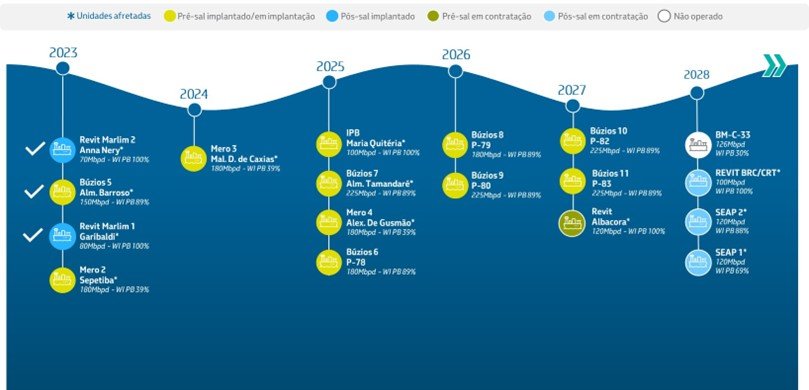
The Exploration and Production (E&P) segment remains Petrobras’ cornerstone, receiving US$ 73 billion, or approximately 72% of the plan’s total investment. The primary focus is on Pre-Salt, which will absorb about 67% of the E&P resources (approximately US$ 48.9 billion). Petrobras’ justification for this concentration is the high quality of the oil found, the lower greenhouse gas emissions associated with these operations, and the economic resilience, with viable projects even with Brent barrel prices at US$ 25.
Petrobras aims to achieve a production of 3.2 million barrels of oil equivalent per day (boed) by 2028. This growth will be fueled by the commissioning of 14 new FPSOs (floating production, storage, and offloading units) between 2024 and 2028. To secure the future and replenish reserves, the company is also betting on the exploration of new frontiers: US$ 3.1 billion will be invested in the Equatorial Margin, where Petrobras plans to drill around 16 wells, and another US$ 3.1 billion in the Southeast Basins, totaling approximately 50 exploratory wells over the next five years.
Modernizing Infrastructure: Investments in Refining and Natural Gas
The Petrobras billion-dollar plan also includes modernization of its refining and gas infrastructure. The Refining, Transportation, and Marketing (RTC) segment will receive US$ 15.3 billion. The goals include increasing processing capacity by 225,000 barrels per day (with the Trem 2 of the Abreu e Lima Refinery – RNEST), improving the energy efficiency of refineries through the RefTOP program, and expanding the production of cleaner fuels, such as Diesel S10, aviation biojet fuel (BioQAV), and 100% renewable diesel (Diesel R100).
For Gas and Energy (G&E), the investment will jump to US$ 3 billion. This increase will be driven by the implementation of the Thermoelectric Power Plant (UTE) in GASLUB and the return of the Bolivian-Brazilian Gas Pipeline Transporter (TBG) to the state company’s investment portfolio. Projects such as Route 3 (currently in operation), Raia, and SEAP aim to increase the supply of natural gas to the Brazilian market.
Energy Transition in Focus: Investments in Low Carbon
Recognizing the evolution of the global energy landscape, Petrobras is directing resources toward the transition. The 2024-2028+ plan allocates US$ 11.5 billion (about 11% of total CAPEX) for low-carbon projects. This figure is expected to increase to US$ 16.3 billion (15% of CAPEX) in the 2025-2029 cycle, representing a 42% growth in this type of investment, according to company information.
Low-carbon investments include US$ 5.2 billion for wind and solar energy projects in the current plan. The planning for the 2025-2029 cycle also details a significant focus on ethanol (US$ 2.2 billion), in addition to investments in biorefining, biodiesel, and biogas. The company has set clear decarbonization targets, such as a 30% reduction in total absolute operational emissions by 2030 (compared to 2015) and the goal of achieving operational emissions neutrality by 2050. Carbon Capture, Utilization, and Storage (CCUS) initiatives are also planned, with the goal of reinjecting 80 million tons of CO2 by 2025.
Challenges and Controversies: The Equatorial Margin and Multiple Perspectives
Despite its financial robustness and ambitious targets, the Petrobras billion-dollar plan is not without challenges and controversies. Exploration in the Equatorial Margin, in particular, is a point of intense debate. Environmental organizations, such as Greenpeace, criticize the initiative, pointing to significant environmental risks in an ecologically sensitive region and questioning compatibility with global climate commitments.
Petrobras, in turn, defends its ability to operate in the region safely and responsibly. The company argues that resources from the Equatorial Margin are vital for funding the country’s energy transition and for avoiding future dependence on oil imports. On the workers’ side, unions like the Unified Federation of Oil Workers (FUP), through analyses from the Institute for Strategic Studies of Oil, Natural Gas and Biofuels (Ineep), would like to see a plan with an even greater focus on national development and energy transition, with investments that could surpass those announced and not limited solely by the company’s cash generation. The financial market, on the other hand, assesses value generation and financial sustainability but also questions the pace of diversification into renewable energies, as noted by consultancies such as Rystad Energy.
The Impact of Petrobras’ Billion-Dollar Plan on Brazil’s Energy Future


The central strategy of Petrobras for the upcoming years is clear: to balance the exploration of its vast and competitive oil and gas assets, mainly in Pre-Salt, with gradual and increasing investments in low-carbon energies, using hydrocarbon profits to finance the transition. The company seeks to reconcile leadership in a fair energy transition with the responsible exploration of its resources.
The production performance in 2024, which met all established targets, with records in Pre-Salt (where own production reached 2.2 million boed), demonstrates Petrobras’ execution capacity, even in the face of challenges such as maintenance shutdowns and the complex global supply market scenario. The great challenge for Petrobras will be to navigate through a global energy environment in deep transformation, meeting current demand, managing risks, achieving decarbonization targets, and responding to the expectations of its various stakeholders, thus shaping the energy future of Brazil.










Seja o primeiro a reagir!