





 Portuguese
  English
  Spanish
  3 min of reading
  1 comment


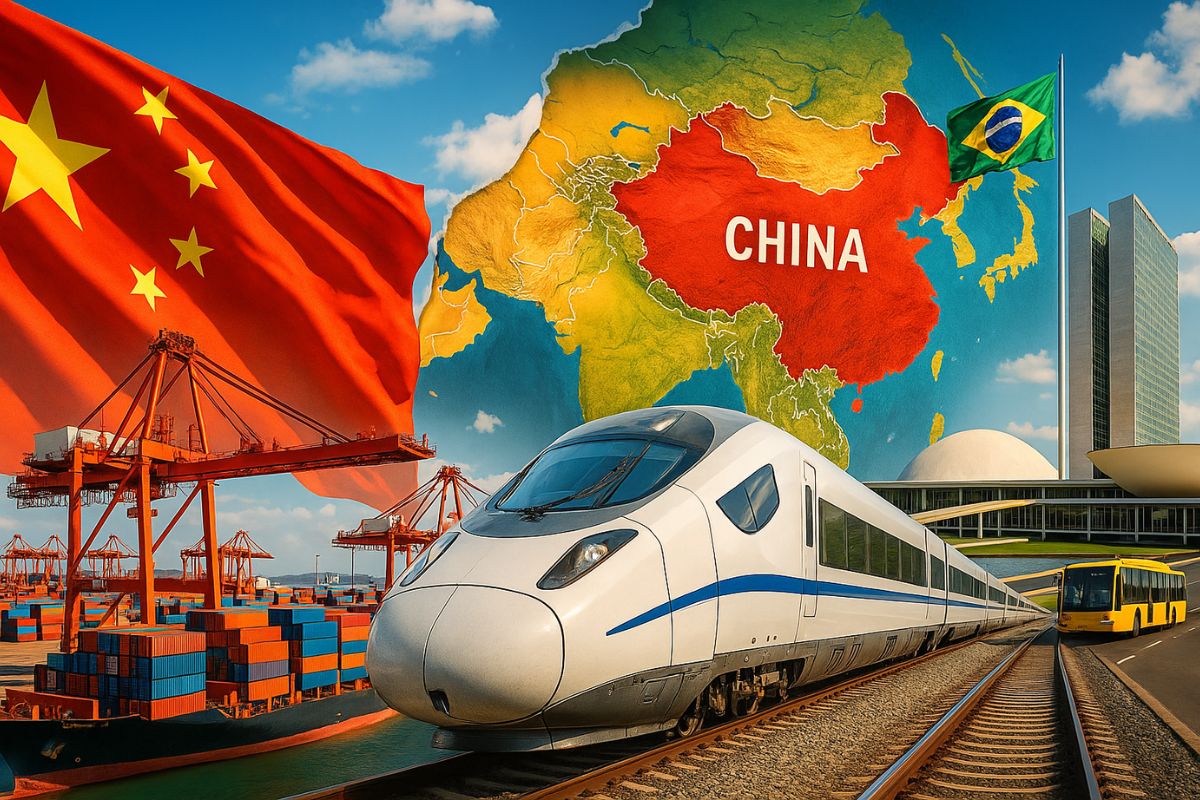

What The Global Power China Did To Reach The Top And How It Continues To Expand Its Influence. From Economic Reforms To Geopolitical Strategies, Understand How China Built Its Global Strength And Why It Keeps Advancing In New Markets
The global power China did not emerge by chance. In just a few decades, the country transformed from a closed economy to the second largest in the world, combining strategic patience, long-term planning, and a voracious appetite for resources and markets. Today, its influence extends far beyond Asian borders, directly affecting the geopolitics, trade, and even culture of other countries.
According to expert Ricardo Geromel, guest of Market Makers, the Chinese advance is not just a result of accelerated economic growth, but of a global repositioning that involves active diplomacy, expansion of strategic companies, and massive investments in infrastructure outside its territory. This combination has changed the balance of international power.
The Strategic Turn: Less Dependence On The U.S.
Until 2018, more than half of China’s trade surplus came from the United States. Today, this share has dropped to around 30%, a result of a planned repositioning in light of the trade war and political tensions. The global power China has diversified its partners and strengthened ties with countries in Africa, Latin America, and Southeast Asia.
-
Piauí will produce a new fuel that replaces diesel without needing to change anything in the truck’s engine and reduces pollutant gas emissions by half: truck drivers from all over the Northeast are already celebrating the news that will arrive later this decade.

-
A new Brazilian shopping center worth R$ 400 million will be built in an area equivalent to more than 4 football fields, featuring 90 stores, 5 cinemas, a supermarket, a college, and parking for 1,700 cars, potentially generating 3,000 jobs.

-
Larger than entire cities in Brazil: BYD is building a 4.6 km² complex in Bahia with a capacity for 600,000 vehicles per year, but the discovery of 163 workers in conditions analogous to slavery has shaken the entire project.

-
With an investment of R$ 612 million, a capacity to process 1.2 million liters of milk per day, Piracanjuba inaugurates a mega cheese factory that increases national production, reduces dependence on imports, and repositions Brazil on the global dairy map.


This strategy has reduced the impact of barriers imposed by Washington and opened new fronts for exports and investments. As a result, trade with the U.S. now represents only a small fraction of China’s GDP, giving the country greater autonomy to face external shocks.
The New Silk Road And Global Expansion
One of the main instruments of China’s rise is the Belt and Road Initiative, or New Silk Road. Launched in 2013, the project funds infrastructure works in dozens of countries in exchange for privileged access to markets and natural resources.
In Brazil, this movement is already visible. Chinese companies have increased their presence in sectors such as energy, technology, and agribusiness. According to reports from specialist Ricardo Geromel at Market Makers, the South American country is seen as a strategic market, not only because of its population size but also due to its receptivity to Chinese products and investments.
Cultural Influence And Narrative Control
Unlike the U.S., whose “American Dream” has been widely promoted through cinema, music, and fashion, the global power China has yet to project a clear “Chinese Dream” globally. Nonetheless, it invests indirectly in the Western cultural industry by financing Hollywood productions through companies like Alibaba Pictures.
This involvement allows China to influence content that reaches its internal market and reinforce its image abroad, albeit in a subtle manner. At the same time, it maintains strict control over its own domestic narrative.
Security And Internal Model
Public security is one of the most highlighted points by foreigners living in China. The massive presence of cameras and strict control of urban order allows large cities to have low crime rates.
On the other hand, the centralized political system limits freedom of expression and unrestricted access to information. For the Chinese government, this is an acceptable trade-off to maintain social stability and economic growth — and many citizens support this view.
Lessons For Brazil And Other Emerging Countries
For Brazil, the growing presence of the global power China represents both opportunities and challenges. Negotiating with the Asian giant requires diplomatic balance to avoid exclusive alignment and preserve relations with other powers.
Experts point out that the Chinese experience demonstrates the value of long-term planning and coordination between state and private sector, but also exposes risks of economic and technological dependency.
Do you think the model of the global power China can be replicated in other countries? Do you believe this strategy will ensure Beijing’s global leadership in the coming decades? Leave your opinion in the comments and join the conversation.






Gosto mais da china do que estados unidos, sua influência é bem vinda ao Brasil, um povo respeitador, e com baixa criminalidade em seu país, já visitei 3 vezes, a última foi em janeiro desse ano, torço por seus investimentos aqui no Brasil, país que ainda está sem solução com esses governantes que temos e falta de cultura