





 Português
  Inglês
  Espanhol
  4 min de leitura
  0 comentários


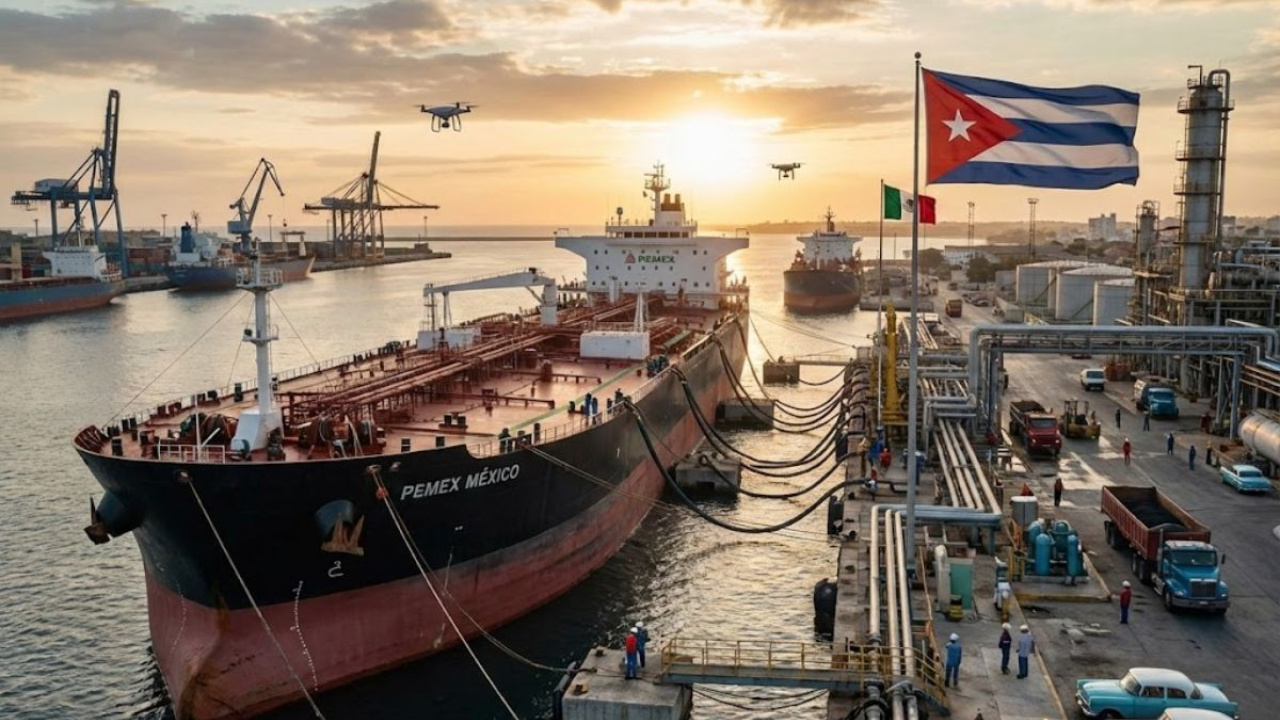
The Possible Interruption of Venezuelan Oil to Cuba, Following Donald Trump’s Threat, Reignites the Risk of an Energy Crisis, Pressures the Island’s Economy, and Heightens Geopolitical Tensions in Latin America.
The oil has returned to a central position in Cuba’s political and economic landscape following the threat from U.S. President Donald Trump to block the island’s access to fuel from Venezuela.
This warning, accompanied by the alert that Cuba should make a deal “before it’s too late,” has reignited fears of a new energy crisis in the Caribbean nation. Experts assess that this measure represents a significant hardening of U.S. policy toward Havana.
According to analysts consulted by UOL, the potential blockade of Venezuelan oil signals an “unprecedented advance in the United States’ aggression policy” against Cuba. Additionally, the move occurs at a time of internal economic fragility, marked by structural difficulties that have lingered since the pandemic.
-
Offshore industrial demand in Macaé skyrockets with the recovery of oil and gas and could grow by up to 396% by 2026 in the Campos Basin.
-
Offshore industrial demand in Macaé surges with the recovery of oil and gas and could grow by up to 396% by 2026 in the Campos Basin.
-
Brazilian giant expands borders in the Southeast: Petrobras confirms new oil discovery in ultra-deep waters in the pre-salt of the Campos Basin.

-
Alert in the global energy market: Severe tropical cyclone hits the coast and disrupts gas production at major plants in Australia, threatening global supply.


Oil Blockade May Open Path to Broader Crisis
The impact of a possible interruption in the oil supply goes beyond the energy sector. According to Joana Salém, a graduate professor in global political economy at UFABC, the measure would be “the gateway to a total crisis.” She warns that fuel restrictions would directly affect transportation and food distribution, as well as access to basic items for the population.


The “economic blockade imposed by the U.S. interferes with Cuba’s trade relations with other countries, making island commerce more expensive,” Salém states. For the researcher, “these threats from Trump correspond to a new historical moment,” as they intensify external pressure and undermine partnerships built over decades.
Change in Oil Suppliers’ Profile Aggravates Scenario
Although Venezuela has been, for many years, Cuba’s main oil supplier, this scenario has begun to change recently. Sector data indicates that, in the last year, Mexico took the lead, exporting about 12,300 barrels of oil per day to the island. This volume accounts for approximately 44% of total Cuban imports.
Nonetheless, Venezuela remained a relevant partner, exporting around 9,500 barrels daily. The threat of a blockade thus impacts a strategic relationship built since the 1990s and adds instability to a system already pressured by financial and logistical constraints.
Energy Crisis Adds to Post-Pandemic Economic Difficulties
Cuba was already facing energy problems before the new threats. During the pandemic, the country’s Gross Domestic Product fell by almost 11%, and economic recovery has not fully materialized. “The country has not managed to fully recover and now finds itself facing a new difficulty,” says Joana Salém, who researched Cuban history in her master’s degree.
In this context, uncertainty intensifies. For Professor Raúl Rodríguez Rodríguez, director of the Hemispheric Studies Center and U.S. Studies at the University of Havana, the scenario is unpredictable. “It is impossible to know exactly what is going to happen; the U.S. says one thing, the Venezuelan government, another, but there will be impacts,” he states.
U.S. Pressure Is Likely to Intensify, Experts Assess
Rodríguez believes that the scenario is “very negative” for Cuba. According to him, “the United States will focus on increasing economic warfare, cutting all external financing sources for Cuba, creating obstacles, and criminalizing the country’s attempts and intentions to diversify economic relations with other governments in the region and Europe.”
Despite this, the professor emphasizes the historical resilience of the country. “But it is important to consider that no country in Latin America has the tradition and combative experience of Cuba,” he states. Similarly, experts assess that the most immediate impact would be a reduction in fuels, but not necessarily a government downfall.
Cuba–Venezuela Relationship and the Role of Oil in Bilateral Agreements
The alliance between Cuba and Venezuela was formalized in the 1990s and gained strength with the creation of ALBA (Bolivarian Alliance for the Peoples of Our America) in 2004. The agreement was signed in Havana by Fidel Castro and Hugo Chávez. “The two countries developed a political exchange with positions based on anti-imperialism, anti-colonialism, and the right to self-determination of the peoples of the global south,” Rodríguez says.
In this model, Cuba began to access Venezuelan oil in exchange for social services. “The Cubans exported intelligence, medical services, and counterintelligence in exchange for oil,” explains Joana Salém. According to Rafael Pinheiro de Araújo from the Department of American History at UERJ, Venezuela sought Cuba for being an international reference in health and education.
U.S. Strategic Interests Go Beyond Oil
For Araújo, U.S. interest in Cuba is essentially political. He assesses that Trump’s pressure has a strong symbolic character. “In this moment of a resurgence of U.S. leadership over the continent, he makes it clear that if economic pressure does not work, he will resort to force.”
“Trump will sensationalize the threat of intervention to get Cuba to the negotiation table. Weakening Cuba once again would send a message to Latin America and the world that the last bastion of socialism has been defeated,” the historian notes.
In addition to oil, Cuban natural resources also come into focus. “Cuba has one of the largest nickel reserves in the world,” highlights Joana Salém. According to her, these minerals attract the interest of American corporations, which maintain plans for economic transition for the island based on pragmatic, rather than merely ideological, criteria.








Seja o primeiro a reagir!