





 Portuguese
  English
  Spanish
  3 min of reading
  0 comments


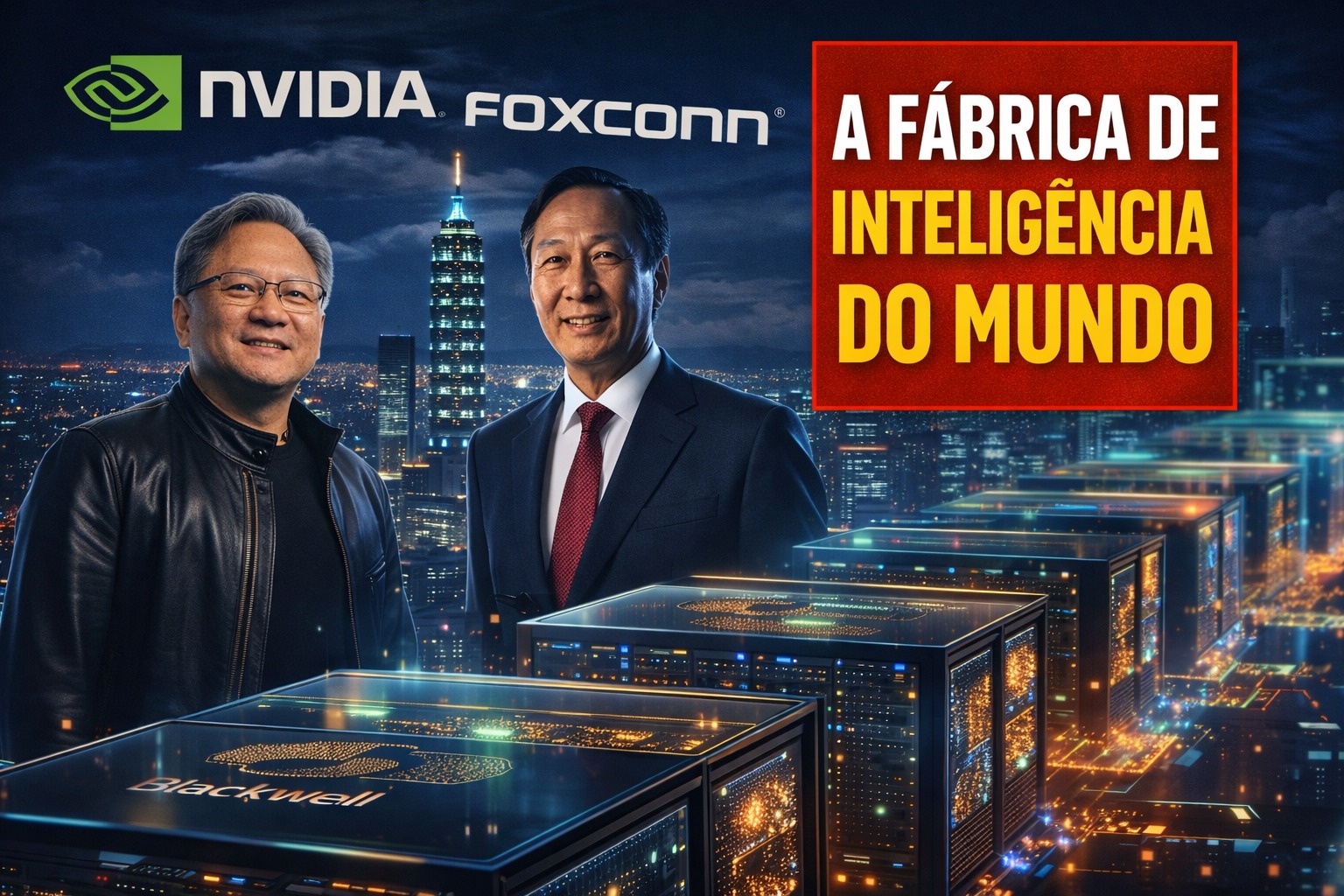
Partnership Between Jensen Huang, Terry Gou, and the Taiwanese Government Plans Superstructure with 10,000 Blackwell GPUs, Foxconn Cloud, and Strategic Ambition to Transform the Island into a Global Intelligence Factory
Taiwan has taken a step that could redefine its role in the global digital economy. The Asian island will host one of the largest artificial intelligence factories on the planet, a project led by two central figures in technology. Jensen Huang, founder of NVIDIA, and Terry Gou of Foxconn announced a strategic partnership with the Taiwanese government to build an “AI factory Supercomputer.” The information comes from an article by Startse, published in 2025.
A Factory That Does Not Produce Objects, but Intelligence
The concept breaks with the classical idea of manufacturing. Instead of cars, mobile phones, or household appliances, the new structure will be dedicated to massive data processing.
NVIDIA will provide 10,000 Blackwell GPUs, described as the most advanced chips in the world. Foxconn, through Big Innovation Company, will take on the construction and operation of the cloud infrastructure.
-
Motorola launched the Signature with a gold seal from DxOMark, tying with the iPhone 17 Pro in camera performance, Snapdragon 8 Gen 5 that surpassed 3 million in benchmarks, and a zoom that impresses even at night.

-
Satellites reveal beneath the Sahara a giant river buried for thousands of kilometers: study shows that the largest hot desert on the planet was once traversed by a river system comparable to the largest on Earth.

-
Scientists have captured something never seen in space: newly born stars are creating gigantic rings of light a thousand times larger than the distance between the Earth and the Sun, and this changes everything we knew about stellar birth.

-
Geologists find traces of a continent that disappeared 155 million years ago after separating from Australia and reveal that it did not sink, but broke into fragments scattered across Southeast Asia.

In practice, it will be a digital production line. Data enters, models are trained, systems learn.
There, autonomous agents, optimization algorithms, decision engines, and applications capable of continuously evolving will be born. It is not a factory for products, but for computational cognitive capacity.
Taiwan Expands Its Position in the AI Supply Chain
Taiwan already holds a unique position in the technology ecosystem. The country is recognized as an essential base for modern hardware, especially due to the presence of TSMC.
The company is responsible for manufacturing a large portion of the chips that power everything from smartphones to supercomputers and AI systems.
This industrial dominance has solidified the island as a critical piece of the planet’s digital infrastructure. Now, with the AI factory Supercomputer, Taiwan signals a broader ambition.
Not only to produce the electronic brains but also to participate directly in training the intelligences that run on them.
From Physical Manufacturing to Computational Manufacturing
The move represents a symbolic transition. For decades, Taiwan has strengthened its economy as a hub of electronic production.
The new initiative shifts this prominence to a more abstract and strategic territory: intelligence processing.
Training AI models requires extreme computing power, energy, connectivity, and specialized engineering.
By concentrating these elements on a large scale, Taiwan creates an environment capable of attracting companies, researchers, and global projects.
The island ceases to be merely a supplier of components and begins to operate as a platform for developing intelligent systems.
Epicenter of the Next Technological Revolution
Amid the global race for sovereignty in AI, the project emerges as a geopolitical and economic positioning.
Countries compete for infrastructure, talent, and technological autonomy. Taiwan, by combining a tradition in semiconductors with AI-focused supercomputing, reinforces its strategic relevance.
The plan also alters the narrative about the future of the industry. If factories were previously synonymous with tangible production, they now represent centers for training algorithms.
Artificial intelligence transforms data into value, decisions into efficiency, and models into competitive advantage.
On the horizon, the initiative indicates a redesign of the global technological map. Taiwan, a relatively small island in East Asia, is advancing to become not only the world’s chip factory but potentially the factory of intelligence.
With information from Startse.







-

Uma pessoa reagiu a isso.