





 Portuguese
  English
  Spanish
  3 min of reading
  0 comments


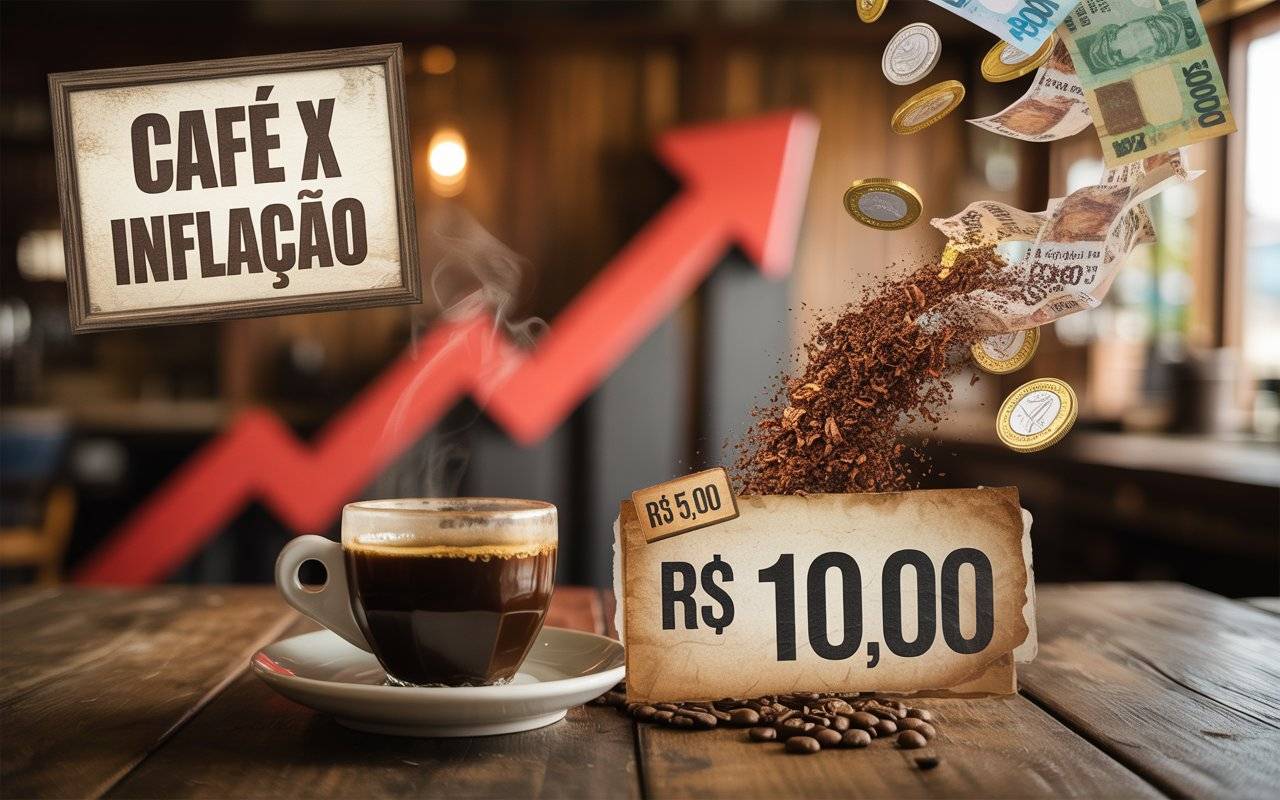
Discover, Simply, Why Putting More Money Into Circulation Can Make Everyone Poorer
You may have heard the question: “Why doesn’t the government print more money so everyone can get rich?” The answer seems simple, but the reality is quite different. Although it may seem like a quick solution at first glance, printing money without planning directly affects the economy and can create a serious problem: inflation.
To understand better, let’s use a practical example. Imagine a cup of coffee costs R$ 5.00 and there are only 5 cups available in a coffee shop. Five people — Ana, Paula, Pedro, João, and Enzo — each have R$ 5.00. In this scenario, each person buys one coffee, everyone is satisfied, and stock runs out.

Now, suppose the government decides to print more money and distribute an additional R$ 5.00 to each person. Thus, everyone now has R$ 10.00 in their pocket. However, the quantity of coffee remains the same: 5 cups. With more money available, everyone wants to buy 2 coffees.
-
The government requests the Federal Revenue Service for a new system to automate the income tax declaration, reducing errors, time, and bureaucracy for millions of Brazilians.

-
Pix in installments, international Pix, and contactless payment without internet: the Central Bank revealed the new features coming to the tool that is already used by almost every adult in Brazil.

-
Mercado Livre has just started selling medications with delivery in up to three hours to your door, and this move could completely change the way Brazilians buy medicines on a daily basis.

-
In Dubai, rising tensions from the war in the Middle East are causing super-rich individuals to leave the Gulf and direct their fortunes to a new financial refuge in Asia.


The coffee shop, noticing that demand has increased, raises the price of each coffee to R$ 10.00. The result? Each person continues to take only one coffee, but now paying double. No one has become richer; prices have just increased.

Why Does Inflation Increase When Money Grows Without Production Keeping Up?
To try to meet the new demand, the coffee shop needs to prepare more coffees. However, for that, it depends on more beans. And these inputs do not appear immediately. It takes time to plant, harvest, process, and transport, in addition to respecting the production limit.
When many coffee shops start competing for the same coffee beans, the price of this raw material rises. Consequently, production costs increase, and the final price of the beverage does too. Thus, the domino effect spreads throughout the economy, causing various products and services to become more expensive.

What Inflation Really Means
Inflation occurs when prices rise in a widespread and continuous manner, reducing the purchasing power of money. In other words, even with more money in your wallet, you can buy fewer products and services.
Printing money without a corresponding increase in real production doesn’t create real wealth. On the contrary, it only accelerates the loss of value of the currency and harms the entire population, especially those with fixed incomes or lower purchasing power.
In the end, what seemed like an easy solution turns into a serious problem, capable of disorganizing the economy and affecting everyone’s daily lives.
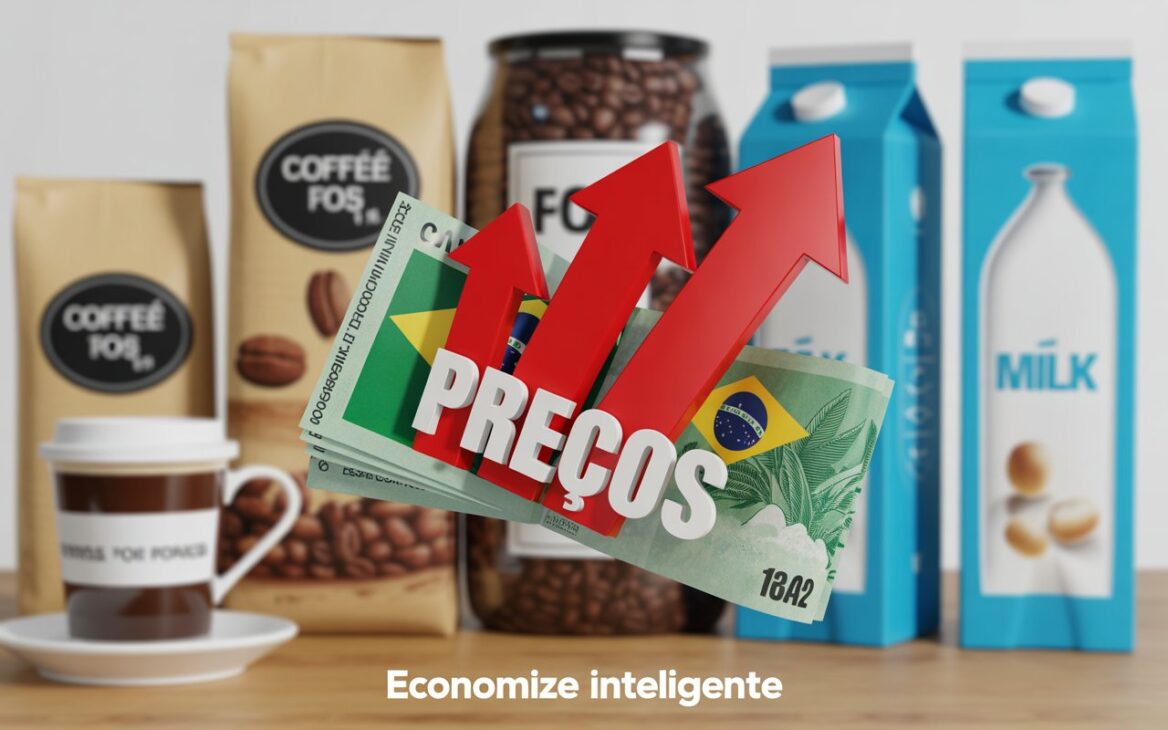
History of Major Inflation in Brazil Caused by Excessive Money Issuance
Although inflation can be caused by various factors, throughout Brazil’s history there have been moments when uncontrolled money issuance was one of the main triggers for widespread price increases.
- 1980s – Chronic Inflation and Hyperinflation
Between 1980 and 1989, Brazil experienced persistent inflation that reached over 2,000% per year at the end of the decade, according to data from the Brazilian Institute of Geography and Statistics (IBGE). Part of this chaos was a result of excessive money issuance to cover public spending, a practice that quickly eroded the value of the cruzeiro, the currency at the time. - Cruzado Plan (1986)
President José Sarney launched the Cruzado Plan to try to control inflation, freezing prices and salaries, but also increasing money issuance to support public policies and ensure consumption. The result was a sudden demand increase without a corresponding rise in production, causing shortages and a new price surge a few months later. Source: Getulio Vargas Foundation (FGV) – Center for Research and Documentation of Contemporary History of Brazil (CPDOC). - Collor Plan (1990)
Facing a scenario of inherited hyperinflation, President Fernando Collor de Mello adopted radical measures, such as seizing part of savings and checking accounts, seeking to reduce liquidity. Nonetheless, in previous years, money issuance to finance deficits had accelerated the inflationary process. Source: Central Bank of Brazil – Inflation Report (1991).
These episodes show that simply putting more money into circulation without a proportional increase in the production of goods and services does not solve economic problems — on the contrary, it can worsen instability and erode the purchasing power of the population.









Seja o primeiro a reagir!