





 Português
  Inglês
  Espanhol
  5 min de leitura
  1 comentário


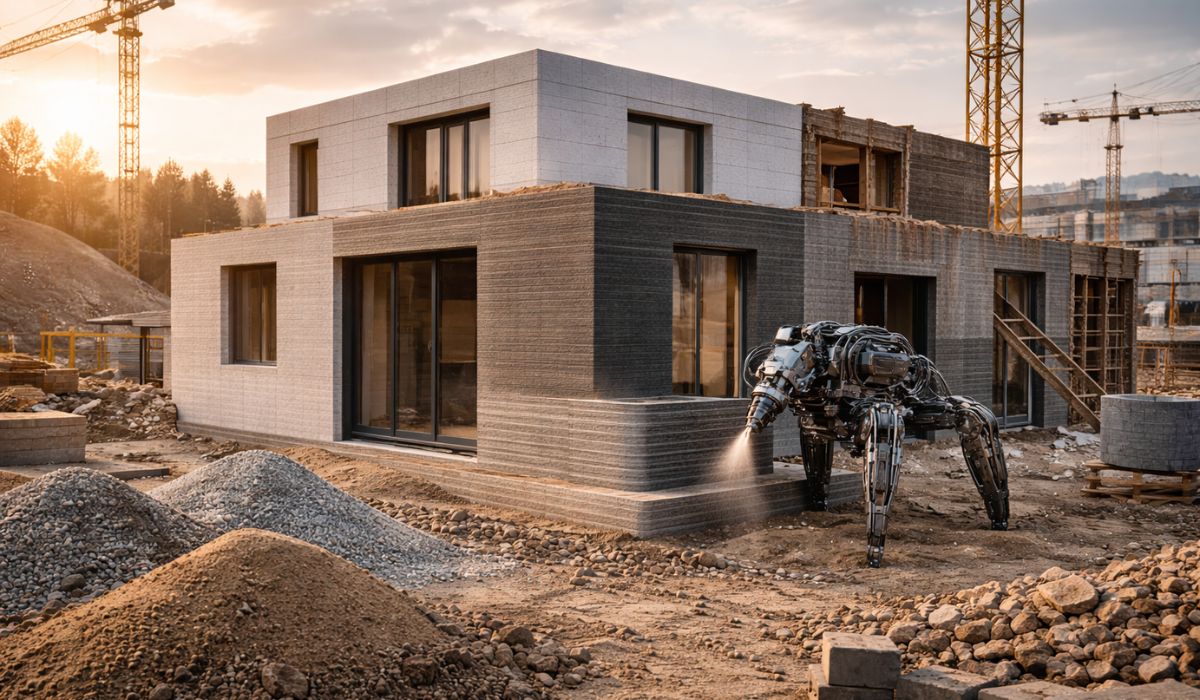


A test technology reignites the discussion about automation, productivity, and housing, while the construction sector watches closely the advance of machines capable of changing historic routines on worksites and pressuring the market for adaptation.
A six-legged robot presented in Australia has brought construction automation to the center of the debate on housing, productivity, and employment.
Named Charlotte, the system combines spider-inspired locomotion with additive manufacturing to build walls directly on the construction site.
Its developers claim that the technology could construct a house of up to 200 square meters in about 24 hours, using local raw materials and processed waste, and reducing traditional construction steps.
-
A bright yellow mushroom imported from Asia escaped from a cultivation farm in the United States in 2010 and is now aggressively spreading across 25 states, destroying entire communities of native fungi in American forests.

-
Buried under China, a colossal machine weighing 20,000 tons began operating as the largest neutrino detector on the planet and, in just 59 days, surpassed results that science took half a century to achieve.

-
Iran enters the center of a climate alert after the war emitted 5.6 million tons of CO2 in two weeks, surpassing the annual pollution of entire countries.

-
Lunar exploration may change after a Chinese probe finds a “cavity” of radiation that reduces the impact on astronauts by up to 20% at certain times on the Moon.


So far, however, the project remains in research and development phase, with a prototype already publicly displayed but lacking independent validation on a commercial scale for all claimed capabilities.
What Is Charlotte and How Does It Work
Charlotte was developed by Crest Robotics in partnership with Earthbuilt Technology, two Australian companies presenting the project as an alternative to reduce costs, shorten deadlines, and decrease reliance on labor-intensive processes.
Instead of operating as a fixed 3D printer, the robot was designed to move over uneven terrain and follow the geometry of the construction, depositing material in layers at the job site.
The proposal gained visibility at the 76th International Astronautical Congress held in Sydney, where the equipment was presented as part of a construction demonstrator aimed at terrestrial applications and, in the future, also space applications.
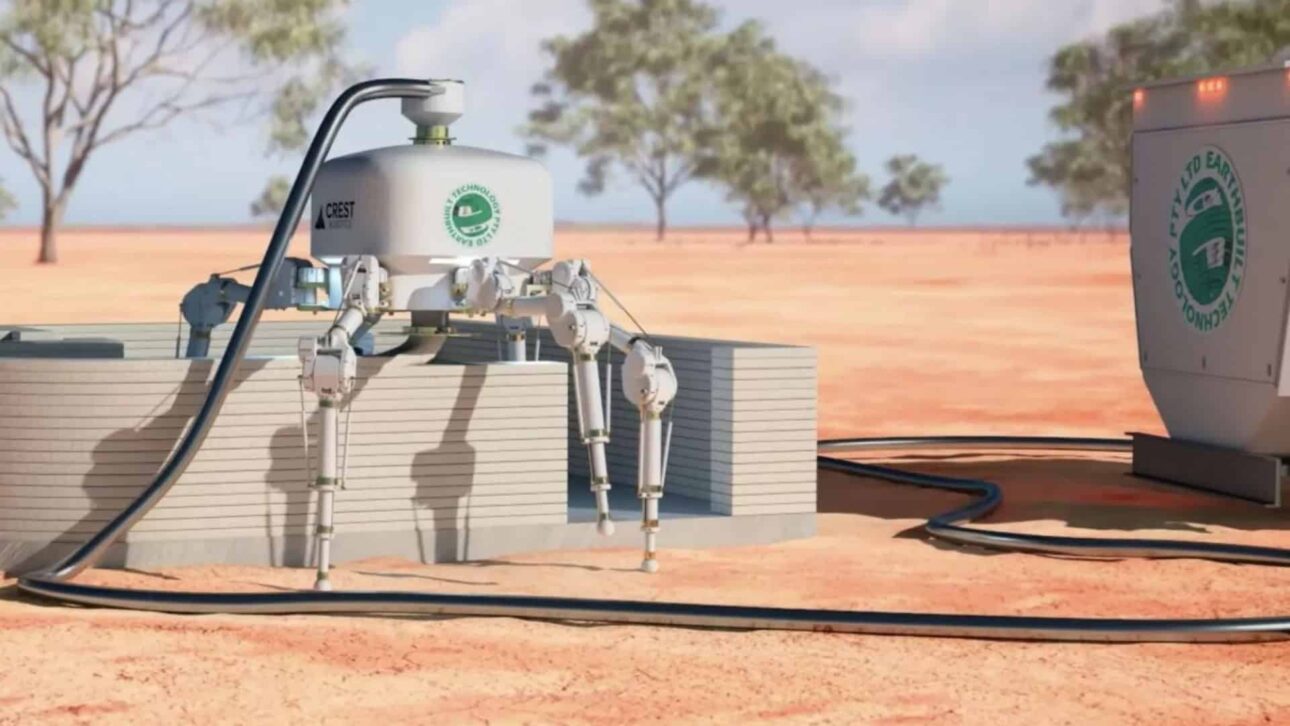
On Crest Robotics’ own site, Charlotte is presented as a six-legged construction robot already revealed at the event.
The official programming associated with the congress also recorded a public demonstration of the system in October 2025.
Still, the current stage of the project requires caution in describing its capabilities.
ABC News reported at the time of the presentation that Charlotte was still in the research and development phase and that the equipment shown to the public was a scaled-down prototype.
In this scenario, the case fits more as a developing technology than as a solution already widespread on construction sites.
Robot in the Construction Sector and the Promise of Building Houses in a Day
According to the creators, Charlotte’s main differentiator is in gathering in one platform tasks that, in a conventional construction, require multiple stages, teams, and intermediate inputs.
The system receives raw materials, processes the building compound, and applies the material to form the walls.
Earthbuilt described this principle as a way to shorten the traditional construction chain, replacing a long sequence of manufacturing, transportation, and assembly with a more direct flow within the worksite.
It was in this context that the most striking claims associated with the robot emerged.
The project’s leaders stated that the equipment could operate at a speed equivalent to that of over 100 bricklayers and assemble a house of 200 m² in a day.
So far, however, these numbers have been presented as projections by the developers, not as results of independent measurements on completed works in series.
In practice, the technology seeks to address two recurring challenges in the sector: low productivity and the difficulty of maintaining schedules amid a shortage of skilled workers.
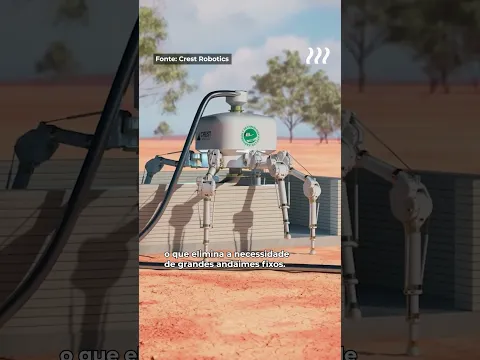

In a report by ABC, researcher Neda Mohammadi from the University of Sydney assessed that robotics tends to expand the work capacity of teams, especially in repetitive and higher-risk tasks.
The analysis indicates potential operational gains but does not, by itself, confirm all the estimates attributed to the project.
3D Printing, Local Materials, and Environmental Appeal
Another avenue used by the developers to support the project is the environmental one.
Charlotte has been presented as capable of operating with locally available materials, including soil, sand, and waste such as glass and crushed brick.
In a piece published by Forbes Australia, Jan Golembiewski from Earthbuilt stated that the proposal aims to eliminate high-emission industrial stages by transforming raw inputs into walls with less intermediate processing.
This argument helps explain why the robot has become associated with a construction of lower carbon footprint.
According to those responsible for the project, reducing transport, waste, and part of the energy incorporated into materials can lessen the environmental impact of the construction.
The developers’ discourse also links the technology to the circular economy by repurposing mineral waste as construction input.
On the other hand, no public and independent data has yet been found that compares in detail structural performance, final cost per square meter, and actual emissions against conventional methods on a market scale.
Without such verification, part of the environmental discourse remains tied to the information provided by the developers themselves.
Impact of Robots on Construction Labor
The diffusion of this type of technology is often associated with the replacement of workers, but consulted sources point to a broader scenario.
ABC’s own coverage treated robotics as a tool to relieve labor constraints and reduce delays, not just as a mechanism for eliminating jobs.
In the short term, the trend indicated by experts is an increase in demand for roles linked to operation, supervision, maintenance, digital modeling, and quality control, while part of the repetitive manual tasks may lose space.
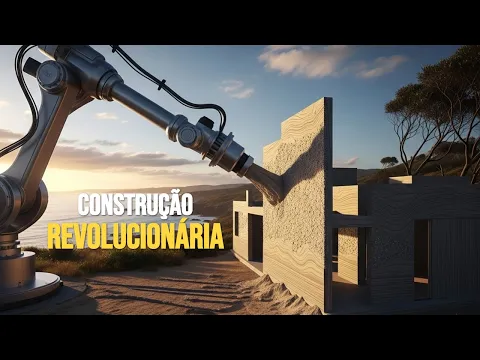
This does not mean an absence of impact on the routine of worksites.
In a sector historically pressured by deadlines, costs, and safety, technologies capable of automating part of the wall production can change the organization of teams and the execution steps.
At the same time, finishing, installations, foundations, roofing, frames, and other areas of construction remain outside the simplified idea that a single robot would build a complete residence by itself.
Housing Crisis, Commercial Scale, and Adoption Challenges
The creators of Charlotte also relate the project to the Australian housing crisis and the sector’s difficulty in increasing productivity.
Forbes Australia cited data from CEDA when reporting that construction productivity in the country has deteriorated over the past decades, a situation that helps explain the interest in automated solutions.
In this environment, systems capable of reducing construction time and waste begin to attract the attention of companies and public policymakers.
Despite this, there is still a gap between potential impact and effective market adoption.
To move out of the demonstration realm and achieve commercial scale, the technology will need to face regulatory requirements, material certification, insurance, implementation costs, adaptation to building codes, and acceptance by builders and buyers.






Deve ser muito util no pós guerra quando se encerrar esses ataques cretinos….a população atingida agradece.