





 Portuguese
  English
  Spanish
  6 min of reading
  0 comments


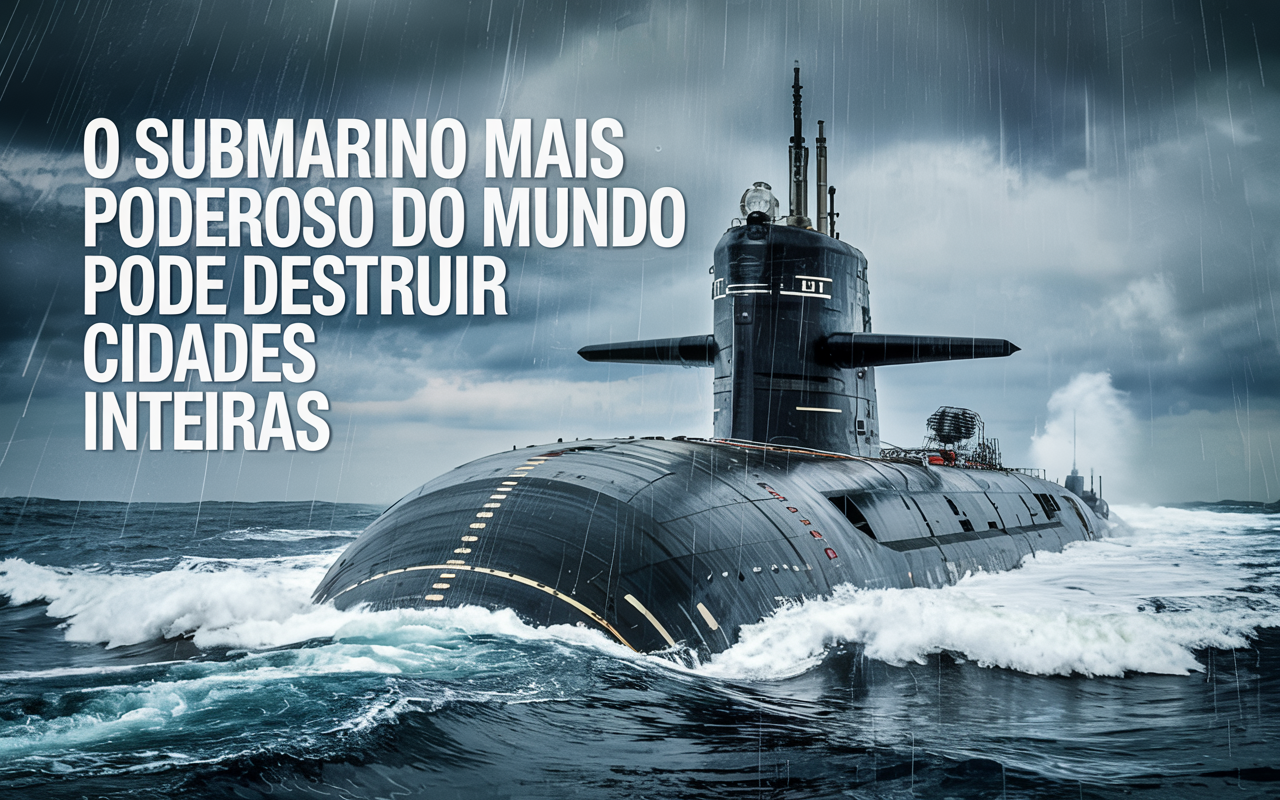
Meet The Ohio Class Nuclear Submarine, Considered The Most Powerful Submarine In The World, Capable Of Launching Nuclear Weapons Accurately — But Whose Exorbitant Cost Forced Cuts In Production By The Navy Itself.
At the heart of the ocean, far from radar and human eyes, sails one of the deadliest creations of modern military engineering: the Ohio class nuclear submarine. Conceived by the United States during the Cold War, it is considered by experts to be the most powerful submarine in the world — a true submerged fortress capable of launching a nuclear apocalypse with a simple command. But despite its unmatched power, the development and maintenance costs of this fleet are so high that even the United States, the world’s greatest military power, decided to halve the initially planned number of units.
What Makes The Ohio Class The Ultimate Symbol Of Submarine Military Power?


The strategic role of the Ohio class is clear: to ensure the survival of the American nuclear arsenal in any scenario. Its submarines make up the maritime leg of the nuclear triad — alongside land-based missiles and strategic bombers — and are designed to remain hidden for months in the oceans, ready to respond to any existential threat to the country with total retaliation.
The secret to its effectiveness lies in its stealth, mobility, and destructive capability. Unlike fixed bases, which are easy targets in a surprise nuclear attack, these submarines can be anywhere on the planet — and no one, not even U.S. allies, knows where they are.
-
A couple buys an old chalet, breaks the kitchen floor for renovation, and finds over a thousand coins of gold and silver hidden since the English Civil War over 4 centuries ago.

-
Rigid bags with their days numbered: new trend prioritizes comfort in 2026.

-
YouTuber creates an excavator equipped with a giant 4.5-meter sword to challenge his brother to a rematch, and the invention quickly goes viral on social media.
-
The U.S. Army surprises the world by presenting the UH-60MX Black Hawk helicopter capable of flying without pilots, controlled by a tablet, featuring the MATRIX system, smart sensors, and full autonomy in real combat and rescue missions.

Ohio Class Nuclear Submarine: Technical And Operational Characteristics
The Ohio class nuclear submarine impresses with its colossal dimensions and practically unlimited autonomy. Its S8G nuclear reactor allows missions lasting up to 90 days without the need for refueling.
Main Specifications (Source: US Navy):
- Length: 170 meters
- Width: 13 meters
- Submerged Displacement: 18,750 tons
- Submerged Speed: over 20 knots
- Operational Depth: classified, but estimated up to 300 meters
- Propulsion: S8G nuclear reactor + steam turbines
- Crew: about 155 military personnel (rotating between two teams: Blue and Gold)
This model was produced between 1976 and 1997. Initially, the U.S. Navy planned to build 24 units, but due to the costs involved and the end of the Cold War, the total was reduced to 18.
Of these, 14 remain armed with Trident II D5 ballistic missiles, while another 4 have been converted to transport Tomahawk cruise missiles and special operations forces.
An Arsenal Capable Of Annihilating Continents
Each Ohio class SSBN is armed with 24 Trident II D5 missiles, considered the most accurate and powerful submarine-launched ballistic missiles in the world. Each Trident can carry up to 14 independent nuclear warheads (MIRVs), with a yield of up to 475 kilotons per warhead — about 30 times the Hiroshima bomb.
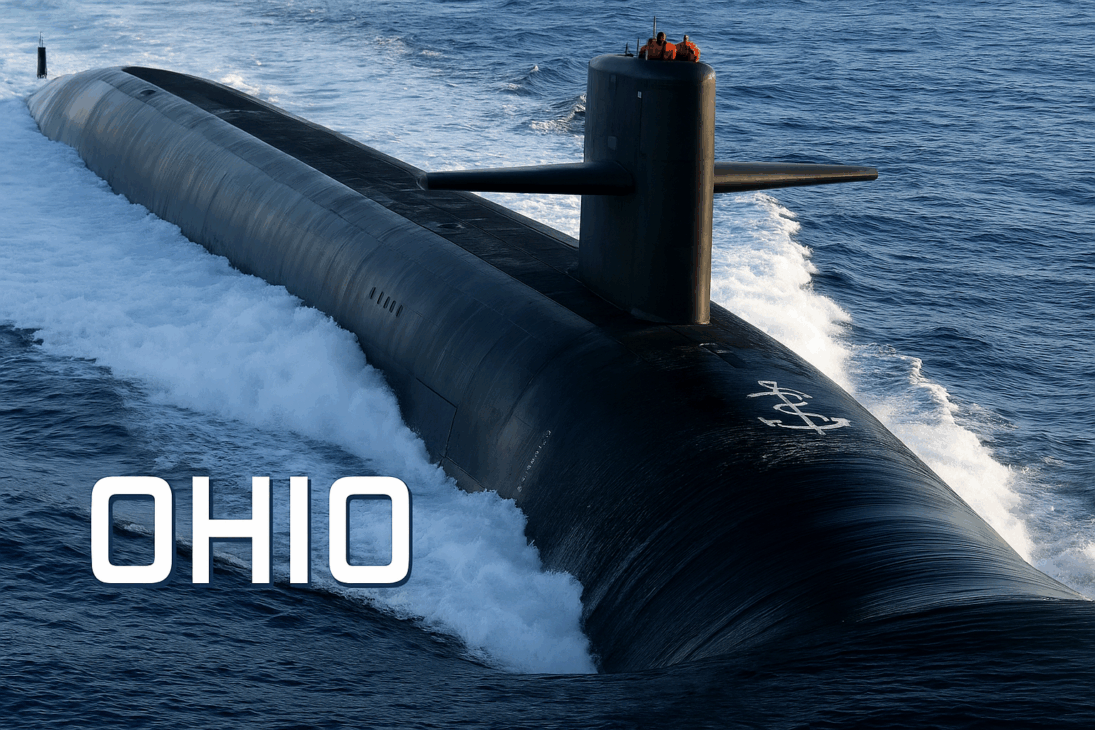
This means that a single Ohio class submarine can carry up to 336 nuclear warheads, capable of destroying dozens of cities simultaneously in less than 30 minutes.
In terms of destructive power and penetration capability against enemy defense systems, no other system currently in operation surpasses the Ohio + Trident II D5 combination.
Why Did The U.S. Cut Production In Half?
Despite its strategic importance, the exorbitant cost of the Ohio class has always raised internal concerns. The unit cost exceeded US$ 2.9 billion in updated values. Overall, the program consumed over US$ 50 billion, not counting operational and maintenance expenses over decades.
With the end of the Cold War, the U.S. government chose to freeze the program at 18 units — canceling the remaining 6 — and redirect resources to modernizing existing submarines and developing new technologies such as the Columbia class, which is expected to replace the Ohio starting in 2031.
According to the Congressional Research Service (CRS), the decision represented a balance between national security and fiscal responsibility in times of reduced geopolitical tension.

The Columbia Class: Natural Successor
The Columbia class will be the new generation of U.S. Navy ballistic nuclear submarines. The current plan is to build 12 units, enough to maintain strategic deterrence, but with substantial improvements in terms of stealth, durability, and reduction of operational costs.
Each Columbia is expected to cost around US$ 9.4 billion, with the total program cost estimated at over US$ 110 billion. They will feature lifetime nuclear reactors (which will not require refueling throughout their life cycle), new noise reduction technologies, and advanced automation.
It is projected that the first Columbia will enter service in 2031, gradually replacing the Ohio over the coming decades.
The Silent Rivalry With Russia: Borei Class
Russia, for its part, has developed the Borei class, its response to the Ohio class. Although they are modern ballistic nuclear submarines, the Borei have less payload capacity and more limited missile range.
Characteristics Of The Borei Class (Source: Russian Ministry Of Defense):
- Length: 170 meters
- Submerged Displacement: 24,000 tons
- Propulsion: OK-650 nuclear reactor
- Missiles: 16 RSM-56 Bulava, with MIRV nuclear warheads
- Crew: about 107 military personnel
While Russian performance is noteworthy, analysts from Defense News and the FAS (Federation of American Scientists) point out that American Ohio class submarines still outperform the Borei in stealth, patrol time, integration with allied systems, and, most importantly, accuracy and reliability of the Trident II D5 missiles.
The Role Of Submarines In The Nuclear Deterrence Doctrine
The submarine-based nuclear deterrence doctrine — known as second-strike capability — is fundamental to maintaining the balance of power. Even if a country suffers a massive nuclear attack and loses a significant part of its infrastructure and armed forces, its submarines hidden on patrol have the capacity to respond with devastating force.
This concept was developed during the Cold War and remains valid in the 21st century. According to the U.S. Navy, there are always armed submarines on active patrol — in secret locations — ready to respond within minutes to any aggression.
The Ohio class submarines operate with a system of rotation between two crews (Blue and Gold), allowing them to remain on patrol virtually uninterrupted. Each mission lasts between 70 and 90 days, followed by maintenance and crew change.
Moreover, the nuclear reactors are replaced only once during the entire service life of the submarine, which drastically reduces the time out of operation.
In each cycle, communication systems, sonars, and launch platforms are updated to ensure technological superiority — including integration with satellites and naval and aerial tactical networks.
Critics And Environmental Concerns
Despite its strategic importance, the Ohio class is not without criticism. Various environmental groups and experts warn of the risks involved in operating submerged nuclear reactors and the environmental impact in case of an accident.
Additionally, there are ethical questions regarding the maintenance of arsenals capable of destroying civilization multiple times. The high cost of the program also raises internal debates in the U.S. about the priority given to the military sector at the expense of social policies.
On the other hand, strategists argue that the existence of submarines like those of the Ohio class is precisely what prevents nuclear wars, through deterrence and balance among powers.
The Ohio class represents the most lethal, stealthy, and technologically advanced capabilities in the history of nuclear submarines. Its role as a pillar of U.S. strategic deterrence has been established for over 40 years. Even with the high costs and the controversy surrounding its operation, the fleet continues to be seen as one of the guarantees of global geopolitical stability.
The most powerful submarine in the world is not just a weapon — it is a silent symbol of a fragile balance that keeps the world on the brink of destruction, but also away from it. And, as the Columbia class prepares to take its place, the Ohios continue to navigate silently, ready to act in seconds — but hoping they never have to.
Official Sources:
- United States Navy – Official Website
- Federation Of American Scientists (FAS)
- Defense News
- Ministry Of Def
- ense Of Russia / RT






-

2 pessoas reagiram a isso.