





 Portuguese
  English
  Spanish
  4 min of reading
  22 comments


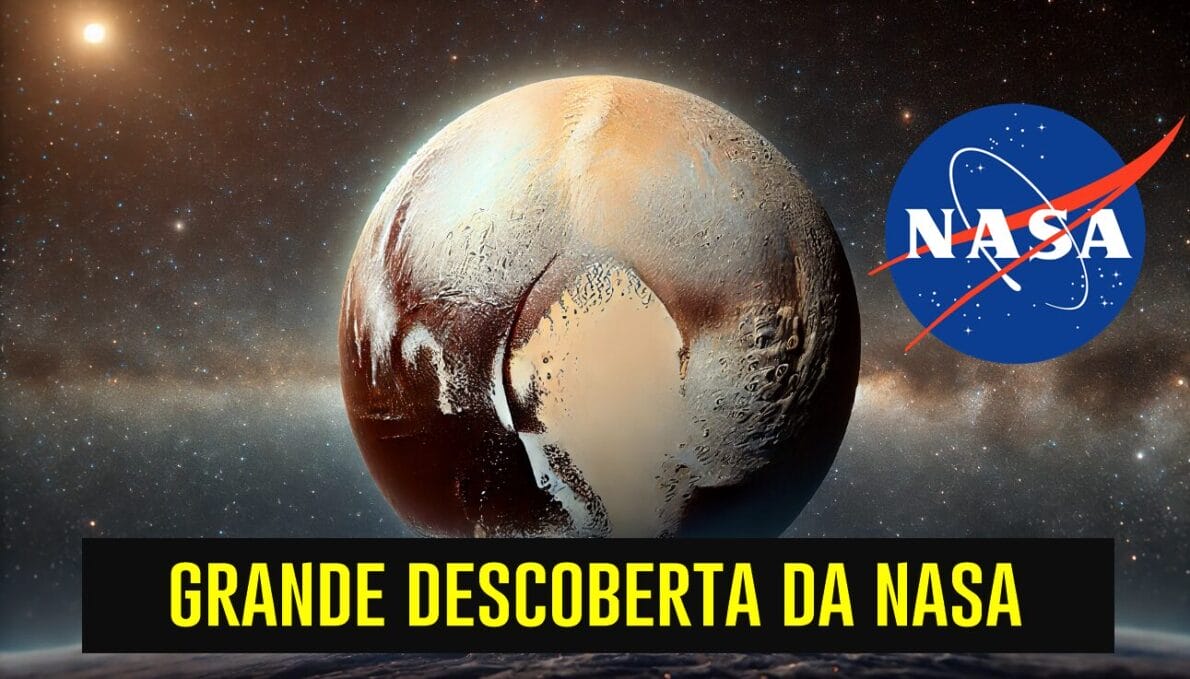

The NASA Webb Telescope Found Carbon Dioxide on the Surface of Charon, Pluto’s Largest Moon, Bringing New Clues About the Composition of Celestial Bodies in Our Solar System and Their Potential Habitability.
In the depths of our Solar System, at an impressive distance of 5.7 billion kilometers from the Sun, lies the dwarf planet Pluto, a icy world of mountains, glaciers, and craters, where the average temperature reaches -232°C. This distance is nothing for the powerful James Webb Telescope of NASA.
Despite its small size, even smaller than Australia, Pluto continues to fascinate scientists and astronomers for its unique characteristics.
Alongside it, five moons orbit: Styx, Nix, Kerberos, Hydra, and its largest, Charon. It is especially the singular relationship between Pluto and Charon that has intrigued the scientists.
-
What can really trigger large volcanic eruptions? Research suggests that gas returning to the magma may be more dangerous than gas escaping from it.

-
Found in one of the most radioactive places on Earth, this Chernobyl fungus may be doing something with radiation that no one has been able to explain to this day.
-
A bright yellow mushroom imported from Asia escaped from a cultivation farm in the United States in 2010 and is now aggressively spreading across 25 states, destroying entire communities of native fungi in American forests.

-
Buried under China, a colossal machine weighing 20,000 tons began operating as the largest neutrino detector on the planet and, in just 59 days, surpassed results that science took half a century to achieve.


A Fascinating Binary System
Unlike most planetary systems, where moons orbit their planets in a more conventional manner, Pluto and Charon form what is known as a “binary system“.
This means that both bodies orbit a common point in space, situated between them, instead of Charon simply orbiting Pluto as the Moon does with Earth.
This behavior is one of the reasons Pluto lost its planet status, being reclassified as a dwarf planet, as the orbit with Charon prevents it from meeting the “clearing the neighborhood” criterion required to be considered a full planet.
Charon was discovered in 1978 and has since been the subject of intense investigation. With a width of about 1,200 kilometers, it is approximately half the size of Pluto, making it the largest known satellite in proportion to its primary body in the Solar System.
This almost equal relationship makes the Pluto-Charon system a unique case, different from most other natural satellites, like our own Moon.
Composition of Charon
In 2015, NASA’s New Horizons mission made history by being the first spacecraft to explore Pluto and its moons up close, revealing fascinating details about Charon’s composition.
It is a cold moon, rich in water ice but also composed of ammonia and a variety of carbon-based compounds.
Additionally, Charon is believed to possess cryovolcanoes – geological formations that, instead of expelling magma like on Earth, release ice and other frozen materials.
These unusual characteristics set Charon apart from other trans-Neptunian objects, which are typically dominated by nitrogen ice and methane.
Recently, a new study led by astronomer Silvia Protopapa and published in the journal Nature Communications, announced the discovery of carbon dioxide and hydrogen peroxide on the surface of Charon.
This discovery, obtained through observations from NASA’s James Webb Space Telescope, offers new insights into the history and evolution of Charon and other objects located beyond Neptune.
The Importance of Carbon Dioxide and Hydrogen Peroxide
The presence of carbon dioxide on Charon is particularly significant as it may provide valuable information about the origin and geological processes that shaped this moon.
It is believed that the carbon dioxide found on the surface of Charon comes from subsurface layers exposed by impact from asteroids and other objects, which create craters and reveal fresh material beneath the frozen surface.
Hydrogen peroxide, another molecule recently detected, is less common but equally interesting. Its presence may indicate that oxidation processes are occurring on Charon, which could impact our understanding of the complex chemistry that takes place on the icy surfaces of these distant bodies.
The study of molecules such as carbon dioxide and hydrogen peroxide can reveal much about the interaction of different compounds in trans-Neptunian objects, providing clues about the formation and evolution of Charon and other similar bodies.
The Power of the James Webb Telescope

The discovery of these molecules was made possible thanks to the detailed observations conducted by the James Webb Space Telescope, which was launched in 2021.
With a mirror six and a half meters wide, this telescope is extremely powerful and sensitive, allowing scientists to observe space in infrared wavelengths, which are invisible to human eyes and most ground-based telescopes.
The James Webb employs a technique called spectroscopy to detect compounds in celestial bodies. This technique splits light into its component colors, just as white light splits into a rainbow. Each element or molecule has a unique “fingerprint” in the light spectrum, allowing scientists to identify which molecules are present in a given object.
Clues to an Ancient Mystery
The origin of Charon remains an intriguing mystery. One of the leading theories suggests that Charon formed similarly to our Moon, after a massive collision of an object in the Kuiper Belt with Pluto about 4.5 billion years ago.
Another theory is that Pluto and Charon were two distinct objects that encountered each other and became gravitationally bound, forming the binary system we see today.
The discovery of new molecules such as carbon dioxide and hydrogen peroxide on the surface of Charon may help refine these theories, providing additional clues about the formation of this system.
Understanding the composition of Charon and the geological and chemical processes occurring on its surface may bring us closer to unraveling the enigma of its origin.
More than that, these discoveries offer a glimpse into how other objects in the Kuiper Belt function, a little-explored region of our Solar System.
As new research is conducted and NASA’s James Webb Space Telescope continues to provide us with detailed information, our understanding of the distant Pluto-Charon system will certainly deepen, revealing the secrets that this icy corner of the cosmos still holds.









Nós temos que amar do nosso planeta, assim como nós se amamos. Não precisamos de se preocupar com isso
Que bom as descobertas do telescópio .é muito importante tecnologia.
Mas o universo é nosso casa tbm.
Temos que entender que temos que cuida do nosso planeta Terra ,com mas amor e carinho .
Se nois cuida da nossa casa tudo ficará melhor .
Que a tecnologia continua nos abençoado ♥️
Kkkkkkkkkkk acorda mané Jesus está voltando