





 Portuguese
  English
  Spanish
  5 min of reading
  1 comment


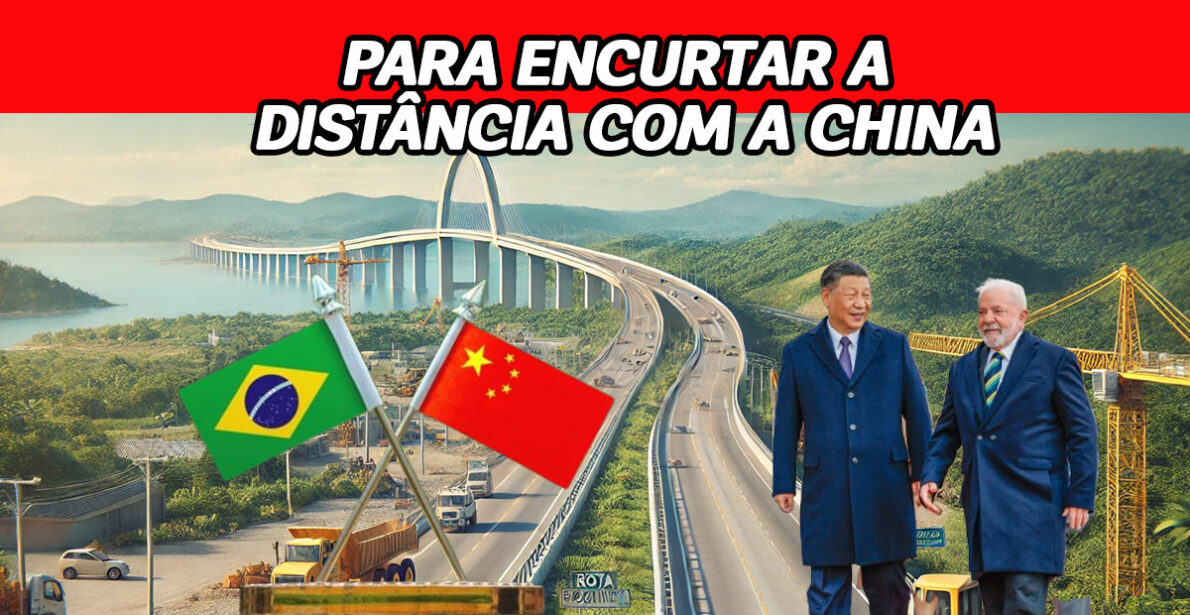

Megastreet That Could Transform Brazil! With the Construction of the Bioceanic Route, the Country Will Shorten Distances with China, Facilitating Exports and Generating Jobs. The Work Also Promises to Strengthen Tourism and Cultural Exchange with Neighbors in South America.
The largest infrastructure project to directly connect Brazil to the Pacific Ocean, passing through Chile, is already underway.
What once seemed like a distant dream is now taking shape. But why is this construction so important for Brazil and its neighbors?
Much more than a simple highway, this megastreet promises to transform commercial and cultural relations in South America, facilitating exports and even speeding up exchange with countries as distant as China.
-
Larger than entire cities in Brazil: BYD is building a 4.6 km² complex in Bahia with a capacity for 600,000 vehicles per year, but the discovery of 163 workers in conditions analogous to slavery has shaken the entire project.

-
With an investment of R$ 612 million, a capacity to process 1.2 million liters of milk per day, Piracanjuba inaugurates a mega cheese factory that increases national production, reduces dependence on imports, and repositions Brazil on the global dairy map.

-
Brazilian city gains industrial hub for 85 companies that is equivalent to 55 football fields.

-
Peugeot and Citroën factory in Argentina cuts production by half and opens a layoff program for more than 2,000 employees after Brazil drastically reduced purchases of Argentine vehicles.


The details of this monumental project may surprise and open doors that have not yet been imagined.
The so-called Bioceanic Route, or Latin American Integration Route (RILA), is a strategic logistics corridor, linking the Atlantic to the Pacific.
The project includes the construction of a 13-kilometer access road, which will connect BR-267 in Porto Murtinho to the Bioceanic Bridge, located at the border between Brazil and Paraguay.
According to the Minister of Planning and Budget, Simone Tebet, the project is already in its initial phase, with the construction of this access having begun on September 20, 2024.
From this corridor, a shorter route for trade between Brazil, Paraguay, Argentina, and Chile will be possible, reducing time and transportation costs.
Impact on the Brazilian Economy
The expectation is that this new route will bring significant logistical gains for Brazil. Studies by the Planning and Logistics Company (EPL) indicate that Brazilian exports to Asia could have their maritime route reduced by 9,700 kilometers.
This means a savings of up to 12 days in transportation to China, one of Brazil’s largest trading partners.
With this time savings and reduction in logistical costs, Brazil could make its products more competitive in the international market, especially in sectors such as animal proteins and higher value-added goods.
According to Simone Tebet, this megastreet is essential for integrating Brazil with the rest of South America, strengthening economic and cultural ties.
She stated that “Brazil needs to look more at its own continent, seizing the opportunities that are right next to it”, referring to the lack of attention given to trade with neighboring countries.
The route promises not only to improve exports but also to encourage tourism and cultural exchange, as the infrastructure will facilitate access to important tourist spots, such as the Hill of Seven Colors in the Andes Mountains, Argentina.
Bioceanic Bridge and Logistical Access
Another essential point for the project is the construction of the Bioceanic Bridge, which is being built by a binational consortium with an investment of R$ 575.5 million.
The bridge will be 1,294 meters long, divided into three parts, and the structure is already 60% complete, according to the Ministry of Public Works and Communications of Paraguay.
While the bridge crosses the Paraguay River, the Brazilian government, through the National Department of Transportation Infrastructure (DNIT), is responsible for building the access to BR-267, as well as a road bypass and a customs center to manage the passage between Brazil and Paraguay.
Simone Tebet emphasized that the customs center, a fundamental part of the project, should be a joint effort between Brazil and Paraguay.
The Federal Revenue Service is already involved in structuring this unit, which can simplify trade between the two countries, according to information from the minister.
Logistical Challenges and Concerns About Imports
Although the new route is viewed optimistically by much of the industry, there are concerns about the increase in imports and their impact on the local market.
Sérgio Longen, president of Fiems, pointed out that despite the evident benefits for exports, “Brazil still faces a high cost in terms of imports, which may reduce the competitiveness of the local industry.”
This is a concern that will be discussed at both federal and state levels, seeking to balance the gains for exports with potential challenges for Brazilian industries.
Jaime Verruck, state secretary for the Environment, Development, Science, and Technology, also emphasized that the challenge now is to establish an efficient customs system among the four countries involved in the route.
Simplifying this system is crucial to ensure that Brazil makes the most out of the Bioceanic Route, especially in higher value-added supply chains.
Opportunities for Trade with Asia
One of the main attractions of the Bioceanic Route is its potential to facilitate trade with Asia, especially with China.
Reaching the Asian market at a cost 30% lower than through traditional routes could provide a significant boost for products such as animal proteins and other value-added goods.
The goal, according to Verruck, is not to export commodities like soybeans but rather to focus on products with greater value in the international market.
Moreover, the route creates opportunities for the import of Asian products at reduced costs. This could transform Mato Grosso do Sul into an important distribution hub for Asian products to the rest of Brazil, as highlighted by Jaime Verruck.
The state can benefit both from exports and from the internal distribution of imported goods.
Bioceanic Bridge Promises to Revolutionize Trade
With a project that promises to revolutionize trade between Brazil and its neighbors, the Bioceanic Route is seen as a unique opportunity for economic growth and regional development.
The challenge now is to ensure that the necessary infrastructure is completed within the established deadlines and that the customs system is sufficiently agile to support commercial flow.
Is Brazil prepared to fully take advantage of this new route for continental integration, or could logistical and commercial challenges limit its potential?








Outra matéria perfeita.
https://www.rcwtv.com.br/