





 Portuguese
  English
  Spanish
  7 min of reading
  0 comments


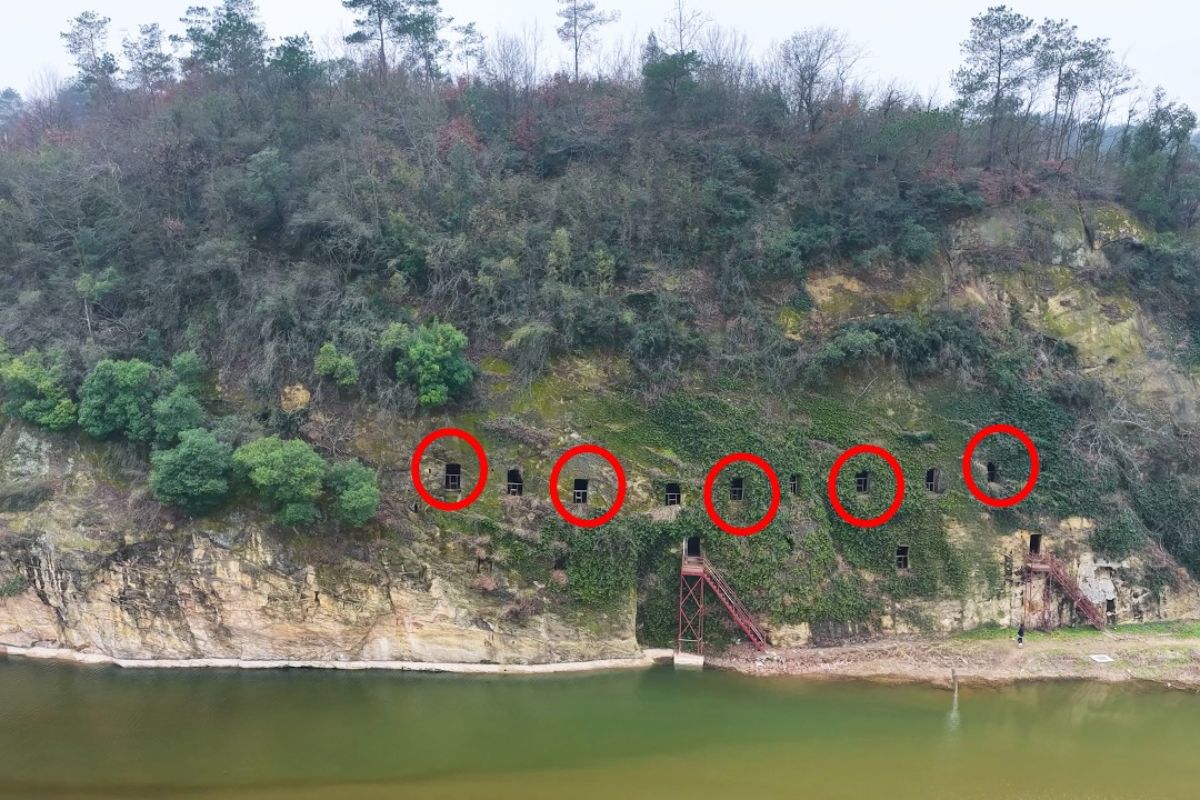
In Dangyang, In Hubei Province, A Mountain Was Carved As A Fortress: Dozens Of Two-Story Houses Emerge From The Rock, Connected By Doors, Windows And Passageways, With Stoves, Beds And Possible Bathrooms. A Thousand Years Later, The Settlement Remains Intact And Full Of Questions About Who Built It And How They Lived.
In Dangyang, In Hubei, China, dozens of houses were excavated directly into a steep cliff, with two-story rooms, defensive openings and tool marks on the stone that can still be seen. Local tradition attributes the work to eight brothers who sought refuge and safety high above the ground, in a “sky fortress” that was difficult to attack.
What intrigues is not only the scale of the settlement but also the level of detail preserved: stoves integrated into the rock, stone beds, door grooves, wells, ditches and signs of bathrooms. Even with divergent theories about the origin, the site continues to raise the same central question: how did a community manage to carve, occupy, and maintain such an extreme shelter for so long?
Where Is The Suspended City And Why Does It Seem Impossible

The settlement known as Baibaozhai Stone House is located in a cliff area in Dangyang, Hubei Province, China.
-
New CCR concrete paving technology promises roads up to 3x more durable, less maintenance, and cost reduction in Brazil.
-
Made from recycled plastic, plastic wood is gaining space in the construction industry because it does not rot, resists moisture, and reduces maintenance costs over the years.

-
Florianópolis will receive a million-dollar BRT that will begin construction in 2026 with nearly 400 million in funding from the federal government and the Inter-American Development Bank, and the map already shows the routes for the exclusive bus corridors.

-
Without a blueprint, without an engineer, and using scrap from the dump, a father spends 15 years building an 18-room castle for his daughter, featuring tram tracks, 13 fireplaces, and over 700 m², which may now be demolished.

From below, the entrance does not appear head-on, which already gives a sense of the difficulty: access reveals itself more from the sides and through openings scattered along the slope than from an obvious “door”.
The mountain was excavated as if it were a single block of architecture. Instead of constructions added with bricks or wood, the interior space was removed from the rock, creating caves, and within them, sculpted houses.
There are more than a dozen cavities of varying sizes on the slope, and within these cavities, there are more than a dozen interconnected houses, forming a kind of suspended city.
How To Enter The Dozens Of Houses And What That Reveals About Defense

To reach the dozens of houses, the journey includes crossing a river by boat, the Ju River, and then reaching the base of the cliff where there is a cultural relics protection marker identifying the area as Baibaozhai Stone House.
From there, the visitor realizes that the layout does not favor those trying to arrive unannounced.
The entrance is high, about four to five meters above the ground. Climbing the rock is described as impossible, reinforcing the defensive logic: those up high completely controlled access.
One hypothesis raised during the visit is that in the past, a rope ladder may have been used, which could be extended and retracted, making the settlement even more protected.
Today, the existing stairs were built recently to facilitate tourism.
This detail is important because, without them, the site retains the same characteristic that made it attractive to someone fleeing threats: isolation and control of entrance.
Doors, Grooves And Fittings: The Engineering Hidden In The Stone

Upon entering, what stands out the most is the presence of “carpentry” elements converted into rock. There are grooves for bolts and door frame fittings, as if the house had received wooden doors that slid and locked in channels precisely carved.
In some sections, there is a main door and another internal door, suggesting layers of protection.
The defensive system appears not only in the height of access but also in the forms of narrowings, elevations and passage points that force a person to bend or slow down. In a fortress, this is not detail: it’s strategy.
Another aspect is the intentional irregularity of heights and widths. Some doors are described as narrower than previous ones; some passages require the body to curve.
The space was not designed for modern comfort, but rather for survival and control of movement.
Two Stories In The Rock: Internal Stairs, Wells And Large Ditches

The stone houses are divided into two levels, and there are internal stairs leading to the second floor. At some points, the incline is steep and the space is narrow.
The settlement also features lowered areas in the flooring and small chambers on the ground floor, contrasting with higher and lighter upper environments.
One of the most intriguing elements is a large, deep well in one of the chambers. At the edge of this well, there are horizontal grooves that appear to be made to support cross beams.
There is even a piece of wood lodged in one of these grooves, indicating that internal structures existed there.
The function of the well is uncertain, but coherent interpretations arise from what is seen: it could be a water reservoir or space for livestock, with boards and beams supporting an upper floor.
The presence of moss next to the well is pointed out as a sign of moisture, reinforcing the hypothesis of water. In other areas of the settlement, large ditches appear without visible drainage systems, increasing the mystery: why dig such deep cavities without a clear outlet for liquids?
Stoves, Beds And Bathroom Remnants: Signs Of Everyday Life

Among all the clues, few are as strong as the marks of routine.
There are stone beds carved in chambers, appearing as sleeping platforms.
There are also stone stoves integrated into the structure, where it would be possible to cook by placing a pot over the base.
In at least one spot, there are signs of smoke on the wall, used as evidence that someone lived there for a significant period.
The site also features spaces that seem to have been used as bathrooms.
In a smaller area, the odor is described as strong, associated with the presence of excrement, suggesting sanitary use or shelter for animals at some point.
In another house, there is a lateral hole interpreted as a possible sewage disposal.
It is not merely an improvised shelter: the combination of stoves, beds and areas with sanitary function points to permanence, adaptation, and internal organization.
Narrow Passages And Inclined Openings: Ventilation, Watching And Escape
The settlement is full of openings with possible functions of ventilation, lighting and observation.
In one of the chambers, there is an opening that can be seen as a window or door, and the view is described as wide, with open landscape and even animals grazing in the distance.
There are also small inclined holes in the wall, interpreted as ventilation or lookout points.
The existence of openings with different depths suggests that they were not mere “defects” in the rock, but choices in excavation.
One of the most suggestive hypotheses involves a narrow passage next to a lowered area, described as a possible secret passage.
The defensive logic would be clear: in the event of an attack, the passage could be sealed to prevent intruders from ascending.
This mix of internal circulation and potential blockages reinforces the idea of a fortress, not just of habitation.
The Versions About The Origin: Eight Brothers, Merchants, Guan Yu And Hermits
The most repeated story by the locals is that eight brothers spent years carving the houses into the slope to escape from bandits and survive in an isolated, defensible spot.
This legend explains the choice of the cliff and the logic of “not touching the ground,” turning the place into a refuge.
However, there are other theories cited to explain the dozens of houses. One version suggests that wealthy merchants built them during the Qin Dynasty, to escape from bandits or hide money.
Another attributes the site to use related to Guan Yu, as an outdoor grain storage point. There is also a hypothesis that it was a place of isolation associated with Guiguzi.
What is most revealing is that these versions attempt to answer the same questions: why invest so much effort in such a difficult place, and what risk would justify a work of this scale?
Why The Construction Date Remains Uncertain And What Is Known About The Discovery
The exact date of construction is described as unknown.
There is evidence that the stone house was discovered during the Wanli period of the Ming Dynasty, but this refers to the moment when the site began to be officially recognized, not necessarily to when it was built.
This difference between “construction” and “discovery” fuels uncertainty.
The settlement is described as being over 1,000 years old according to local residents, but the very diversity of theories shows that there is no single historical consensus.
An additional interpretation emerges, changing the framing of the place: the resemblance to tombs in cliffs.
The presence of beds, stoves, and bathrooms could fit the idea that some ancients treated death as a continuation of life, reproducing everyday objects and spaces.
Over time, coffins may have disappeared from the caves, and during wartime, people might have used and modified the structures to escape conflicts.
The Enigma That Remains: How To Carve, Supply And Survive On The Cliff
Even with the physical clues, the heart of the mystery remains intact.
Carving two stories into rock, opening wells and ditches, shaping door fittings, creating integrated stoves and planning internal passageways requires time, effort, and method.
The practical question also remains: how was this type of dwelling supplied? How was water, food, and materials transported to an isolated settlement, on a steep slope, with elevated entrances?
And, above all, why so many internal variations, with houses of different sizes, ditches without apparent drainage, and chambers with functions that are difficult to decipher?
In the end, it is this combination of scale and preservation that transforms Dangyang into a rare case: dozens of houses that seem to transcend time with their stoves, beds, and still legible defensive systems, without fully revealing the secret of who made them and how they managed to live there.
Which theory do you consider most plausible to explain the dozens of houses on the cliff of Dangyang: defensive refuge of eight brothers, work of merchants, military use or a complex linked to rituals and tombs?










-

-

-

-

-

-

44 pessoas reagiram a isso.