





 English
  Francês
  Alemão
  Italiano
  Japonês
  Norueguês
  Portuguese
  Spanish
  9 min of reading
  0 comments


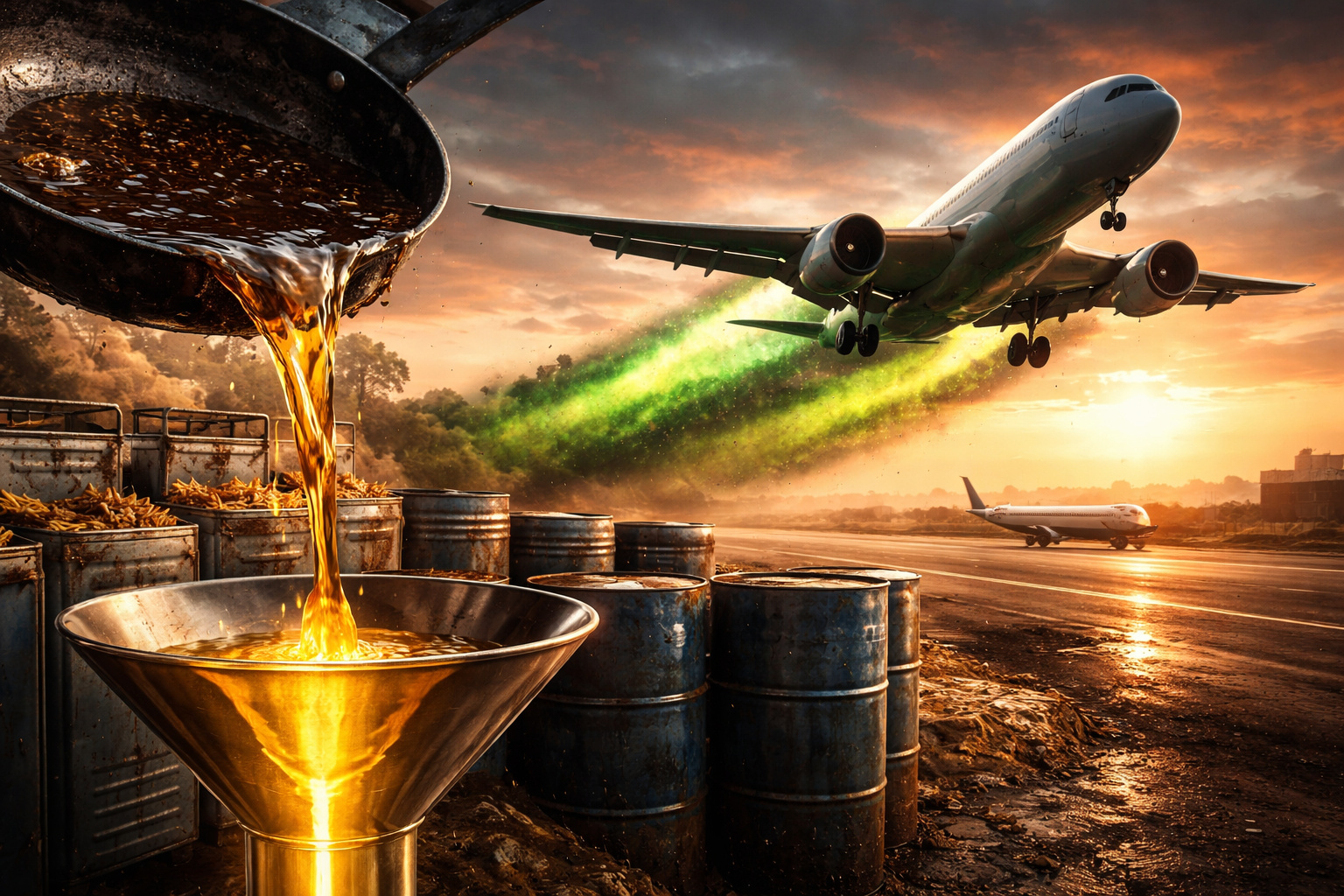
Used Cooking Oil Has Turned Into Strategic Raw Material For SAF, The Sustainable Aviation Fuel, And Is Already Causing Commercial Dispute Between The USA, China, And Europe.
In October 2025, the President of the United States publicly threatened to end the trade of used cooking oil with China. The statement drew attention because it was not a geopolitical metaphor or a traditional dispute over oil or gas. The reference was literal: the frying oil discarded by restaurants, hotels, and fast-food chains, which until a few years ago was collected by recycling companies and transformed into biodiesel for urban buses.
Today, this same waste is traded as strategic raw material for sustainable aviation fuel, sought after by refineries, global traders, and governments in Europe, the United States, and Asia. In some markets, the price of used cooking oil is already being tracked by commodities analysts in the same way as the price of crude oil.
The reason for this transformation is straightforward: it has been found that the oil discarded in kitchens is currently one of the most viable raw materials to produce SAF (Sustainable Aviation Fuel), the sustainable fuel that the aviation industry bets on to reduce carbon emissions.
-
Brazil accelerates decarbonization in the South: International forum in Foz do Iguaçu gathers leaders to discuss the advancement of biomethane in the energy matrix and the potential of “caipira pre-salt.”

-
As diesel prices soar due to conflicts in the Middle East, a Brazilian city decides to test a little-known biofuel that promises to completely replace fossil fuel without adaptation and could change the future of energy in the country.
-
Innovation with biofuel engines transforms agribusiness by replacing diesel without the need for major adaptations, ensuring energy efficiency and helping to reduce dependence on oil.
-
Middle East War Drives Up Methanol Prices and Threatens Global Biodiesel Production, Triggering Warning for Biofuels Industry and Agricultural Market

Why Aviation Is One Of The Most Difficult Sectors To Decarbonize
Commercial aviation is responsible for about 800 million tons of CO₂ emitted per year, according to global data from 2023. This represents between 2% and 3% of global emissions, a seemingly small share but extremely difficult to reduce.
Energy transition works relatively well in other transport sectors. Cars can be electrified with batteries, urban buses also operate with electric motors, and even short-haul trucks are beginning to migrate to new technologies. However, long-haul commercial airplanes depend on fuel with extremely high energy density.
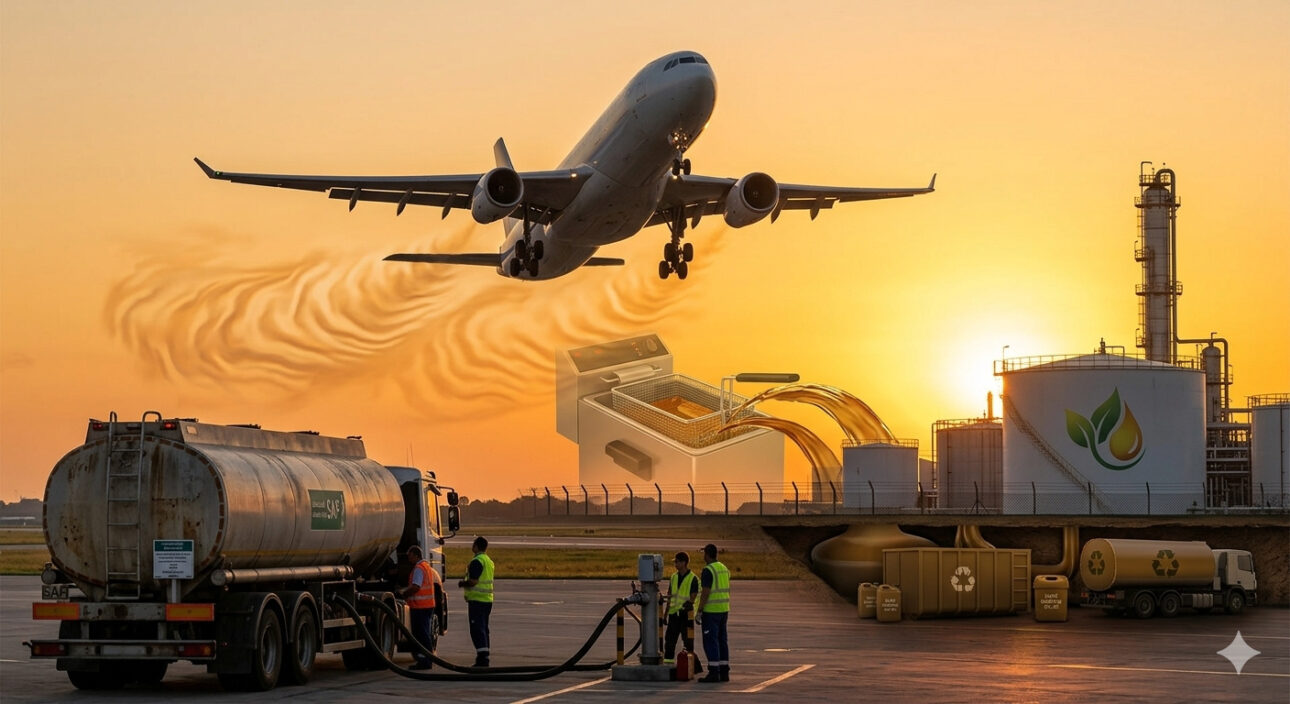
No existing battery can store enough energy to move a widebody aircraft like a Boeing 777 on intercontinental routes, such as São Paulo–Frankfurt. Liquid hydrogen emerges as a theoretical alternative, but it would require completely redesigning aircraft, airports, and refueling systems. In this case, the limitation is not only economic — it is physical.
Faced with this challenge, the aviation industry has bet on SAF, the sustainable aviation fuel. The idea is to produce jet fuel from non-petroleum sources while maintaining the same chemical composition as traditional fuel. SAF works in current engines without modification and can be blended with conventional jet fuel in proportions of up to 50% with Jet-A fuel, the standard used by commercial aviation.
Depending on the raw material used, SAF can reduce up to 80% of emissions in the fuel’s life cycle, considering production, transportation, and combustion.
How The HEFA Process Transforms Frying Oil Into Aviation Kerosene
The main industrial process used today to produce SAF is called HEFA (Hydroprocessed Esters and Fatty Acids). Despite the technical name, the chemical principle behind it is relatively straightforward.
Oils and fats — used or not — are heated under pressure in the presence of hydrogen. In this process, the oxygen present in the molecules is removed, transforming the material into saturated hydrocarbons. The final result is a fuel chemically very similar to the conventional jet fuel used by aviation.
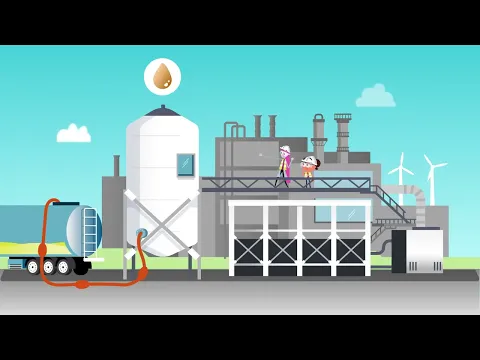

The final product is a clear, stable liquid approved by ASTM International, the organization responsible for standardizing fuels used in commercial aircraft. The technology has existed since the 1990s but gained global relevance only recently when climate policies and regulatory incentives began to stimulate its expansion.
Today, the HEFA process accounts for about 80% of global SAF production. And the cheapest and most abundant input to feed it is precisely used cooking oil, collected from industrial fryers in restaurants, hotels, fast-food chains, and food processing facilities.
Global SAF Production Is Growing, But Is Still Small Compared To Kerosene Consumption
In 2024, global sustainable aviation fuel production reached 1 million tons, double the volume recorded in 2023. Despite the accelerated growth, the figure is still small compared to total global aviation consumption.
The aviation sector uses between 300 and 350 million tons of kerosene per year, meaning that SAF represented only about 0.3% of total consumption.

The IATA (International Air Transport Association) celebrated the growth in production but also warned that the pace is below what is needed to meet future climate goals. Previous projections indicated that the world should produce 1.5 million tons in 2024, but delays in the commissioning of plants in the United States reduced this volume.
For 2025, the expectation is to reach about 2.1 million tons, still less than 1% of global aviation fuel consumption.
Decarbonization Targets Pressure SAF Expansion Until 2030
The growth in production is primarily driven by international regulatory mandates. The European Union has determined that all airports in the bloc must use at least 2% SAF starting in 2025, increasing to 6% by 2030 and reaching 70% by 2050.
Other countries are adopting similar policies. The United Kingdom, Japan, Singapore, and South Korea have announced their own targets for the mandatory blending of sustainable fuels in aviation. According to industry estimates, global demand for SAF could reach between 5 and 17 million tons by 2030, depending on the speed at which these regulations are implemented.
The difference between the 2.1 million tons projected for 2025 and the 17 million possible in 2030 reveals the size of the challenge facing the industry.
Oil Refineries Are Being Converted To Produce SAF
The Finnish company Neste is currently the largest producer of sustainable aviation fuel in the world. Founded as a state oil company in the 1940s, the firm reinvented itself over the 2000s and now positions itself as a global leader in renewable fuels. More than half of the company’s revenue now comes from this division.
By 2025, Neste operates a capacity of 1.5 million tons of SAF per year, distributed among three large industrial facilities: Rotterdam in the Netherlands; Singapore; and Porvoo in Finland. There are plans to expand to around 2.2 million tons by 2027.
The recently expanded Rotterdam refinery is currently considered the largest renewable fuel plant in the world.
Other companies are following suit. TotalEnergies has announced plans to produce more than 500,000 tons of SAF per year by 2028, while American companies like Phillips 66, Diamond Green Diesel, and Montana Renewables are already operating or expanding facilities in the United States.
The pattern of expansion is similar across almost all projects. Refineries originally designed to process oil are being adapted to process vegetable oils, animal fats, and food waste, leveraging existing infrastructure.
Over 360,000 Flights Have Already Used Sustainable Aviation Fuel
According to data from ICAO (International Civil Aviation Organization), over 360,000 commercial flights worldwide have used SAF at some level of blending with conventional kerosene. In the European Union, used cooking oil was responsible for 81% of the SAF produced in 2024, while animal fat accounted for about 17% of the raw material used.
The journey of a liter of discarded oil to an aircraft’s tank involves several stages. The waste is collected from commercial establishments, filtered, and pre-treated. It is then sent to refineries that carry out chemical hydroprocessing and produce the final fuel.
This fuel is then blended with conventional kerosene and distributed to airports through the existing infrastructure of pipelines and storage tanks.
SAF Tests Show Significant Reduction in Emissions and Contrails
A study conducted in 2024 by Airbus, Rolls-Royce, the German Aerospace Center (DLR), and Neste tested the use of 100% SAF in an Airbus A350.
The results showed not only a significant reduction in CO₂ emissions over the fuel’s life cycle but also a 56% decrease in contrail formation, the white streaks that appear behind airplanes.
These trails of ice crystals can trap heat in the atmosphere and contribute to the climate impact of aviation. Reducing their formation is considered an additional benefit of using sustainable fuels.
Global Supply of Used Cooking Oil May Not Be Sufficient
Despite market growth, there is a fundamental problem: there is not enough used cooking oil in the world to meet all future SAF demand.

In 2024, the United States collected about 3.3 billion pounds of used cooking oil, while the American biofuel industry consumed 5.7 billion pounds. The difference was covered by imports — mainly from China.
China exported nearly 3 million metric tons of used cooking oil in 2024, becoming the world’s largest supplier. About 43% of this volume was purchased by the United States, generating approximately US$ 1.2 billion in sales that year.
Fraud And Adulteration Are Beginning To Appear In The Recycled Oil Market
Research organizations like Transport & Environment warn that the growing demand is creating incentives for fraud. Used cooking oil and virgin vegetable oil have very similar chemical compositions, making it challenging to differentiate between the two in laboratory analyses.
Some countries are exporting volumes of recycled oil far exceeding what would be physically possible to collect. Malaysia, for example, exports about three times more used cooking oil than it can collect domestically, according to industry estimates.
This suggests that some of this material may actually be virgin vegetable oil labeled as waste, taking advantage of subsidies meant for low-carbon fuels.
Frying Oil Has Become A New Geopolitical Variable
The growing importance of this market explains why the issue has entered the international political agenda. In October 2025, the President of the United States threatened to suspend imports of used cooking oil from China as part of trade disputes involving agricultural products.
China had eliminated a 13% subsidy on recycled oil exports in 2024 to retain more raw material in the country to supply its own biofuel and SAF production.
The result was immediate. Chinese exports decreased, and the prices of recycled oil in the United States rose rapidly. The product’s value rose from about 20 cents per pound in 2020 to over 50 cents in 2024, an increase of approximately 150%.
With trade tariffs imposed in 2025, part of this trade flow was redirected to Europe, which had imposed antidumping tariffs on Chinese biodiesel but kept SAF exempt from fees to avoid compromising its climate goals.
New Technologies Are Trying To Replace Cooking Oil As Raw Material
The industry itself recognizes that frying oil cannot be the definitive solution. The available volume is limited, fraud threatens the market’s credibility, and demand is expected to grow far beyond the capacity for food waste collection.
For this reason, companies and research centers are investing in new technological routes to produce sustainable aviation fuel. One of these routes uses the Fischer-Tropsch process, which converts solid biomass — such as agricultural waste, wood, or urban trash — into synthetic gas and then into kerosene.
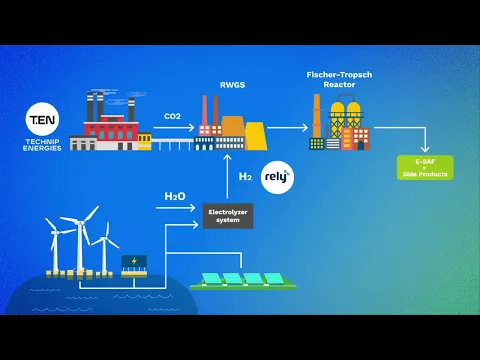
Another alternative is the alcohol-to-jet process, which transforms ethanol into aviation fuel. The company LanzaJet opened in 2024 the first commercial plant of this type in the United States, with an initial capacity of 9 million gallons per year.
The most ambitious route is the so-called Power-to-Liquid, also known as e-fuel, which captures CO₂ from the atmosphere and combines that carbon with green hydrogen to produce synthetic kerosene. The technology is considered theoretically scalable but currently costs between five and eight times more than conventional kerosene.
Projects of this type are being developed by companies like SkyNRG in Sweden, and Shell in Germany, although they are still far from achieving commercial scale.
The Role Of Oil Refineries In The Transition To Sustainable Fuels
For the oil and gas industry, SAF represents both a threat and an opportunity. It threatens part of the traditional kerosene market derived from fossil fuels but also creates a new space for refineries that quickly adapt.
Refineries already possess hydroprocessing infrastructure, distribution logistics, and contracts with airlines. This enables many plants to be converted to process oils and fats instead of crude oil, with lower investments compared to building an entirely new plant.
Companies such as TotalEnergies, Phillips 66, and Repsol have already begun this conversion process. Diamond Green Diesel, a joint venture between the American oil company Valero and the fat processor Darling Ingredients, produces SAF as a natural extension of its renewable diesel business.
In the coming years, with the advancement of climate goals for aviation, the strategic question for refineries will not be whether to enter the SAF market but when and with which technology they will make this transition.
The discarded frying oil in kitchens was just the first step in this energy transformation.









-

Uma pessoa reagiu a isso.